SUSTAINABLE DEPENDENCY: HOW BELIZE MASTERED THE ART OF SURVIVING—BUT NOT DEVELOPING
By: Omar Silva – Editor/Publisher
National Perspective Belize – Digital 2026
Belize City: Monday 20th April 2026
SPECIAL INVESTIGATIVE FEATURE
There is a dangerous illusion carefully maintained in Belize’s national discourse—one that has been repeated so often it has become accepted as truth:
That Belize is on a path toward sustainable development.
But when the numbers are stripped of political rhetoric…
When the funding structures are examined…
When the policies are traced back to their origins…
A different reality emerges.
Belize is not practicing sustainable development.
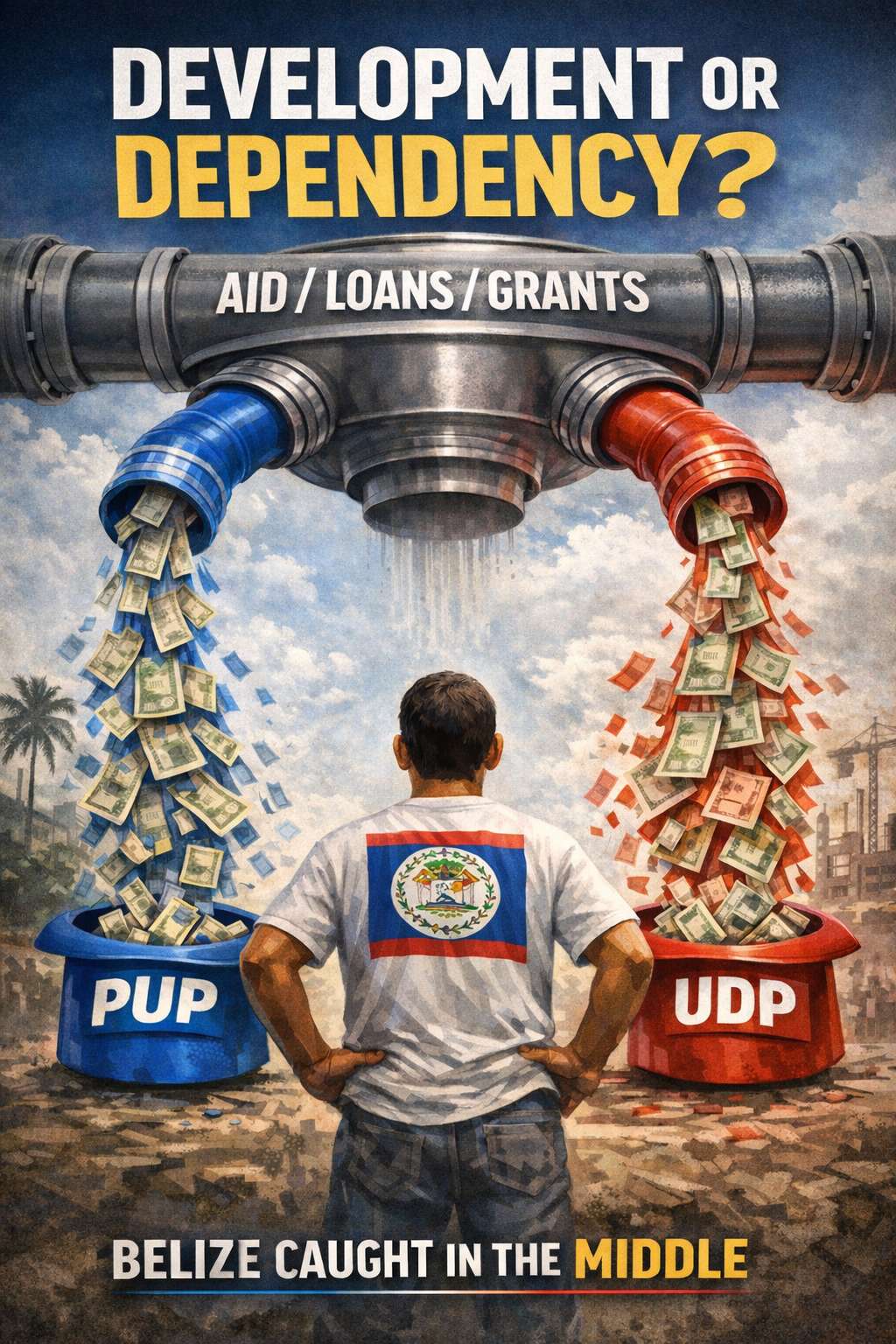
Belize is practicing sustainable dependency.
And the difference between the two may well determine whether this nation ever achieves true economic independence—or remains permanently tethered to external lifelines.
I. THE ILLUSION OF DEVELOPMENT
On paper, Belize appears active, engaged, and “progressive”:
- Climate resilience programs
- Energy transition initiatives
- Education reform projects
- Digital transformation strategies
- Social protection systems
Each accompanied by:
- International partners
- Multilateral institutions
- Bilateral donors
- Technical agencies
From the outside, it looks like motion.
From the inside, it feels like stagnation.
Because what Belize has perfected is not development…
But the continuous attraction of external financing to simulate development.
II. THE STRUCTURAL TRUTH: BELIZE DOES NOT FINANCE ITS OWN DEVELOPMENT
The most revealing evidence is not political—it is economic.
Belize’s development model is defined by a persistent domestic financing gap:
- National savings remain too low
- Investment needs remain too high
- The difference is filled externally
This gap forces Belize into a cycle:
External Funding → Project Implementation → Temporary Relief → Structural Weakness Remains → Repeat
This is not transformation.
This is maintenance of dependency.
III. FOREIGN MONEY IS NOT FREE MONEY
There is a deeply misleading narrative in Belize:
That grants, concessional loans, and international support are acts of goodwill with no strings attached.
That narrative is false.
Every major financing channel influencing Belize carries conditions—some explicit, others subtle.
A. FORMAL CONDITIONS (THE ONES WRITTEN IN DOCUMENTS)
These include:
- Fiscal discipline requirements
- Debt reduction targets
- Tax reform expectations
- Public expenditure controls
- Governance and transparency frameworks
- Legislative and regulatory reforms
- Sector-specific restructuring (energy, land, finance, etc.)
These are not optional.
They are embedded into financing agreements.
B. STRUCTURAL CONDITIONS (THE ONES BUILT INTO THE SYSTEM)
Even when not explicitly stated, external funding shapes:
- What projects get priority
- Which sectors are “fundable”
- What policies are considered “acceptable”
- How government planning is structured
This creates a quiet but powerful shift:
National policy begins aligning with funding availability… instead of national necessity.
C. POLITICAL CONDITIONS (THE ONES NEVER PUBLICLY ADMITTED)
This is where the conversation becomes uncomfortable—but necessary.
External financing relationships often influence:
- Diplomatic alignment
- Strategic silence on international issues
- Economic positioning
- Institutional behaviour
Not through coercion.
But through dependence.
Because when your development pipeline depends on external approval…
Policy autonomy becomes conditional.
IV. THE GRANT ECONOMY: WHEN SOCIAL PROGRAMS DEPEND ON FOREIGN SUPPORT
One of the most alarming trends is the normalization of foreign-supported domestic programs.
Education programs…
Social initiatives…
Institutional upgrades…
Increasingly financed through:
- Bilateral grants
- Multilateral programs
- Technical assistance packages
This introduces a profound risk:
What happens when the funding stops?
Because grants do not build sustainability.
They build continuity dependence.
V. EVEN THE STATE IS BEING BUILT FROM THE OUTSIDE IN
It is no longer just infrastructure or social programs.
External funding now supports:
- Statistical systems
- Institutional frameworks
- Policy design
- Planning mechanisms
In other words:
The very tools Belize needs to govern itself are increasingly externally financed.
This raises a critical question:
Is Belize strengthening its state…
Or outsourcing its development architecture?
VI. THE MCC, WORLD BANK, IMF MODEL: DEVELOPMENT OR DIRECTION?
Large-scale programs—often celebrated publicly—reveal the deeper pattern.
They are structured around:
- Pre-approved reform agendas
- Policy benchmarks
- Performance milestones
- Implementation frameworks designed externally
These programs do bring:
- Infrastructure
- Capacity building
- Technical improvements
But they also bring something else:
Direction.
Belize is not just receiving funding.
It is operating within externally structured development pathways.
VII. THE REAL ECONOMIC FAILURE: NO TRANSFORMATION OF THE PRODUCTIVE BASE
Despite decades of funding, Belize still faces:
- High import dependence
- Limited industrialization
- Weak manufacturing base
- Low export diversification
- Vulnerability to external shocks
- Heavy reliance on tourism and agriculture
The core question becomes unavoidable:
After decades of grants, loans, and partnerships… why hasn’t Belize transformed?
Because funding has been used to support the system… not change it.
VIII. THE POLITICAL MINDSET: MANAGING DEPENDENCY, NOT ENDING IT
This is where the critique sharpens.
Belize’s political class—across administrations—has mastered:
- Negotiating funding
- Securing international support
- Presenting donor-backed initiatives as national achievements
But has consistently failed to:
- Build domestic capital formation
- Strengthen productive industries
- Reduce structural dependency
- Create a self-financing development model
Why?
Because dependency has become politically functional.
It allows:
- Project-based visibility
- External validation
- Reduced pressure for deep structural reform
In short:
It sustains governance without requiring transformation.
IX. SUSTAINABLE DEPENDENCY VS. SUSTAINABLE DEVELOPMENT
Let us define the distinction clearly:
SUSTAINABLE DEVELOPMENT
- High domestic savings
- Strong local industries
- Value-added production
- Export competitiveness
- Fiscal independence
- Policy sovereignty
SUSTAINABLE DEPENDENCY
- Continuous access to external funding
- Policy alignment with donors
- Project-driven growth
- Weak domestic production
- External vulnerability
- Managed—not eliminated—dependency
Belize today fits far closer to the second model.
X. THE DANGEROUS COMFORT ZONE
The most dangerous aspect of sustainable dependency is not poverty.
It is comfort.
Because the system works—just enough:
- Salaries get paid
- Projects get launched
- Reports get written
- Donors stay engaged
But beneath that surface:
The structural weaknesses remain untouched.
XI. THE NATIONAL QUESTION BELIZE MUST NOW FACE
This is no longer an academic debate.
It is a national reckoning.
Belize must ask:
- Are we developing… or managing decline?
- Are we building capacity… or borrowing it?
- Are we sovereign in policy… or compliant in practice?
- Are we transforming… or surviving?
XII. THE HARD TRUTH
Belize has not failed because of lack of funding.
Belize has received funding.
Consistently.
Substantially.
Strategically.
Belize has failed because it has not used that funding to:
Break the cycle of dependency.
XIII. THE WAY FORWARD: FROM DEPENDENCY TO SOVEREIGN DEVELOPMENT
Breaking this cycle requires a fundamental shift:
1. Build domestic savings and investment capacity
2. Prioritize industrialization and manufacturing
3. Retain value within the local economy
4. Reduce import dependency strategically
5. Use foreign funding as a bridge—not a crutch
6. Reassert policy independence based on national priorities
FINAL WORD
Belize stands at a crossroads.
One path continues the current model:
Well-funded. Well-supported. Well-managed.
But ultimately dependent.
The other path is harder:
Less comfortable. More demanding. Politically disruptive.
But transformative.
Because in the end:
A nation cannot borrow its way to sovereignty.
It must build it.
- Log in to post comments