Fuel Shock Nation: How a War Abroad Is Breaking Belize at Home
By: Omar Silva I Editor/Publisher
📰 NATIONAL PERSPECTIVE BELIZE
Belize City: Thursday 26th March 2026
Belize woke up to a number that few believed possible — $14.55 per gallon for diesel.
Not a gradual increase.
Not a creeping adjustment.
But a $2.50 overnight surge — the largest in memory.
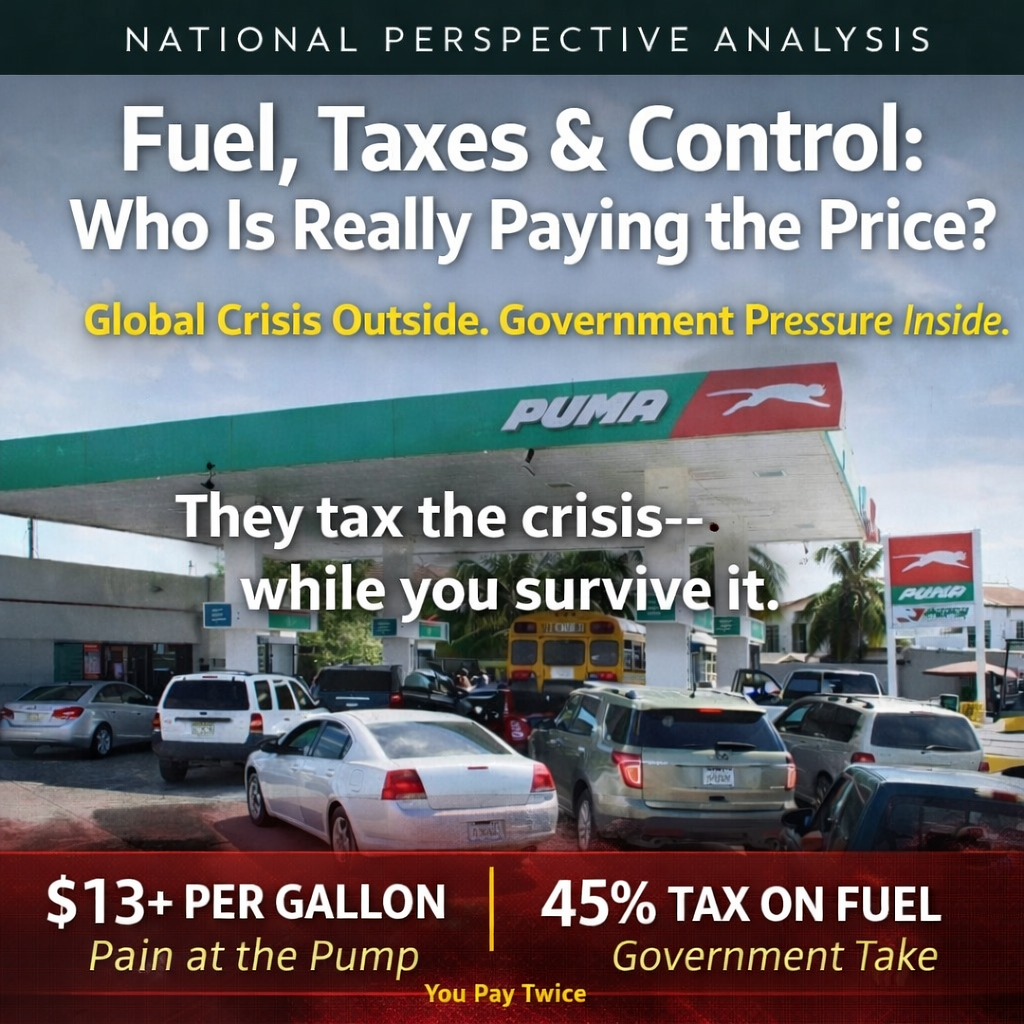
Just days earlier, gasoline had already crossed the $13 threshold. Now, diesel — the lifeblood of transport, agriculture, and production — has detonated across the economy.
This is no longer a fluctuation.
This is a shock event.
And its impact is already unfolding — in real time — across every sector of Belizean life.
⛽ Diesel: The Hidden Engine of the Economy
While gasoline affects commuters, diesel fuels the country itself.
It powers:
- Public transportation fleets
- Cargo and distribution networks
- Agricultural machinery in the sugar, citrus, and livestock sectors
- Marine transport — including the water taxis that connect the cayes
- Construction and industrial operations
When diesel rises, it does not move alone.
It pulls the entire cost structure of a nation with it.
🚤 From the Sea to the Streets: The Ripple Effect Begins
Within hours of the increase, the consequences became visible.
Water taxi operators — already stretched — have requested approval for a fuel surcharge, signalling imminent fare increases for Belizeans traveling to and from the islands.
One operator has already acted.
Caribbean Sprinter announced a $2 increase on in-person tickets, quietly shifting passengers toward its mobile app as Easter travel demand builds.
On land, the National Bus Company has pledged to absorb the increase for now, but even that reassurance carries an expiration date. Independent operators — outside the NBC structure — are now facing the full weight of the increase with no buffer.
The question is no longer if fares will rise.
It is when — and by how much.
🌾 The Sugar Belt Under Pressure
In the north, where Belize’s sugar industry sustains thousands of families, the impact is immediate and severe.
Diesel fuels:
- Harvesting equipment
- Transport trucks
- Field operations
For farmers already operating under tight margins, this increase is not an inconvenience — it is a direct threat to viability.
As one industry representative bluntly stated, even before this increase, farmers were struggling. Now, the burden has intensified beyond expectation.
And in agriculture, when production costs rise, the consequences do not stay in the fields.
They move to the market.
🛒 The Consumer Squeeze Tightens
Every increase in fuel carries a multiplier effect:
- Higher transportation costs → higher food prices
- Increased logistics expenses → more expensive goods
- Rising operational costs → pressure on wages and employment
For low- and middle-income Belizeans — already navigating high rent, stagnant wages, and rising living costs — this is where the crisis becomes personal.
The weekly budget stretches thinner.
Choices become harder.
Sacrifices become routine.
🌍 The Global Trigger: War and Oil
This surge is not random.
It is rooted in escalating geopolitical tensions — particularly the conflict involving the United States, Israel, and Iran — which has disrupted global oil markets and raised fears over supply routes, especially in the Strait of Hormuz, a critical artery for global energy flows.
When uncertainty grips oil markets, prices react instantly.
And countries like Belize — which import nearly all of their fuel — feel the impact without delay and without control.
⚠️ A Structural Vulnerability Exposed
This moment reveals a deeper reality.
Belize is:
- Heavily import-dependent
- Tied to a fixed exchange rate with the U.S. dollar
- Lacking energy diversification at scale
- Without meaningful insulation from global price shocks
So when oil prices surge, Belize does not negotiate.
Belize absorbs.
📉 Hope vs. Reality
Government officials have expressed hope that the increase will be temporary — tied to global instability that may ease.
But hope is not policy.
- Because if tensions persist…
- If supply chains tighten further…
- If oil prices remain elevated…
Then what Belize is experiencing now is not the peak.
It is the beginning of sustained pressure.
🔥 A Nation at the Mercy of External Forces
What is unfolding is not simply a fuel issue.
It is a national exposure.
A reminder that Belize’s economic structure leaves it vulnerable to events far beyond its borders — wars it did not start, decisions it did not make, and markets it does not control.
And yet, the cost is paid here:
- At the pump.
- At the grocery store.
- In the fields.
- On the buses.
- Across every household.
🧭 The Question Belize Must Now Confront
This moment demands more than reaction.
It demands reflection.
Because the real issue is not just the price of diesel.
It is the price of dependency.
How long can a nation absorb external shocks before the strain becomes unsustainable?
And more importantly:
What must change so that the next global crisis does not hit Belize this hard — this fast — and this deep?
🔻 Conclusion
The $2.50 jump in diesel is not just a number.
It is a signal.
A warning that Belize’s economic reality is tightly bound to global forces — and that without structural change, every external crisis will continue to become a domestic one.
For now, Belize waits — hoping for global calm.
But hope alone will not lower the pump.
Nor will it protect the people from what may still be coming.
- Log in to post comments