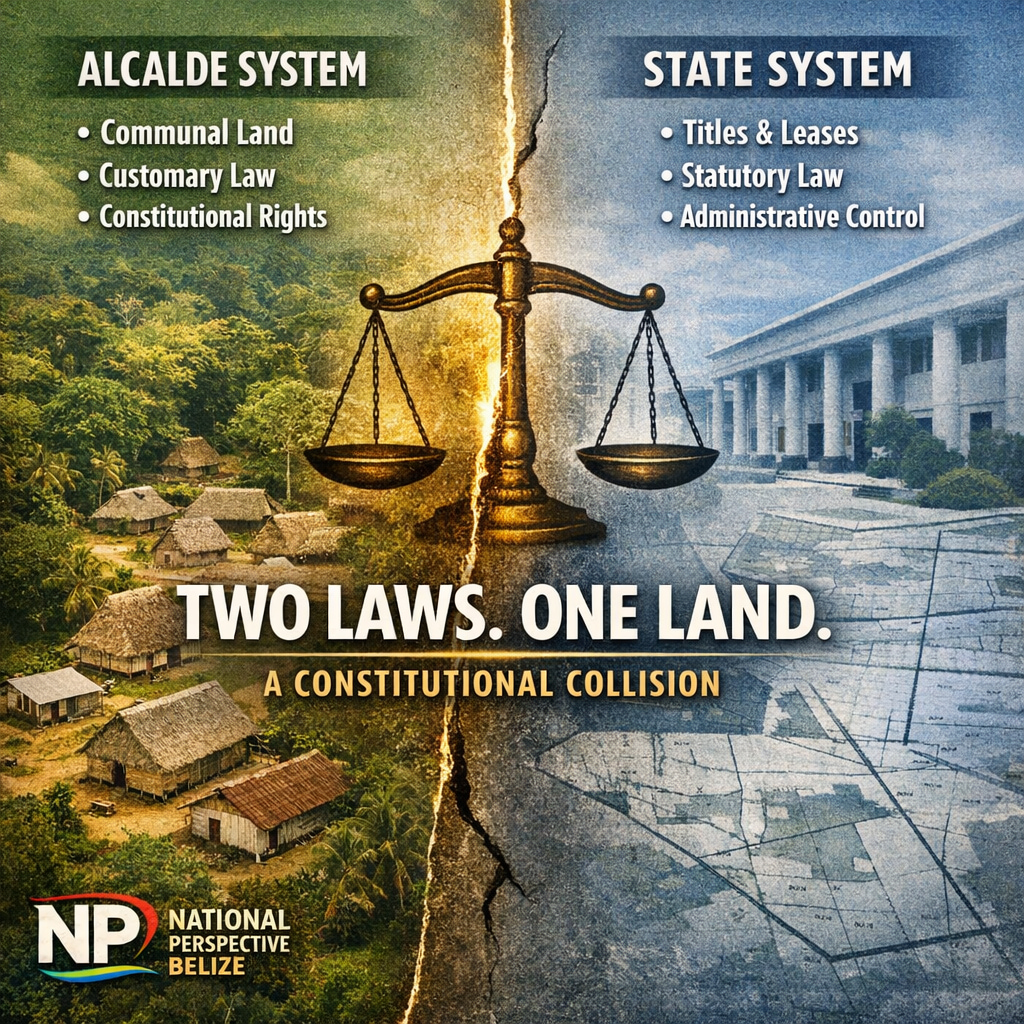
“Two Laws, One Land: The Constitutional Collision Between the Alcalde System and the Village Councils Act in Belize”
By: Omar Silva I Editor/Publisher
National Perspective Belize – Digital 2026
Belize City: Monday 13th April 2026
📰SPECIAL FEATURE
I. INTRODUCTION: A CONFLICT ROOTED IN LAW, NOT CHAOS
What is unfolding in Indian Creek is not disorder.
It is not confusion.
It is not even merely a land dispute.
It is a direct constitutional confrontation between two legally recognized systems of governance:
- One rooted in customary Indigenous law, now constitutionally protected
- The other grounded in statutory governance, exercised through the State
At the center of this confrontation lies a fundamental legal question:
Can the Government of Belize continue to administer land under statutory authority where constitutionally protected customary rights already exist?
The answer, based on binding law, is far more uncomfortable than policy-makers would prefer.
II. THE ALCALDE SYSTEM: CUSTOMARY LAW WITH CONSTITUTIONAL FORCE
The Alcalde system is often misunderstood as informal or cultural.
Legally, that characterization is no longer tenable.
⚖️ Legal Status
Following the landmark judgment of the Caribbean Court of Justice, Maya customary land tenure is:
- A form of property right
- Protected under the Belize Constitution
- Enforceable against the State
📜 Constitutional Anchoring
Under the Constitution of Belize, particularly:
- Section 3(d) → Protection of property
- Section 17 → Protection from deprivation of property
- Section 16 → Protection from discrimination
The CCJ confirmed:
Customary land tenure constitutes “property” within the meaning of the Constitution.
🔑 Legal Implication
This means:
- Maya communal lands do not require formal title to exist legally
- The Alcalde system operates as a recognized governance structure tied to those rights
- The State is legally obligated to respect and protect these rights
👉 This is not political accommodation—it is constitutional obligation.
III. THE VILLAGE COUNCILS ACT: STATUTORY ADMINISTRATION WITHOUT LAND AUTHORITY
The Village Councils Act was designed for:
- Local governance
- Community administration
- Civic coordination
It was never designed to override customary land tenure systems.
⚖️ Legal Scope
Village Councils:
- Have no inherent authority over land ownership
- Cannot:
- Grant title
- Override communal rights
- Authorize land use in contradiction to constitutional protections
Land authority remains vested in:
- The Minister responsible for lands
- The Lands Department
But even that authority is subject to the Constitution.
🔑 Legal Limitation
👉 Statutory authority cannot override constitutional rights
This is a fundamental doctrine of constitutional law:
Where statutory law conflicts with constitutional rights, the Constitution prevails.
IV. THE CCJ JUDGMENT: A BINDING RESTRUCTURING OF LAND LAW
The 2015 consent order and judgment of the CCJ did more than recognize Maya rights.
It redefined the legal landscape of Belize.
📜 Core Orders of the CCJ
The Government of Belize must:
- Recognize Maya customary land tenure
- Demarcate and protect those lands
- Refrain from acts that infringe those rights
- Ensure consultation before any development
⚖️ Legal Effect
The CCJ ruling is:
- Final and binding
- Equivalent to constitutional interpretation
- Enforceable against the State
🔥 Critical Legal Reality
Once customary rights are established:
👉 The State cannot lawfully issue leases, concessions, or permissions on those lands without consent
Any such action may constitute:
- Unlawful deprivation of property (Section 17)
- Violation of constitutional rights
V. INDIAN CREEK: A CASE STUDY IN CONSTITUTIONAL BREACH
The Indian Creek situation reflects a textbook violation of the legal framework described above.
⚠️ Legal Issues at Play
- Assertion of communal ownership under customary law
- State-sanctioned or supported land use activity
- Absence or dispute over community consent
🔑 The Legal Trigger
The doctrine of Free, Prior, and Informed Consent (FPIC) is not merely international—it is embedded in the CCJ’s interpretation of constitutional rights.
Failure to obtain consent results in:
👉 A prima facie constitutional violation
⚖️ Legal Characterization
This is not:
- A village dispute
- A misunderstanding of jurisdiction
It is:
A potential breach of constitutionally protected property rights by the State or its agents
VI. THE SOURCE OF CONFLICT: DUAL LEGALITY WITHOUT HARMONIZATION
Belize is currently operating under:
1. Customary Constitutional Rights (via CCJ)
2. Statutory Administrative Structures (Village Councils Act & Lands Regime)
⚠️ The Structural Failure
The State has:
- Not fully demarcated Maya lands
- Not integrated customary governance into statutory frameworks
- Continued to operate parallel systems
🔥 Result
👉 Legal overlap becomes legal conflict
👉 Administrative action becomes constitutional risk
VII. POLITICAL INTERFERENCE: WHERE LAW IS DISTORTED
While the issue is legal, the persistence of conflict is tied to how the law is applied.
⚖️ Legally Observable Patterns
Without speculation, the following realities can be stated:
- Selective application of authority
- Recognition of one structure over another depending on circumstance
- Continued issuance or facilitation of land use
- Despite unresolved constitutional obligations
- Delay in compliance with CCJ directives
- Particularly demarcation and formal recognition
🔑 Legal Consequence
These actions create:
- Exposure to constitutional litigation
- Liability for damages
- Erosion of legal certainty
VIII. THE CONSTITUTIONAL IMPERATIVE
The path forward is not political—it is legal.
📜 The State Must:
- Complete demarcation of Maya lands
- Legally recognize communal governance structures
- Suspend conflicting land allocations
- Ensure FPIC compliance in all affected areas
⚖️ Failure to Act
Failure to comply exposes the State to:
- Constitutional claims
- Judicial enforcement
- International scrutiny
IX. CONCLUSION: A NATION AT A LEGAL CROSSROADS
The Indian Creek conflict is not an anomaly.
It is a symptom of an unresolved constitutional contradiction.
Belize cannot simultaneously:
- Recognize Maya land rights at the highest judicial level
and - Administer those same lands through frameworks that ignore those rights
🔥 Final Legal Position
The Constitution, as interpreted by the Caribbean Court of Justice, is clear: customary land rights are property rights. Any action inconsistent with those rights is not merely administrative error—it is unconstitutional.
- Log in to post comments