Beyond Dependency: Belize, China, and the Question of Sovereignty in a Multipolar World
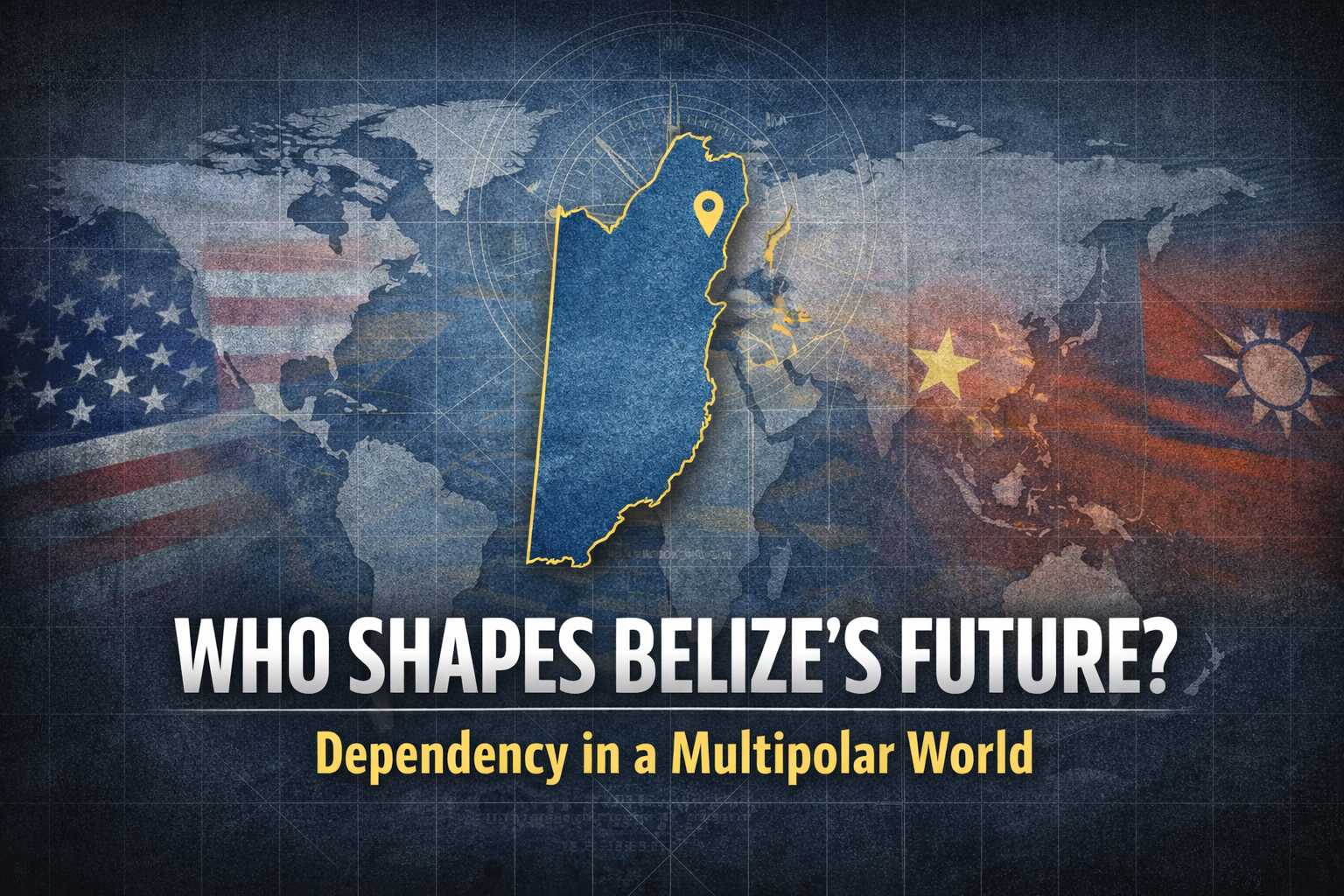
Belize’s economic condition is not accidental. It is structural.
By: Omar Silva – Editor/publisher
NATIONAL PERSPECTIVE BELIZE – Digital 2026
Belize City: Friday 23rd January 2026
INVESTIGATIVE FEATURE
More than four decades after political independence, Belize remains locked into a colonial economic architecture: import dependency, weak domestic production, low industrial capacity, externally conditioned policy-making, and political institutions that reproduce dependency rather than dismantle it. This is not a failure of geography. It is a failure of political design.
The uncomfortable truth is this: Belize has not built a sovereign economy. It has managed a dependent one.
The Illusion of “Partnership”
Belize is repeatedly told it has “strong partners” in the West. Yet partnership implies mutual benefit and shared power. In practice, Belize’s role in this relationship has been far narrower:
- We import most of what we consume.
- We export primarily low-value primary goods.
- We borrow under conditional frameworks.
- We align politically in ways that limit strategic autonomy.
- We adopt policy models designed elsewhere.
This is not partnership. This is structural dependency.
The Belize dollar remains pegged at 2:1 to the U.S. dollar, binding the country’s monetary reality to Washington’s economic decisions, regardless of Belize’s domestic conditions. That peg brings short-term stability, but it also locks Belize into a monetary orbit we do not control. Meanwhile, regional economies such as Mexico, Brazil, and parts of South America are diversifying currency exposure, trade routes, and development finance relationships.
The world is shifting. Belize is not.
What Has Actually Changed in Latin America
Since China expanded engagement through the Belt and Road Initiative (BRI) and broader South–South cooperation, Latin America has not become “Chinese-controlled,” but it has undeniably expanded its strategic options.
Across the region:
- Hundreds of large infrastructure projects have been financed or constructed with Chinese participation (ports, rail, power plants, logistics corridors).
- Trade between China and Latin America now exceeds hundreds of billions annually.
- Countries such as Brazil, Argentina, Peru, Chile, Colombia, and others have diversified export markets beyond traditional Western dominance.
- Development finance alternatives exist beyond IMF–World Bank conditional frameworks.
Importantly, countries that benefited most were not those that blindly embraced China, but those that negotiated strategically with clear national plans.
China did not “develop” these countries. But China provided leverage — leverage that these states used to reduce unilateral dependence on Western systems.
Belize has not exercised such leverage with anyone.
The Belize Question Is Not “China vs. the West”
The public discourse often collapses into false binaries: either fear China or reject the West. That framing is intellectually lazy and politically dangerous.
The real question is:
Does Belize have a national development strategy capable of engaging any power on equal footing?
Right now, the answer is no.
Belize has no publicly articulated industrial strategy.
- No manufacturing roadmap.
- No national logistics vision.
- No coherent export expansion plan.
- No transparent foreign asset mapping.
Without those, every external partner becomes dominant by default.
Chinese Assets in Belize: Facts vs. Fear
Chinese presence in Belize is real but poorly documented publicly. It appears concentrated in:
- Retail and wholesale distribution,
- Food import chains,
- Construction contracting,
- Telecommunications equipment supply.
The problem is not Chinese participation. The problem is Belizean opacity.
Belize does not maintain a transparent, publicly accessible register of:
- Foreign-linked strategic assets,
- Ownership structures,
- Sectoral concentration,
- National security implications,
- Supply chain dependency risk.
This absence of institutional oversight would be dangerous regardless of whether the foreign actors were Chinese, American, Taiwanese, Saudi, or European.
Weak states lose sovereignty not because foreigners arrive — but because institutions fail to govern their arrival.
Taiwan, China, and Belize’s Strategic Limbo
Belize currently recognizes Taiwan diplomatically. This reality places Belize outside formal PRC state frameworks such as the BRI. That is not inherently good or bad; it is a policy choice.
But what is unacceptable is that Belize maintains this alignment without a transparent national conversation about long-term strategy.
Diplomatic recognition should not be a matter of political habit. It should be a product of:
- National economic planning,
- Trade diversification goals,
- Infrastructure financing needs,
- Sovereignty safeguards,
- Public consent.
Belize currently has none of these debates at the national level.
The Core Danger: Not China, But Structural Incompetence
The greatest threat to Belize is not Beijing. It is not Washington. It is not Taipei.
It is the colonial political architecture still governing Belize:
- Closed elite political culture,
- Weak accountability mechanisms,
- Patronage-based governance,
- Absence of long-term national planning,
- Electoral politics divorced from economic transformation.
Under such a system, any foreign partner — Western or Eastern — becomes dominant by default.
A weak house invites control. A strong house negotiates power.
What Belize Must Do Before Choosing Alignment
Before Belize debates whether to deepen ties with China, strengthen Western alignment, or pursue multipolar diversification, it must first put its own house in order.
At minimum, Belize needs:
- A national audit of foreign-linked assets across strategic sectors.
- A publicly debated industrial and manufacturing strategy.
- Clear procurement and transparency laws for mega-projects.
- Legal safeguards for data, infrastructure, and cyber sovereignty.
- A development doctrine beyond election cycles.
Without these, Belize will remain dependent regardless of which flag flies over investment contracts.
The Honest Conclusion
Chinese assets in Belize are not an existential threat.
Western partnerships are not inherently exploitative.
Taiwan’s cooperation is not illegitimate.
But Belize’s lack of strategic statecraft is the real crisis.
- A multipolar world rewards countries that think long-term, plan structurally, and negotiate from coherence. It punishes those that drift, improvise, and confuse loyalty with strategy.
- Belize does not need to “choose China.”
- Belize needs to choose sovereignty.
And sovereignty begins with intellectual honesty, institutional reform, and a population willing to question inherited political structures.
That is the conversation Belize must finally begin.
- Log in to post comments