The Fourth Estate Under Pressure: When Power, Telecom Control, and Narrative Management Collide
By Omar Silva – Editor/Publisher
National Perspective Belize Digital 2026
Belize City: Thursday 22nd January 2026
Belize’s democracy rests on three formal pillars of governance: the Executive, Legislature, and Judiciary. But history — and every functioning democracy on earth — recognizes a fourth pillar just as vital to freedom and accountability: a free, independent press.
When that Fourth Estate becomes vulnerable to political influence, infrastructure control, or narrative manipulation, democracy itself becomes fragile.
The recent controversy surrounding the temporary disconnection of Channel 7’s internet and telephone services by Belize Telemedia Limited (BTL) has exposed more than a technical error. It has revealed a deeper and more uncomfortable question Belizeans must now confront honestly:
Is the media in Belize truly free, or merely tolerated when convenient?
The Incident That Sparked the Concern
BTL’s Chairman publicly insinuated that Channel 7’s services were disconnected due to unpaid bills.
Yet a formal letter from BTL to Channel 7 stated clearly that:
- The disruption was due to an internal service error
- No arrears existed
This contradiction matters.
When a politically influenced telecommunications entity offers two different narratives — one public and one documented — it raises legitimate concerns about credibility, motive, and institutional integrity.
The Prime Minister later defended the incident as an “automated system error” during a transition to a new billing platform. Perhaps that is true. But the larger issue remains untouched:
If Belize returns to a telecom monopoly, what safeguards exist to prevent politically inconvenient media houses from being quietly silenced — whether by “error,” regulation, or selective enforcement?
Infrastructure Power Is Political Power
Telecommunications is no longer just about phone calls and internet speed. It is about:
- Information flow
- Broadcasting capacity
- Newsroom connectivity
- Public reach
- Editorial survival
When the same political ecosystem that governs the country also exerts influence over national telecom infrastructure, the danger is structural, not hypothetical.
Across the world, history has shown a consistent pattern:
- Control the infrastructure
- Manage the narrative
- Marginalize dissent
- Gradually weaken independent journalism
Belize must not walk blindly into that architecture.
The Press Office Problem: Information vs. Management
The Prime Minister’s comments also unintentionally highlighted another longstanding concern:
the increasing role of Belize’s Government Press Office as information manager rather than public informer.
Many journalists across Belize will privately admit that:
- Press releases are often incomplete
- Context is strategically omitted
- Certain ministries sanitize uncomfortable facts
- Access to information varies depending on political friendliness
- Narratives are crafted to protect image, not inform the public
This is not transparency.
This is curated governance communication.
A democratic government does not exist to manage perception. It exists to serve truth.
When the PM Lectures the Press
Perhaps the most troubling portion of the Prime Minister’s comments was not about policy, but about posture.
He publicly criticized media houses for allegedly failing to defend Channel 5 during a past incident, implying that the media community had failed a test of solidarity.
That framing is dangerous.
A Prime Minister does not get to:
- Grade the media
- Evaluate their loyalty
- Publicly scold the press
- Define when journalism is acceptable
The press owes loyalty only to the public — not to politicians, not to parties, not to Cabinet.
When political leaders begin to speak as though media respect must be earned through alignment, the Fourth Estate is no longer seen as independent — but as something to be disciplined.
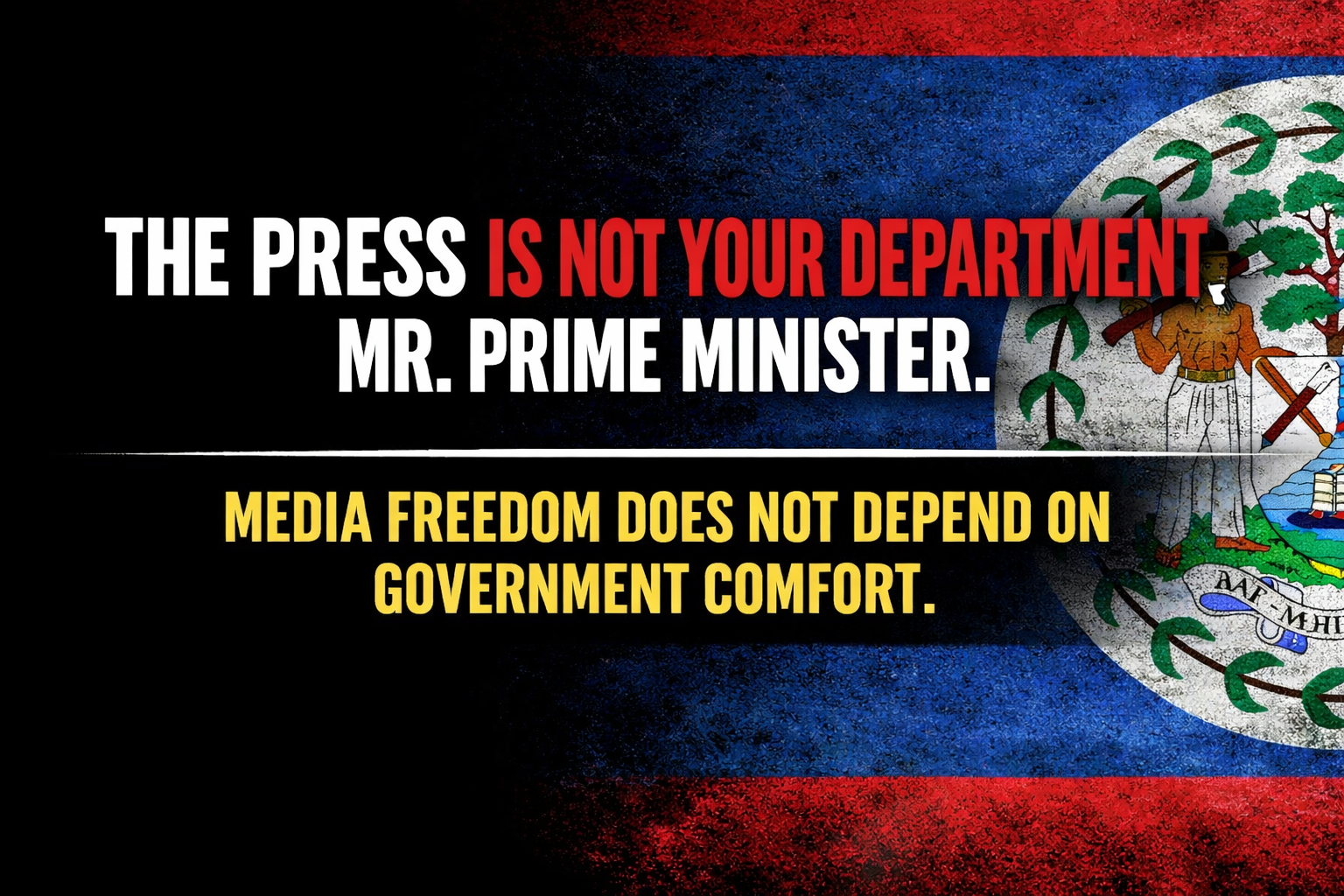
Declaring Media “Essential” Is Not Enough
The Prime Minister’s proposal to classify media houses as essential services sounds positive on the surface. But it raises another critical question:
Why should the freedom of the press require Cabinet approval to be protected?
A truly free media does not depend on government goodwill. It is safeguarded by:
- Strong constitutional culture
- Independent institutions
- Non-politicized infrastructure
- Legal protections enforced without bias
If media protection depends on political benevolence, then that protection can also be withdrawn.
The Bigger Truth Belize Must Face
This incident has exposed three systemic vulnerabilities:
- The politicization of critical infrastructure (BTL)
- The management of public narrative through centralized government communication
- The fragile position of independent media in an increasingly partisan ecosystem
Belize does not yet live under censorship.
But the architecture that allows censorship to become possible is quietly forming.
And history teaches us clearly:
freedom is rarely lost overnight — it is usually lost gradually, through normalization of small controls.
The Role of the Fourth Estate Must Be Reaffirmed
- Journalism is not opposition.
- Journalism is not rebellion.
- Journalism is not hostility.
- Journalism is public service.
Media houses, independent reporters, alternative platforms, and investigative voices are essential not because government declares them essential — but because democracy collapses without them.
If the Briceño Administration truly respects the Fourth Estate, that respect must be demonstrated not in words but in structure:
- By depoliticizing infrastructure
- By increasing transparency
- By reducing narrative manipulation
- By respecting journalistic independence even when uncomfortable
Anything less is not protection.
It is containment.
National Perspective Belize will continue to ask the questions others fear to ask — because democracy depends on those questions being asked.
- Log in to post comments