DAMAGE CONTROL WITHOUT CONTROL: A Government Learns Its Own System the Hard Way

By Omar Silva | Editor/Publisher
National Perspective Belize – Digital 2026
Belize City Tuesday 14th April 2026
EDITORIAL
There are moments in governance when policy does not merely stumble—it reveals itself.
What Belize has just witnessed with the Ministry of Health and Wellness is not a routine misstep. It is a rare, unfiltered exposure of how policy, when detached from reality, collides with the very people it is meant to serve.
And in this case, the collision was immediate.
The Admission That Changed Everything
When the Director of Health Services publicly stated:
“We were not aware of the amount of people who go into a pharmacy and purchase prescription medications without a prescription.”
The damage was done.
Because in that single sentence, the Ministry admitted what no institution tasked with national health management can afford to confess:
It did not understand how its own system was functioning.
Not in theory. Not in practice. Not on the ground.
Policy Without Intelligence
For years, Belize operated under a quiet, informal reality.
Pharmacies filled the gaps.
They became the bridge between an overstretched public healthcare system and a population navigating chronic illness, economic hardship, and geographic limitation.
This was not ideal. It was not textbook medicine.
But it was functional.
And more importantly—
It was known.
Or at least, it should have been.
Yet, the Ministry now tells the nation it was unaware of the scale of this dependence.
That is not a regulatory oversight.
That is a failure of institutional awareness.
The Contradiction Spiral
The Ministry’s response since the backlash has not clarified matters—it has deepened them.
We are told:
- The law always existed
- But it was not enforced
- People were relying on informal access
- But the Ministry did not know how many
- The policy does not create barriers
But access gaps are acknowledged
Enforcement is necessary
But pharmacists should use discretion
This is not communication.
This is contradiction layered upon contradiction.
And the public sees it.
“Informed Consent” or Conditional Access?
Perhaps the most troubling argument advanced by the Ministry is the notion that requiring prescriptions—particularly for contraceptives—enhances “informed consent.”
On paper, it sounds reasonable.
In reality, it collapses under scrutiny.
Because consent is not merely about information.
It is about freedom of access.
When access is:
- Limited by geography
- Constrained by cost
- Dependent on time and transport
- Filtered through an already strained system
Then consent is no longer freely exercised.
It is negotiated.
It is delayed.
And in some cases—
It is denied.
The Burden Shift
At the core of the Ministry’s response lies a subtle but critical shift in responsibility.
The public is now being told:
- You must prioritize your health
- You must take the time to visit clinics
- You must comply with the system
But what happens when:
- Clinics are overcrowded
- Medications are unavailable
- Transportation is unaffordable
- Time off work is impossible
Responsibility without capacity is not empowerment.
It is displacement.
The “Use Discretion” Collapse
Then came the moment that exposed the policy’s internal fracture.
The call for pharmacists to:
“Use judgment… go ahead and dispense.”
In that instant, the Ministry effectively reintroduced the very system it had moved to eliminate.
Because now:
- Enforcement is inconsistent
- Authority is informal
- The rule is flexible
This is not structured policy.
This is controlled improvisation.
The Phased Retreat
The announcement of a 12-month phased implementation is being presented as strategy.
It is not.
It is retreat.
A necessary one, perhaps—but a retreat nonetheless.
Because enforcement had already begun.
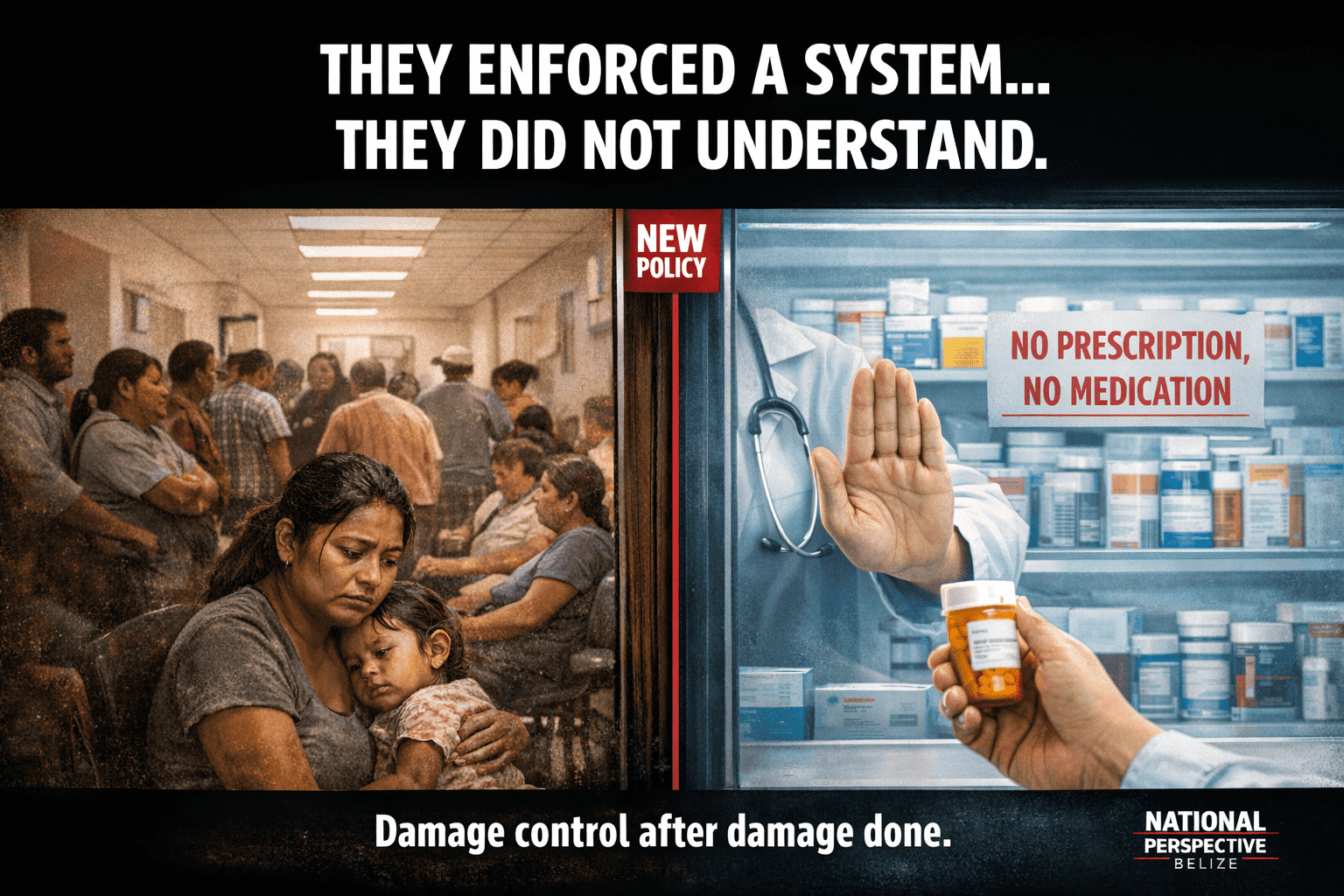
Patients had already been turned away.
The backlash had already ignited.
The phase now being introduced is not preparation.
It is recovery.
The Real Failure
Strip away the language, the explanations, the justifications—and what remains is simple:
- A policy enforced without full understanding
- A population affected without consultation
- A system strained without reinforcement
- A response delivered after the fact
This is not a failure of medicine.
It is a failure of governance.
The Lesson the Government Must Now Learn
Belize is not a textbook.
It is a lived environment shaped by inequality, resilience, and adaptation.
Policy cannot be imported in form and imposed in function without first understanding how people survive within the system as it exists.
Because when governance ignores reality—
Reality responds.
And it does so swiftly.
Final Word
What unfolded this past week is not just about prescriptions, pharmacies, or contraceptives.
It is about something far more fundamental:
A government attempting to regulate access—without first understanding access.
And in doing so, it has been forced, in real time, to learn the very system it sought to control.
**“You cannot fix what you do not first understand.
And you cannot control what you have never truly seen.”**
- Log in to post comments