“Prescription Without Access, Control Without Care: How Belize’s Health Policy Is Colliding with Reality, Rights, and Survival”
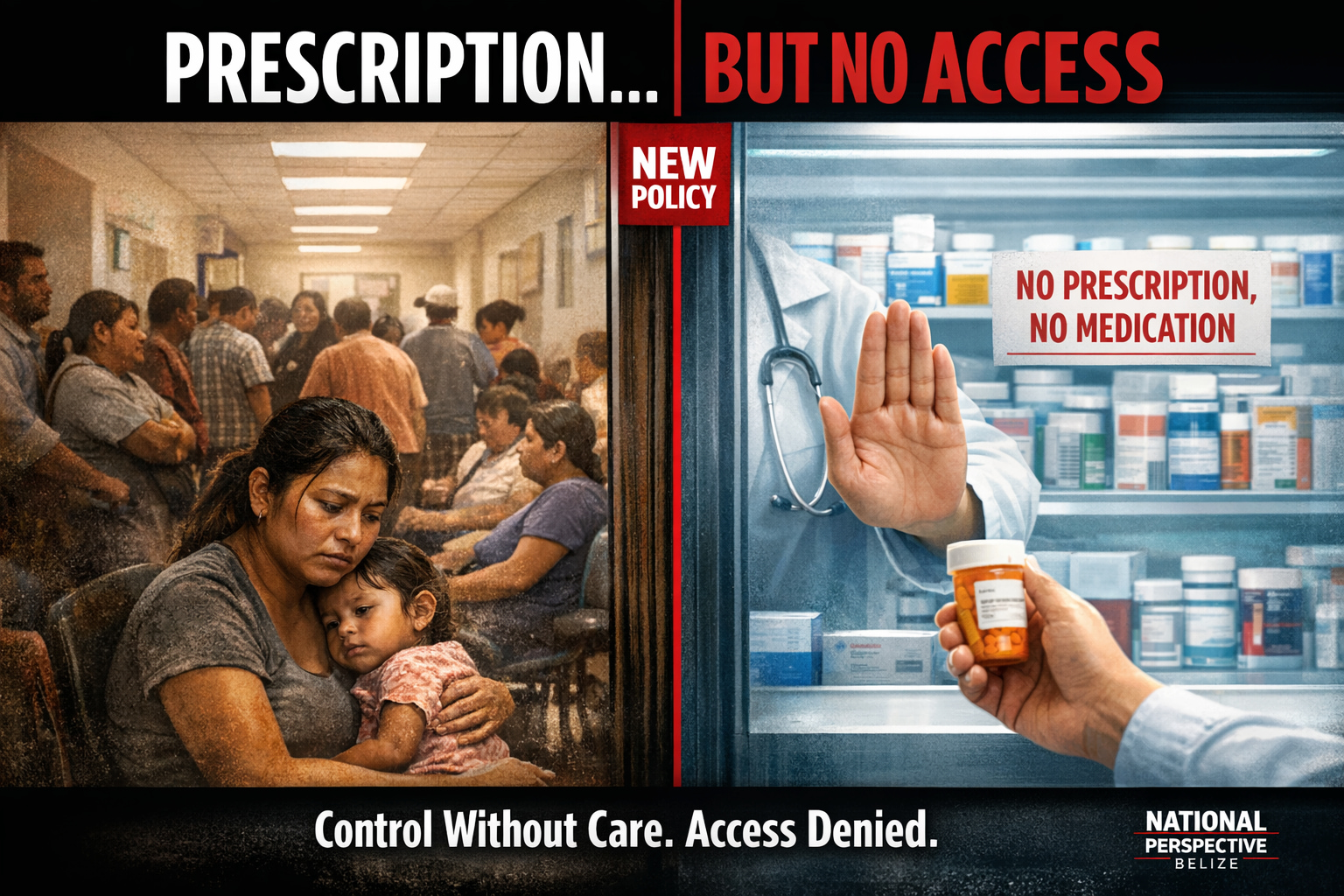
By Omar Silva | Editor/Publisher
National Perspective Belize – Digital 2026
Belize City: Saturday 11th April 2026
📰SPECIAL— FEATURE ARTICLE
A policy decision that might appear routine in a functioning healthcare system has ignited a national debate in Belize—one that now stretches far beyond pharmacies and prescriptions.
What began as the Ministry of Health and Wellness tightening enforcement on prescription medications has rapidly evolved into a multi-layered crisis, exposing deep fractures within Belize’s healthcare system, its governance approach, and now—its commitment to fundamental human rights.
At the heart of the matter lies a simple but devastating contradiction:
The State is enforcing medical control in a system where access to care is neither guaranteed nor equitable.
⚖️ I. THE POLICY: MEDICALLY SOUND, SOCIALLY DETACHED
The Ministry of Health’s position is, on its face, difficult to dispute.
Prescription medications—antibiotics, chronic disease treatments, and now contraceptives—require oversight. Patients should be evaluated. Risks must be assessed. Drug misuse must be prevented.
From a clinical standpoint, this is standard practice across the world.
Health officials argue that:
- Patients need regular monitoring
- Medications must be tailored to individual conditions
- Contraceptives require risk assessment due to potential complications
- Consultations allow for broader health screenings
This is the language of modern medicine.
But Belize is not operating within the conditions required for such a system to function effectively.
🏥 II. THE REALITY: A SYSTEM UNDER STRAIN
Across Belize, particularly within the public health system, the lived experience of patients tells a very different story.
At institutions such as the Karl Heusner Memorial Hospital (KHMH), widely regarded as the country’s principal healthcare provider, patients routinely encounter:
- Shortages of essential medication
- Long waiting periods for consultations
- Limited access to diagnostic testing
- Overburdened healthcare workers
- Inconsistent follow-up care
In rural and underserved communities, the situation is even more severe:
- Limited or no access to doctors
- Transportation barriers
- Financial constraints
- Irregular clinic availability
For many Belizeans, particularly the working poor, the public healthcare system is not a reliable entry point—it is an obstacle course.
💊 III. THE PHARMACY: BELIZE’S INFORMAL HEALTH SAFETY NET
In the absence of a fully functioning healthcare system, pharmacies across Belize have played an unspoken but critical role.
They have become:
- The first point of care
- The fallback for chronic patients
- The only accessible option for many
A diabetic patient unable to secure a timely appointment could still purchase Metformin.
A hypertensive patient could maintain their medication regimen without navigating bureaucratic delays.
Women—particularly young and working-class women—could access contraceptives discreetly, affordably, and consistently.
This informal system was not perfect.
But it worked.
It preserved continuity of care in a system that often could not.
🚨 IV. THE SHIFT: FROM FLEXIBILITY TO ENFORCEMENT
With the Ministry now enforcing long-standing but previously relaxed regulations, that informal safety net is being dismantled.
Patients must now:
- Obtain a valid prescription before accessing medication
- Undergo medical consultations
- Comply with a system that is already strained
Pharmacies are being monitored more strictly. Access pathways are narrowing.
And suddenly, what was once a matter of practical survival is now framed as non-compliance.
⚠️ V. THE IMMEDIATE CONSEQUENCES
The implications are neither abstract nor distant—they are immediate and measurable.
For chronic patients:
- Interrupted treatment for diabetes, hypertension, and other non-communicable diseases
- Increased risk of complications such as stroke, kidney failure, and cardiovascular events
For the healthcare system:
- Increased pressure on already overwhelmed public facilities
- More emergency cases due to unmanaged conditions
For the economy:
- Higher long-term healthcare costs
- Lost productivity due to preventable illness
But perhaps the most profound consequences are now emerging in a different domain entirely.
⚖️ VI. THE ESCALATION: FROM HEALTH POLICY TO HUMAN RIGHTS
The enforcement of prescription requirements for contraceptives has transformed this issue into something far more significant.
What was once a question of access to medication is now a question of:
Access to choice. Access to autonomy. Access to control over one’s own body.
The backlash has been swift and intense.
The Belize Family Life Association (BFLA), a long-standing advocate for reproductive health and rights, has raised serious concerns, warning that this move could:
- Reverse decades of progress in women’s empowerment
- Increase unplanned pregnancies
- Lead to unsafe and clandestine abortions
- Raise maternal and infant mortality rates
Their position is clear:
This is not merely a regulatory adjustment—it is a regression.
🧠 VII. THE WOMAN ON THE GROUND: THE TRUE COST OF POLICY
For policymakers, a prescription requirement may seem like a minor procedural step.
For the average Belizean woman, it can represent an insurmountable barrier.
Consider the realities:
- A contraceptive pill may cost less than $10
- But accessing a prescription may require:
- Transportation costs
- Time off work
- Childcare arrangements
- Consultation fees
In some cases, the true cost of that $10 medication can exceed $150 or $200.
For rural women, the challenge is even greater.
For working-class women, it is often impractical.
For young women navigating legal and social constraints, it can be impossible.
⚔️ VIII. POLICY WITHOUT CONSULTATION: A SYSTEMIC FAILURE
Equally troubling is the apparent absence of consultation.
The BFLA has stated that it was not involved in the decision-making process.
This raises serious questions:
- Who was at the table?
- What data informed this decision?
- Why were key stakeholders excluded?
Effective public policy is not imposed—it is constructed through dialogue, evidence, and inclusion.
This appears to have been none of the above.
🧭 IX. THE PRIME MINISTER’S ADMISSION: A CRUCIAL CLUE
The Prime Minister’s remarks provide an important insight.
He acknowledged:
- The regulations already existed
- They were simply not enforced
- The intent behind enforcement may have been well-meaning
- But the outcome may not serve the public effectively
This is significant.
It confirms that:
👉 The system previously allowed flexibility
👉 That flexibility enabled access
👉 Enforcement is now being prioritized without systemic readiness
🔍 X. THE CORE FAILURE: SEQUENCING
At the centre of this crisis is a fundamental policy error:
Control is being enforced before capacity is established.
In any functional system, the sequence is clear:
- Strengthen access
- Ensure availability
- Build infrastructure
- Then enforce regulation
Belize has reversed this sequence.
⚖️ XI. THE BROADER IMPLICATION: CONTROL VS CARE
When examined in full, this policy trajectory suggests something deeper.
It signals a shift toward:
- Increased State control over access to healthcare
- Standardization without accommodation for local realities
- Regulation without support systems
And in doing so, it risks transforming healthcare from a public service into a controlled gateway.
🔥 XII. THE NATIONAL QUESTION
Belize must now confront a question that goes beyond policy and into principle:
Can a State regulate access to medicine—and even reproductive choice—when it cannot guarantee access to healthcare itself?
Until that question is answered, enforcement alone risks becoming something far more troubling than governance.
🧾 XIII. CONCLUSION: A SYSTEM AT A CROSSROADS
Belize stands at a critical juncture.
On one path lies:
- Structured, accessible, equitable healthcare
- Policies grounded in reality
- Regulation supported by capacity
On the other lies:
- Restriction without readiness
- Control without care
- Policy detached from lived experience
The choice is not theoretical.
It is unfolding now—in pharmacies, clinics, homes, and communities across the country.
Final Word
What began as a technical enforcement of prescription regulations has exposed a far deeper truth:
From insulin to contraception, access in Belize is no longer assumed—it must now be authorized.
And for many Belizeans, particularly the most vulnerable, that authorization may be the one thing they cannot afford.
- Log in to post comments