
JAMAICA FOUND A WAY—WHY IS BELIZE STILL WAITING? Cuban medical professionals, national dignity, and the duty to put patients first
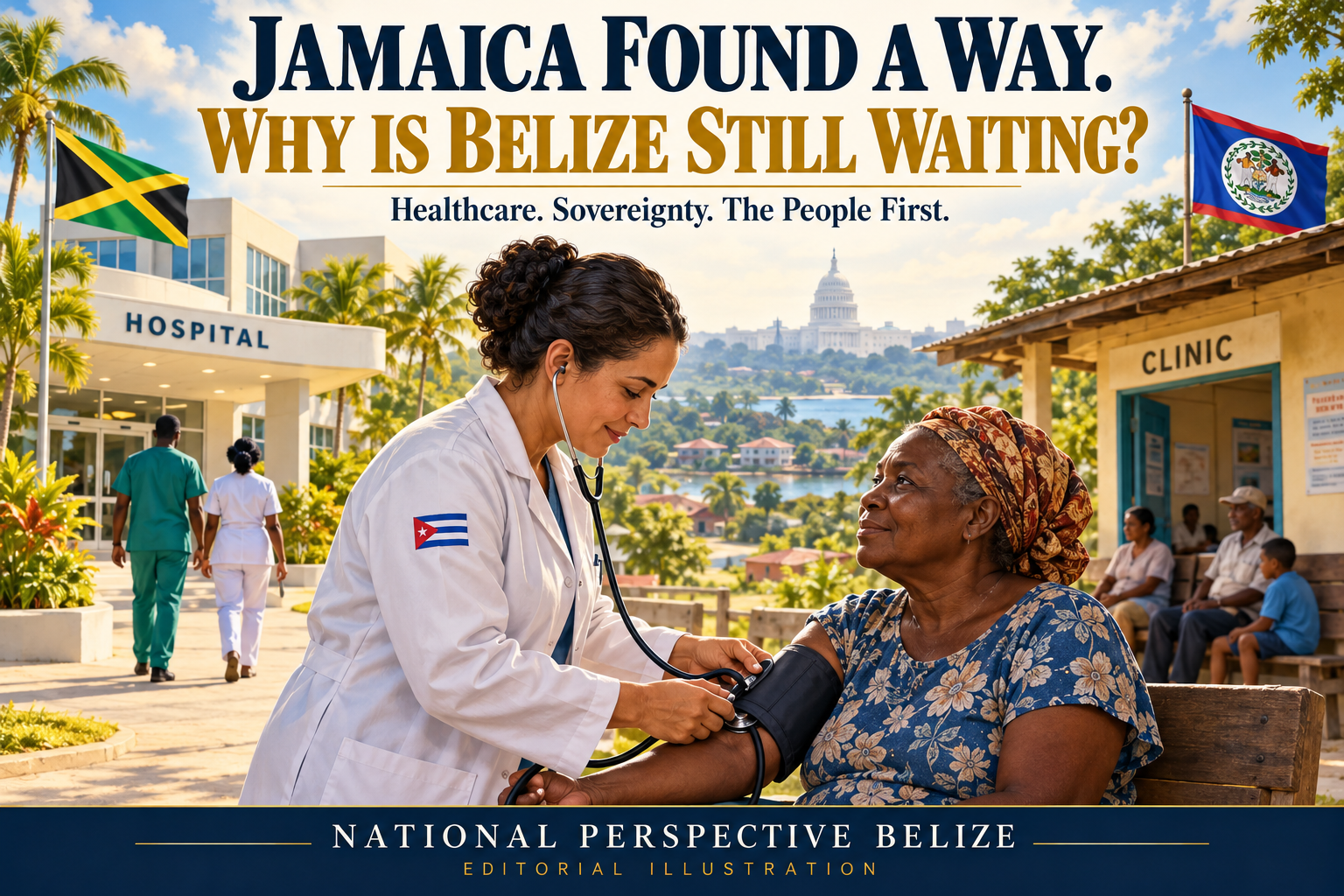
Cuban medical professionals, national dignity, and the duty to put patients first
National Perspective Belize | Analysis and Commentary
Belize City 19th October 2026
A nation’s sovereignty becomes meaningful when its government uses its authority to protect the people who depend on it. In healthcare, that responsibility reaches beyond diplomatic language. It concerns whether a rural clinic has a doctor, whether specialist services remain available, and whether patients can continue treatment when international relationships become difficult.
- Jamaica’s re-engagement of Cuban healthcare professionals’ places that responsibility squarely before Belize’s Briceño administration.
- By early October, 157 Cuban medical professionals had returned to Jamaica under individual contracts. They joined 43 who had remained after the previous arrangement ended, bringing the Cuban contingent in the public health system to 200. The Jamaica Gleaner reported that these professionals were engaged directly rather than through the Cuban government.
That development deserves attention because it demonstrates a practical possibility: the contractual structure of medical cooperation can change while a country retains access to Cuban expertise.
- Belize’s negotiations, meanwhile, remain unresolved in the latest statements reviewed for this article. On October 14, Foreign Minister Francis Fonseca said the deadline had been extended and expressed hope of reaching a resolution by the end of October.
Belizeans deserve to know what remains unresolved, what has already been agreed, and how patients and medical workers are being protected while discussions continue.
- Local media reported on October 14 that Belize was already exploring individual contracts and that a proposal had been submitted to Cuba. The criticism, therefore, concerns the unresolved outcome and the limited public explanation. Government has considered an alternative; it must now explain what is needed to make that alternative workable.
- Jamaica’s experience requires an honest account. On March 5, its foreign ministry announced the discontinuation of the existing deployment arrangement with Cuba. Its explanation was that the two governments had been unable to agree on new terms following the previous agreement’s expiration in February 2023. The announcement also offered individual employment, consistent with Jamaican labor law, for the remainder of the professionals scheduled tenure.
- Jamaica therefore changed its arrangements in a regional environment shaped by U.S. pressure. Its subsequent recruitment should not be presented as proof that it simply defied Washington and preserved the old program intact.
The transition involved departures. Earlier this year, Jamaica’s health minister reported that more than 40 professionals had stayed under individual contracts and invited others to return. The previously reported cohort was approximately 278, meaning the October total of 200 still fell short of that earlier complement.
- The achievement is nevertheless concrete. Jamaica has moved from an interrupted arrangement to the re-engagement of a substantial number of professionals. Belize should examine both the workable solution and the disruption that preceded it.
For Belize, the Cuban contribution has a long, documented history.
- A January 2007 News report dated the arrival of Cuban medical professionals under the cooperation program to 1999. At that renewal, then Health Minister Jose Coye described a contribution extending across general practice, specialist medicine, nursing and technical services. He also emphasized the program’s value in rural areas and its affordability compared with purchasing equivalent services at market rates.
That historical statement should not be mistaken for an audited calculation of today’s costs. It does establish that successive Belizean governments have understood the program as an important response to weaknesses in domestic healthcare capacity.
- In March 2026, Fonseca put the contingent at approximately 92 medical professionals, including 45 doctors, and acknowledged its importance to rural communities.
- Those figures describe an earlier government-reported complement, rather than a verified headcount for every facility today. They are substantial enough to require a detailed explanation of what would happen if the arrangement changed.
This government cannot responsibly discuss the future of that workforce solely through announcements that talks are continuing. It must identify the services involved, the arrangements needed to retain them, and the resources committed to protecting them.
- One of the most important questions arises from this administration’s own account of how the program operates.
On February 27, Health Minister Kevin Bernard said that the medical personnel received their salaries directly through Belize’s Treasury and that Belize paid nothing to the Cuban government.
- If that account is complete, it raises an obvious question: what additional contractual or operational changes are required?
- Direct salary payment and a direct individual employment contract are related matters, but they are not necessarily identical. A worker may receive money directly while other obligations remain governed by an intergovernmental agreement. The documents are needed to establish the distinction in Belize’s case.
- Government should explain who the employer is, what deductions or obligations apply, how freely professionals can accept or leave an assignment, and what immigration and professional arrangements support their work. A clear explanation would help the public distinguish an actual problem from a general allegation imported from another country’s circumstances.
Washington’s pressure is part of the documented regional context. Reuters reported in March 2025 that the United States had threatened visa restrictions against officials linked to Cuban medical programmes, which U.S. officials characterised as involving trafficking and exploitation. Cuba and Caribbean leaders disputed those allegations.
- Serious concerns about workers’ freedom deserve examination. They must be assessed against evidence about the particular programme. The nationality of a doctor cannot establish the conditions under which that person works.
There is also an important statement from Belize’s foreign minister that must be included fairly. In March 2026, when asked about possible consequences such as visa cancellations, Fonseca said no threats or intimidation had been directed at Belize in its engagements with U.S. officials. He described those discussions as pragmatic and said government was considering options to protect the health system.
- The public record therefore shows supports scrutiny of regional pressure and Belize’s response. It does not establish that a particular aid agreement required Belize to terminate its brigade, or that ministers made decisions to preserve their personal visas.
Accountability is strongest when it rests on what can be demonstrated.
- The same discipline applies to the political language of sovereignty. On February 6, 2025, NEWS 5 reported Fonseca saying:
“U.S. administrations have generally given very little attention to their own backyard—to Central America, the Caribbean.”
- The context was a discussion of Secretary of State Marco Rubio’s regional tour. Fonseca was welcoming greater U.S. attention. He did not explicitly declare that Belize belonged to Washington or announce that Belizeans’ needs came second.
- Nevertheless, the expression warrants criticism. A Belizean minister’s adoption of language describing sovereign neighbours as another country’s backyard invites questions about the assumptions guiding that relationship.
National Perspective Belize’s position is that Belize should approach the United States as a sovereign partner with its own obligations to its people. Cooperation can serve those obligations. Submissiveness becomes a problem when a government accepts external preferences without demonstrating that its decisions protect the national interest.
The medical program provides a concrete test of that judgment.
- Respect for sovereignty also requires respect for the people providing care. Cuban doctors, nurses and technicians have their own rights, professional aspirations and families. They should receive clear information, fair employment terms and genuine choices about their future.
- Their gratitude toward a host country, or a host country’s gratitude toward Cuba, cannot substitute for those protections. Neither can political disagreement with Havana justify treating individual professionals as suspects.
This article has not established individual accounts of mistreatment within Belize’s brigade. What the public record does establish is prolonged uncertainty about the program’s future. Journalists should seek the workers’ experiences directly and confidentially before attributing particular hardships to them.
- Jamaica offers a further lesson in workforce planning. Its government reports recruitment initiatives involving several countries alongside investment in domestic training. An October 12 Jamaica Information Service report described approximately J$900 million invested over three years in scholarships supporting some 600 Jamaicans in health disciplines with identified shortages.[10]
The relevance for Belize is the combination of immediate staffing measures and investment in national capacity.
- Belize should publish a comparable plan suited to its own circumstances: the disciplines in shortage, training places and scholarships required, the conditions needed to retain staff, and the timetable for strengthening services outside the main urban centers.
- International medical cooperation can support that effort. Lasting national capacity also requires equipment, supervision, working conditions and career opportunities that allow Belizean professionals to remain and serve effectively.
By the end of the present negotiations, Belizeans should receive a public explanation of the employment arrangement, its cost and duration, and the number and deployment of professionals retained. They should know what continuity measures apply if workers leave and how any service gaps will be addressed.
- Government should also explain the substance of the objections raised about Belize’s program, its own assessment of those objections, and the safeguards included in any replacement agreement. Confidential negotiations need not mean permanent public ignorance of the policy adopted.
- Jamaica has shown that a substantial number of Cuban professionals can be re-engaged under a changed contractual system. Its experience gives Belize a practical example to study and a warning about the consequences of disruption.
The Briceño administration should now demonstrate what its negotiations have secured for the people who rely on these services.
- Belize’s foreign policy must be judged by how effectively it protects Belizeans’ needs. A government that accepts “backyard” language owes its people a clear demonstration that it still exercises independent judgment.
- That demonstration must be visible in staffed facilities, fair contracts, continuity of treatment and a funded plan for the future. These are the results by which citizens can assess the administration’s stewardship, including when they vote next 2030.
National dignity requires the government to account for the choices it makes in the people’s name. Patients should be able to see how those choices protect their care.
- Log in to post comments
