GUYANA, VENEZUELA, GUATEMALA AND BELIZE: What Happens When International Law Meets National Ambition?
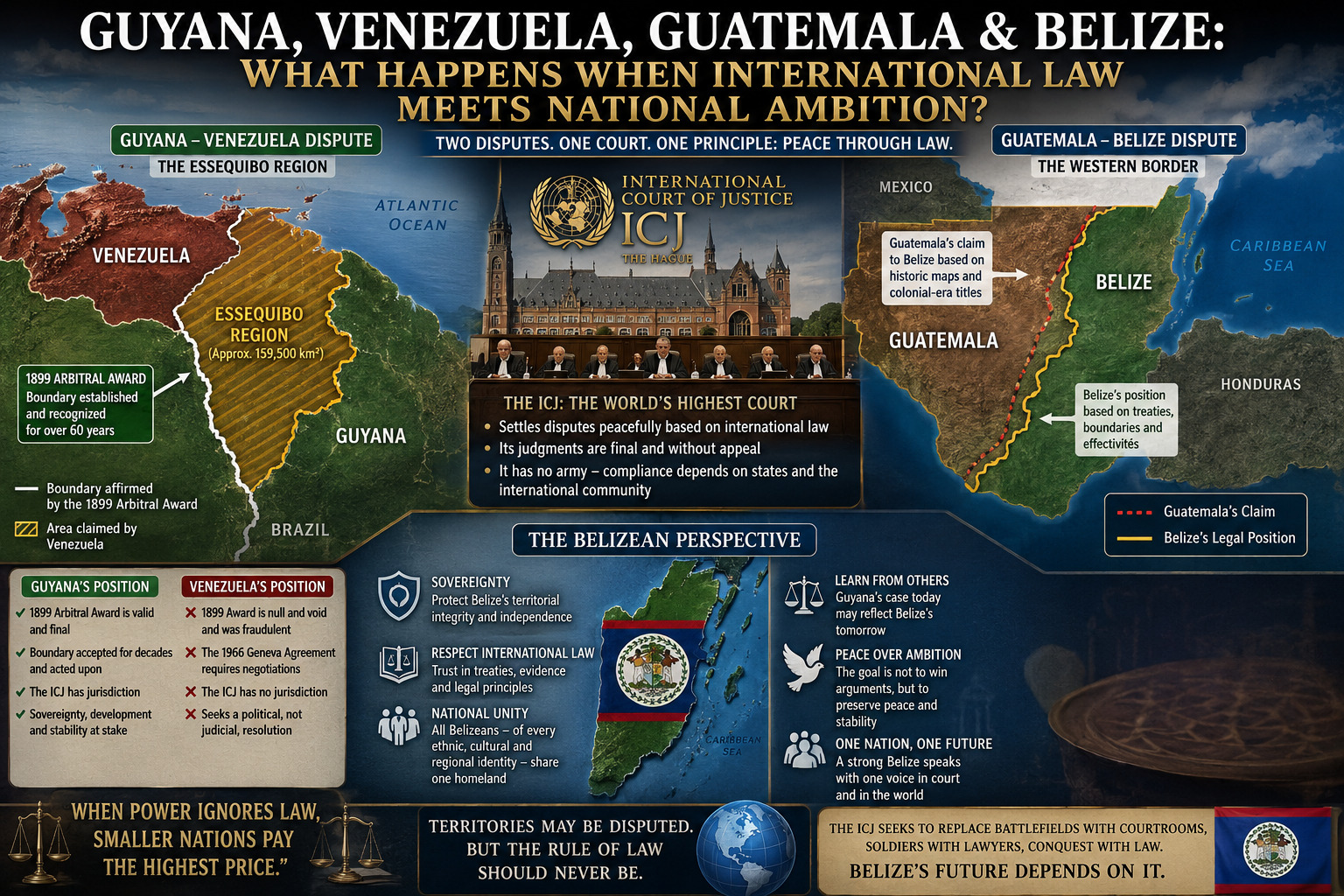
Special Feature.
Belize City: Saturday 6th June 2026: There comes a moment in the life of every nation when history, law, politics, and ambition collide.
Today, that collision is taking place in two corners of the Americas.
One is the century-old dispute between Guyana and Venezuela over the vast Essequibo region.
The other is the centuries-old territorial claim by Guatemala against Belize.
Though separated by thousands of miles, the two cases are remarkably similar.
- Both involve disputed borders.
- Both involve competing historical narratives.
- Both invoke colonial-era treaties and agreements.
- Both are now before the world's highest judicial body—the International Court of Justice.
Yet behind the legal arguments lies a deeper question:
Can international law truly settle territorial disputes when national ambition refuses to accept the answer?
The Dangerous Illusion
Many people believe that once the ICJ rules, the matter is finished.
History suggests otherwise.
- The ICJ can issue a judgment.
- The Court can clarify sovereignty.
- The Court can define legal rights.
But the Court cannot force nations to accept reality.
- It has no army.
- It has no police force.
- It has no mechanism to physically enforce its rulings.
Its authority ultimately rests upon whether states choose to respect the international system itself.
That is why the Guyana-Venezuela case is being watched so closely by governments around the world.
The judgment will not merely determine ownership of territory.
It will test the strength of international law itself.
Guyana's Position
Guyana argues that the boundary was legally settled by the 1899 Arbitral Award.
For more than sixty years, Venezuela effectively accepted that border.
Maps reflected it.
Governments recognized it.
The boundary was physically demarcated.
Guyana's argument is simple:
The matter was settled.
International law recognizes settled boundaries.
A dispute cannot be revived generations later simply because one side changes its political position.
Venezuela's Position
Venezuela sees matters differently.
Caracas argues that the 1899 process was fundamentally flawed and unfair.
Its position rests heavily upon the 1966 Geneva Agreement, which Venezuela interprets as requiring negotiations rather than judicial determination.
The Venezuelan government continues to insist that the issue must be resolved politically and diplomatically, not by judges in The Hague.
Even more significantly, Venezuela continues to challenge the Court's jurisdiction despite the ICJ already determining that it has authority to hear the matter.
Belize Should Be Paying Very Close Attention
Many Belizeans view the Guatemala claim as a uniquely Belizean problem.
It is not.
The legal principles at stake are nearly identical.
- Historical treaties.
- Colonial-era agreements.
- Boundary commissions.
- Arbitration.
- Maps.
- Demarcation.
- State practice.
- Recognition over time.
All these elements appear in both disputes.
When the ICJ examines the Guyana-Venezuela matter, Belizean legal scholars will undoubtedly compare the reasoning to the pending Belize-Guatemala case.
Not because the facts are identical.
But because the underlying legal principles often overlap.
The Forgotten Lesson
There is a lesson many ethnic, cultural, and political groups throughout the Americas frequently overlook.
- Land rights are important.
- Cultural rights are important.
- Historical grievances are important.
But sovereignty is the umbrella under which all those rights exist.
Without sovereignty, every other right becomes vulnerable.
Without a recognized state, there is no constitutional protection.
- No courts.
- No institutions.
- No democratic process.
- No legal guarantees.
Whether one is Maya, Garifuna, Mestizo, Creole, East Indian, Mennonite, Chinese, Arab, or any other Belizean ethnicity, all ultimately depend upon the continued sovereignty and territorial integrity of Belize.
The larger question is not who owns a particular parcel of land.
The larger question is who safeguards the nation that guarantees everyone's rights.
When National Ambition Overrides Law
This is where the danger begins.
Throughout history, nations have often accepted international law only when it benefits them.
When rulings are favourable, governments praise the system.
When rulings are unfavourable, governments suddenly question the system.
The same pattern can be observed worldwide.
From Eastern Europe.
To the Middle East.
To Africa.
To Latin America.
The Guyana-Venezuela dispute may soon become another test of whether nations respect legal outcomes when those outcomes conflict with national ambitions.
The Belizean Question
Belizeans should not merely watch Guyana and Venezuela as spectators.
They should view the dispute as a mirror.
A mirror reflecting our own future.
Because one day Belize too will face the moment when the ICJ speaks definitively on our own territorial controversy.
When that day comes, the question will not only be whether Belize accepts the ruling.
The larger question will be whether all parties involved accept that international law must mean something beyond convenience.
Beyond Borders
Perhaps the greatest lesson from both disputes is this:
- Territories matter.
- Resources matter.
- Oil matters.
- Land matters.
But peace matters more.
The purpose of international law is not merely to draw lines on maps.
Its purpose is to prevent nations from settling disagreements through force.
The ICJ represents humanity's attempt to replace battlefields with courtrooms.
- To replace soldiers with lawyers.
- To replace conflict with evidence.
- To replace conquest with law.
That experiment is now being tested in Guyana.
One day it will be tested in Belize.
And the world will be watching.
Editorial Note
The Guyana-Venezuela case is not merely about Essequibo.
The Belize-Guatemala case is not merely about borders.
Both are ultimately about whether the modern world is governed by law or by power.
And history has repeatedly shown that when power ignores law, smaller nations pay the highest price.
For Belize, the lesson is clear: defend sovereignty, respect law, preserve unity, and never lose sight of the larger national interest that binds all Belizeans together.
- Log in to post comments