THE GOOD, THE BAD, AND THE UGLY: POLICING IN BELIZE BEYOND THE UNIFORM
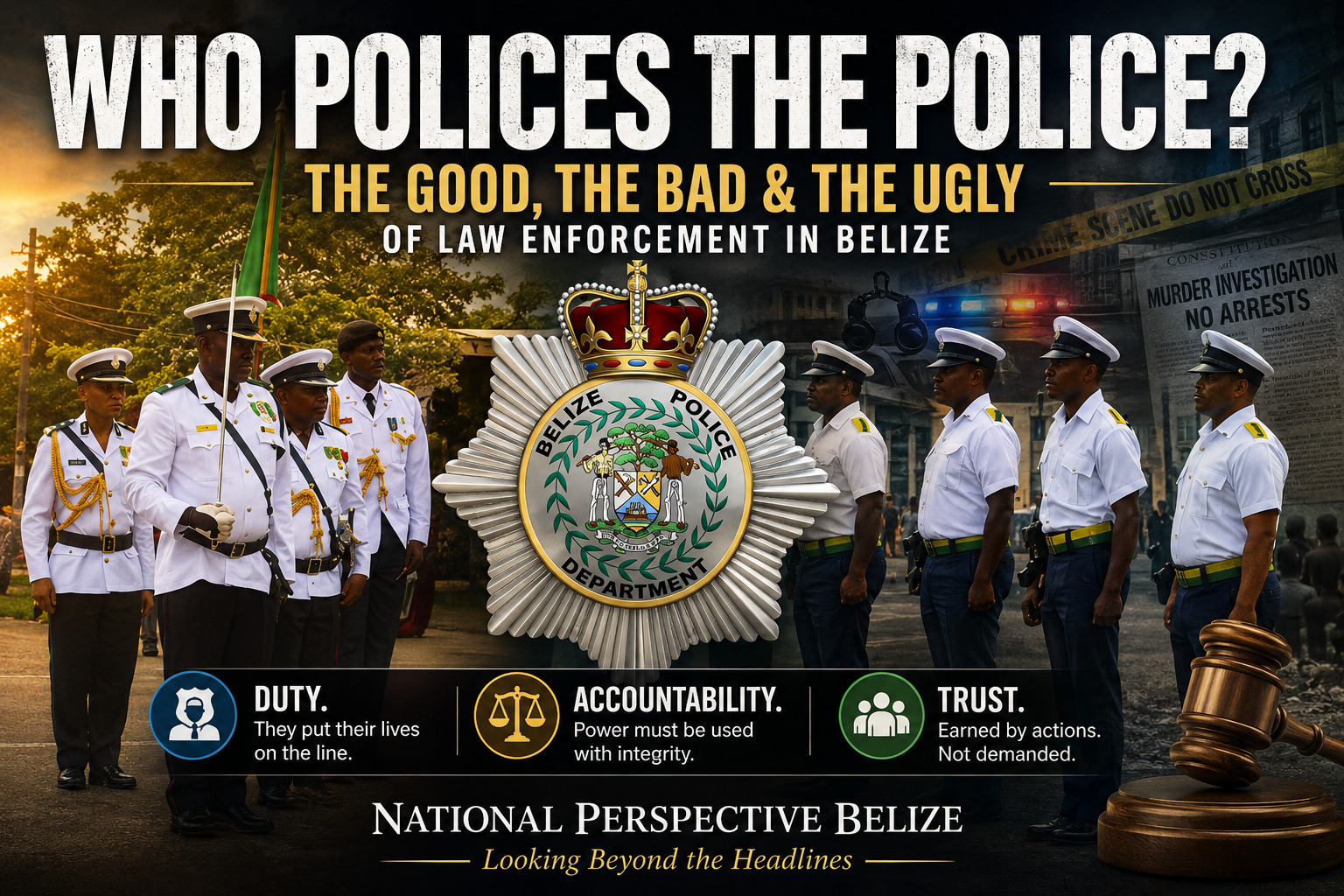
Belize City: Saturday 6th June 2026: Every time crime rises, Belizeans hear the same debate.
One side says the police are doing their best under impossible circumstances.
The other side says the police are ineffective, corrupt, abusive, and incapable of protecting the public.
Both sides contain elements of truth.
Neither side tells the whole story.
The reality of policing in Belize is far more complex.
It contains the good.
It contains the bad.
And it contains the ugly.
To understand where Belize is today, we must be willing to examine all three.
THE GOOD:
The Officers We Rarely Hear About
Lost in the public criticism are hundreds of police officers who quietly perform their duties every day.
These officers patrol dangerous neighbourhoods.
- They respond to domestic violence calls.
- They chase armed suspects.
- They investigate murders.
- They direct traffic under the blazing sun.
- They spend nights away from their families.
- They work holidays.
- They miss birthdays.
- They miss anniversaries.
- They miss their children's milestones.
Many do so for salaries that hardly reflect the risks they undertake.
The public seldom sees the officer who talks a troubled youth away from joining a gang.
The officer who helps an elderly citizen.
The officer who comforts a victim.
The officer who arrives first at a horrific accident scene.
The officer who remains committed despite the criticism.
These officers exist.
Many are honest.
Many are dedicated.
Many genuinely care about Belize.
They deserve recognition.
Without them, Belize would face a far more dangerous reality.
THE BAD:
An Institution Under Pressure
Yet recognizing good officers should not blind us to institutional weaknesses.
Belize's police department faces significant challenges.
Many stations remain understaffed.
Resources are limited.
Investigative capacity is often stretched.
Technology remains inadequate.
Training requirements continue to evolve faster than available funding.
The result is predictable.
Investigations take longer.
Cases accumulate.
Public frustration grows.
Confidence erodes.
The public sees unsolved murders.
The police see overworked investigators.
The public sees delayed justice.
The police see limited manpower.
Both perspectives may be valid simultaneously.
However, acknowledging limitations cannot become a permanent excuse.
The public has a right to expect efficiency.
The public has a right to expect professionalism.
The public has a right to expect results.
A modern police service must continuously improve or risk losing public confidence.
THE UGLY:
When Power Loses Accountability
This is where the conversation becomes uncomfortable.
Because Belizeans are not criticizing the police merely because crime exists.
Many criticisms arise from situations where the institution itself becomes the source of concern.
This is where the ugly reality emerges.
The allegations are well known.
Political interference.
Selective enforcement.
Abuse of authority.
Unlawful detention.
Questionable investigations.
Excessive force.
Cases that mysteriously disappear.
Citizens treated differently depending on their status or political connections.
Whether every allegation is true is not the point.
The point is perception.
And perception matters.
A police service cannot effectively operate without public trust.
Once trust deteriorates, cooperation declines.
Witnesses stop talking.
Communities become hostile.
Investigations become harder.
The cycle worsens.
THE STATE OF EMERGENCY QUESTION
Few issues illustrate this tension more clearly than Belize's repeated use of State of Emergency powers.
Supporters argue that SOEs temporarily reduce violence.
Critics argue that constitutional rights are being compromised.
Many Belizeans ask a simple question:
If a citizen can normally only be detained for a limited period without charge, how does extending detention for weeks or months strengthen democracy?
The police often find themselves in the middle of this debate.
Yet many of these decisions originate at policy levels above ordinary officers.
The public therefore struggles to distinguish between political decisions and police actions.
The result is growing distrust toward both.
THE INVISIBLE WOUNDS
Another uncomfortable reality rarely discussed is the mental health burden carried by officers themselves.
Police officers routinely witness:
Murders.
Suicides.
Child abuse.
Domestic violence.
Fatal accidents.
Human suffering.
Many absorb years of trauma with little psychological support.
Some develop anxiety.
Some develop depression.
Some become emotionally detached.
Others leave the profession altogether.
A nation that expects professionalism must also provide support.
Protecting the mental health of officers ultimately protects the public they serve.
THE BIGGER QUESTION
Perhaps the most important question is not whether police officers are good or bad.
Most institutions contain both.
The real question is:
What kind of police service does Belize want?
One driven by public relations?
Or one driven by public trust?
Trust is not created by press releases.
Trust is not created by slogans.
Trust is not created by demanding public sympathy.
Trust is earned.
Every day.
Through conduct.
Through professionalism.
Through transparency.
Through accountability.
Through equal application of the law.
THE ROAD FORWARD
Belize deserves a police service that is:
Well trained.
Well equipped.
Properly paid.
Politically independent.
Professionally managed.
Constitutionally accountable.
Officers deserve respect.
Citizens deserve protection.
Both can exist simultaneously.
One does not cancel the other.
The public must stop treating all officers as villains.
The institution must stop treating all criticism as hostility.
That middle ground is where trust begins.
And trust is ultimately the most powerful weapon any police service possesses.
Without it, uniforms become symbols of authority.
With it, uniforms become symbols of legitimacy.
Belize must decide which one it wants.
Editorial Reflection:
"Respect Is Given. Trust Is Earned."
The Belizean people do not owe blind loyalty to any institution.
Not to politicians.
Not to governments.
Not to police departments.
Not to anyone.
What they owe is vigilance.
What institutions owe in return is accountability.
The police officer standing on the street corner deserves respect as a fellow citizen performing a difficult job.
The institution behind that officer must earn something far more valuable.
Trust.
And trust, unlike authority, cannot be demanded.
It must be earned every single day.
By: Omar Silva – Editor/Publisher
National Perspective Belize – Digital
- Log in to post comments