WHEN THE WATCHDOG IS MISSING Why the Ombudsman's Vacancy Is Bigger Than One Court Case
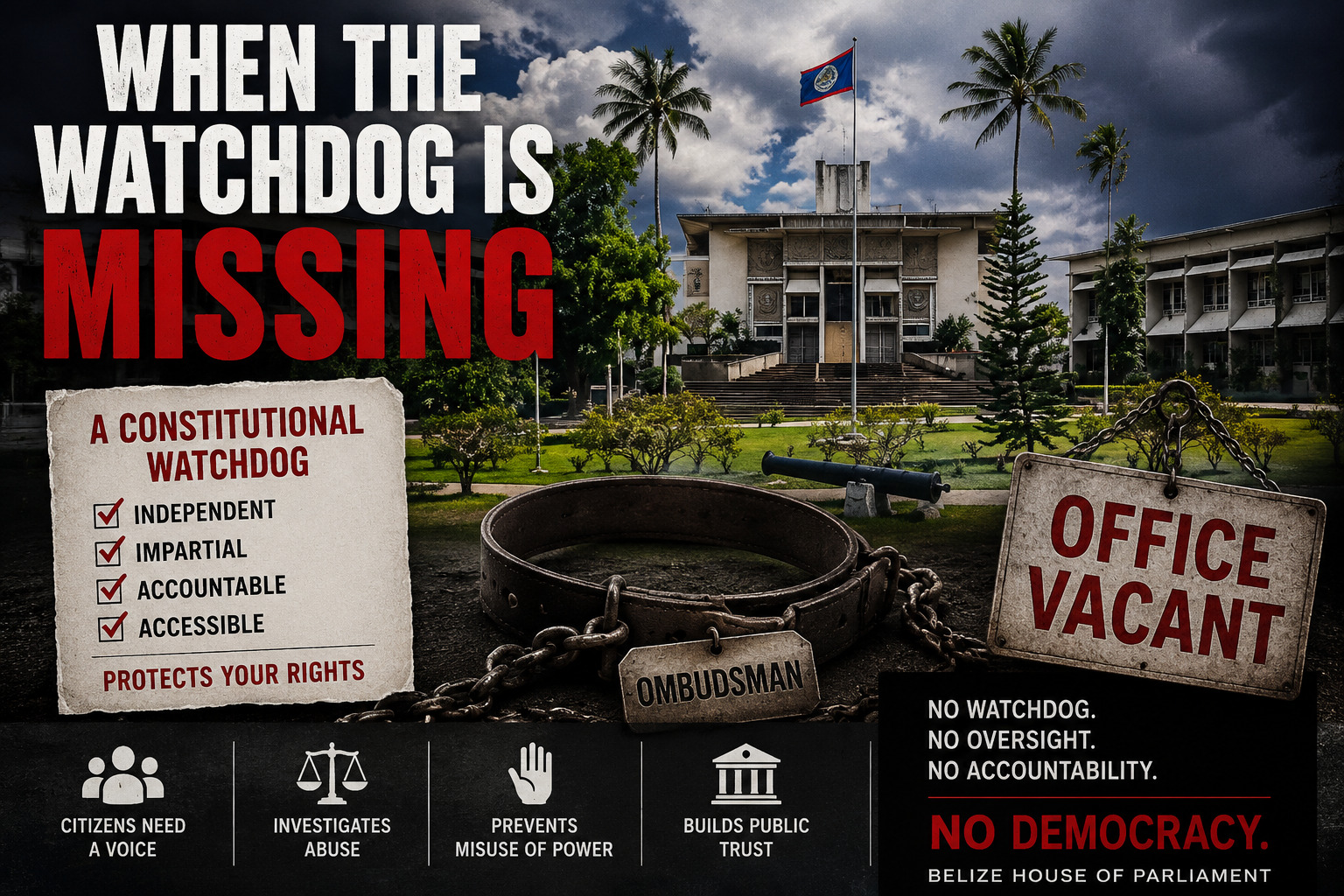
Constitutional Governance Series
Belize City: Sunday 19th July 2026: For months, the public conversation has revolved around one question: Can Jerry Enriquez take the Government of Belize to court over the prolonged vacancy in the Office of the Ombudsman?
The answer to that question is important, but it is not the most important one.
The larger constitutional question belongs to every Belizean:
- What happens to democracy when one of the State's principal watchdogs is left without a watchdog?
- That is the issue now unfolding before the courts, and its implications extend far beyond one citizen, one Attorney General, or one administration.
Beyond the Personalities
Too often, constitutional disputes in Belize become reduced to political personalities. Supporters defend "their side," opponents attack "the other side," and the underlying institutional issue is forgotten.
This case deserves a different approach.
Jerry Enriquez has exercised his constitutional right to seek judicial review. The Attorney General, in turn, has defended the Government's legal position. Both actions are legitimate within a constitutional democracy.
- The courts exist precisely to resolve such disagreements.
- The real issue is not who filed the claim.
- The real issue is why the claim became necessary.
The Ombudsman Is Not a Luxury
The Office of the Ombudsman was never intended to be a ceremonial position.
It exists because governments possess extraordinary powers over ordinary citizens. Decisions affecting employment, land, public services, procurement, licensing, policing, immigration, taxation, and countless other aspects of daily life require an independent avenue through which citizens can seek impartial investigation when they believe they have been treated unfairly.
The Ombudsman is therefore not simply another government office.
- It is one of the constitutional safeguards designed to protect the citizen from the misuse of public power.
When that office remains vacant for an extended period, the question naturally arises:
- Who performs that constitutional oversight in the meantime?
Rule of Law Must Apply Equally
The Attorney General is correct on one important constitutional principle.
No constitutional office is above judicial review.
An Ombudsman, like a Minister, a Public Service Commission, or even the Prime Minister, must exercise authority within the law. Courts exist to determine whether constitutional officers have acted fairly and lawfully.
- That principle strengthens democracy.
- But constitutional accountability is reciprocal.
If Government insists that every constitutional office must comply with the law, then Government itself must also ensure that the institutions established by law remain functional.
- The Rule of Law cannot operate selectively.
- It must apply equally to those who govern and to the institutions that oversee them.
Can Reform Replace Responsibility?
Government has explained that Belize is transitioning toward a National Human Rights Institution (NHRI), supported through an international partnership and expected to unfold over several years.
Modernizing human rights protection is a worthwhile objective.
However, constitutional reform and constitutional continuity are not the same thing.
Until Parliament amends the governing legislation and formally establishes the new institutional framework, the existing Office of the Ombudsman remains part of Belize's legal architecture.
A future reform does not automatically suspend present responsibilities.
Institutional transitions should strengthen accountability—not interrupt it.
Why Vacancies Matter
- Democracies are not judged only by the laws they enact.
- They are judged by whether those laws continue to function in practice.
A vacant oversight office may appear to be an administrative matter.
- In reality, it affects public confidence in government accountability.
The longer an oversight institution remains without leadership, the greater the perception that citizens have fewer independent avenues through which to seek justice.
- Whether that perception is legally justified is one question.
- Whether it weakens public confidence is another.
- Both deserve serious consideration.
More Than One Court Case
This litigation also intersects with a broader dispute over access to public information.
The Attorney General has challenged an Ombudsman's recommendation concerning disclosure of legal costs associated with previous constitutional litigation.
Government is fully entitled to ask the courts to determine whether that recommendation complied with the law.
That is how constitutional democracies resolve disputes.
Yet the public should distinguish between two separate issues.
One concerns whether information should be disclosed.
The other concerns whether the institution responsible for protecting citizens' administrative rights remains adequately staffed and operational.
They are different constitutional questions, even if they arise from related events.
The Lesson for Belize
This case should not become another chapter in Belize's endless cycle of partisan argument.
- Governments change.
- Oppositions change.
- Political fortunes change.
Constitutions endure.
Oversight institutions are not established to serve one administration or another. They exist to serve the Nation and to protect the public regardless of who occupies the offices of power.
A democracy is strongest when its independent institutions continue to function consistently, transparently, and without interruption.
The Real Question Before the Nation
- The courts will determine the legal issues before them.
But Belizeans should already be asking a broader civic question:
Can a constitutional democracy remain fully accountable if one of its principal oversight institutions is allowed to remain vacant while government continues exercising its full constitutional authority?
That question does not belong to Jerry Enriquez.
- It does not belong to the Attorney General.
- It belongs to every Belizean who believes that public power should always be accompanied by public accountability.
For constitutions are not measured only by the powers they grant to governments.
They are measured by the strength, independence, and continuity of the institutions created to hold those governments to account.
By: Omar Silva – Editor/Publisher
National Perspective Belize
www.nationalperspectivebz.com
- Log in to post comments