FROM CRISIS TO RESOURCE Why Belize Needs a National Sargassum Strategy
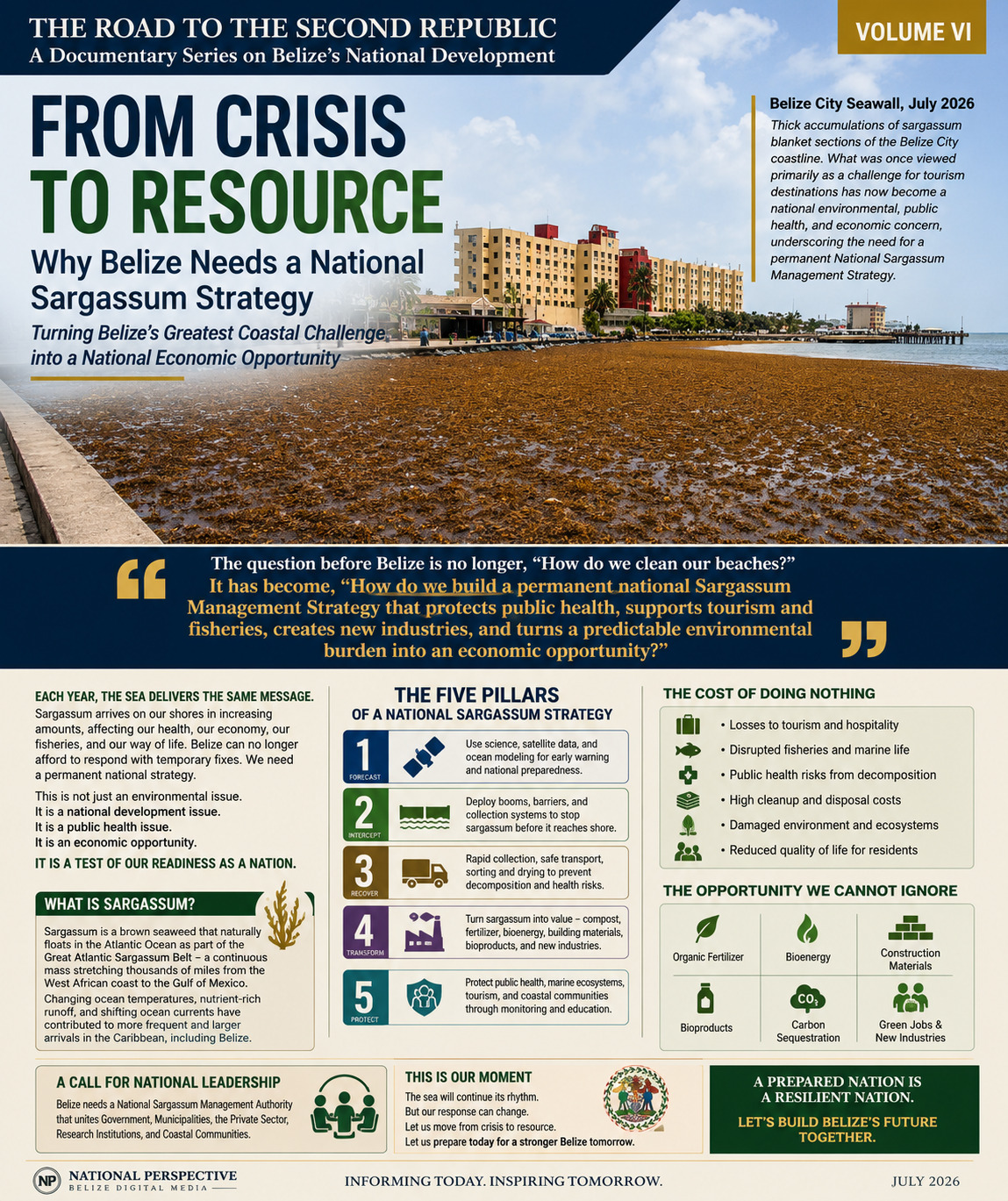
"The sea does not surprise us anymore. Why then are we still surprised by what it brings?"
THE ROAD TO THE SECOND REPUBLIC
A Documentary Series on Belize's National Development
Volume VI
By: Omar Silva – Editor/Publisher
National Perspective Belize
Belize City: Friday 10th July 2026: For generations, Belize has lived with the rhythm of the Caribbean Sea. The tides, the trade winds, the reef, and the mangroves have shaped our economy, our culture, and our national identity. Fishing villages became towns. Small Cayes grew into international tourism destinations. Our coast became one of the country's greatest natural assets.
Yet in recent years, another rhythm has emerged.
Each year, vast quantities of sargassum drift across the Atlantic before washing ashore along Belize's coastline. What was once regarded as an occasional natural occurrence has evolved into a recurring national challenge. Communities from San Pedro and Caye Caulker to Placencia, Hopkins, Dangriga, and now Belize City have all experienced the consequences of increasingly severe sargassum landfalls.
Hotels struggle to keep beaches attractive for visitors. Fishermen contend with clogged channels and damaged fishing grounds. Municipal workers labour to remove mountains of decomposing seaweed before it creates health hazards. Residents endure persistent Odors and growing concerns over air quality. Public resources are redirected into emergency cleanup efforts that must often be repeated year after year.
Despite this, Belize continues to respond as though each arrival were an unexpected event.
- Emergency crews are mobilized.
- Municipal budgets are stretched.
- Businesses absorb losses.
- Communities complain.
- Government reacts.
The season ends.
And the cycle begins again.
This pattern raises a fundamental question that extends far beyond environmental management.
- Why does Belize continue treating a predictable national reality as though it were an unforeseen emergency?
The answer may reveal less about the sea than it does about the way we plan as a nation.
No government can prevent ocean currents from carrying sargassum across the Atlantic. No ministry can control the winds or reverse global climate trends. But every responsible nation can decide whether it will merely react to recurring challenges—or prepare for them.
That distinction defines the difference between crisis management and national governance.
This documentary does not argue that sargassum itself is Belize's greatest problem.
- It argues that the absence of a permanent national strategy has become the greater challenge.
For nearly a decade, Belize has invested significant time, money, and manpower in removing sargassum from beaches after it has already arrived. Yet comparatively little attention has been devoted to forecasting its arrival, intercepting it before landfall, transforming it into economic value, protecting public health, or building permanent institutional capacity to manage a phenomenon that scientists increasingly regard as a recurring feature of the Atlantic ecosystem.
Around the Caribbean and beyond, researchers are exploring ways to convert sargassum into compost, organic fertilizers, construction materials, bioenergy, biodegradable products, and other commercial applications. International organizations are studying improved forecasting systems, offshore containment technologies, and regional cooperation.
These developments suggest an important possibility.
- Perhaps the question is no longer how Belize removes sargassum.
- Perhaps the question is how Belize transforms it.
This publication therefore approaches sargassum not as an annual nuisance, but as a national planning challenge—one that touches environmental protection, public health, fisheries, tourism, municipal governance, scientific research, economic diversification, and climate resilience.
The objective is not to assign blame for the current situation.
Nor is it to offer simplistic solutions to a complex environmental phenomenon.
Rather, the purpose is to ask whether Belize is prepared to move beyond seasonal emergency responses toward a permanent National Sargassum Strategy that protects communities, strengthens coastal resilience, encourages innovation, and transforms a recurring environmental burden into a source of national opportunity.
Because history demonstrates that resilient nations are not distinguished by the absence of challenges.
They are distinguished by their ability to prepare for the challenges they know will return.
- Log in to post comments