WHO WILL CONTROL BELIZE'S DIGITAL FUTURE? WHEN TECHNOLOGY ARRIVES FASTER THAN POLICY
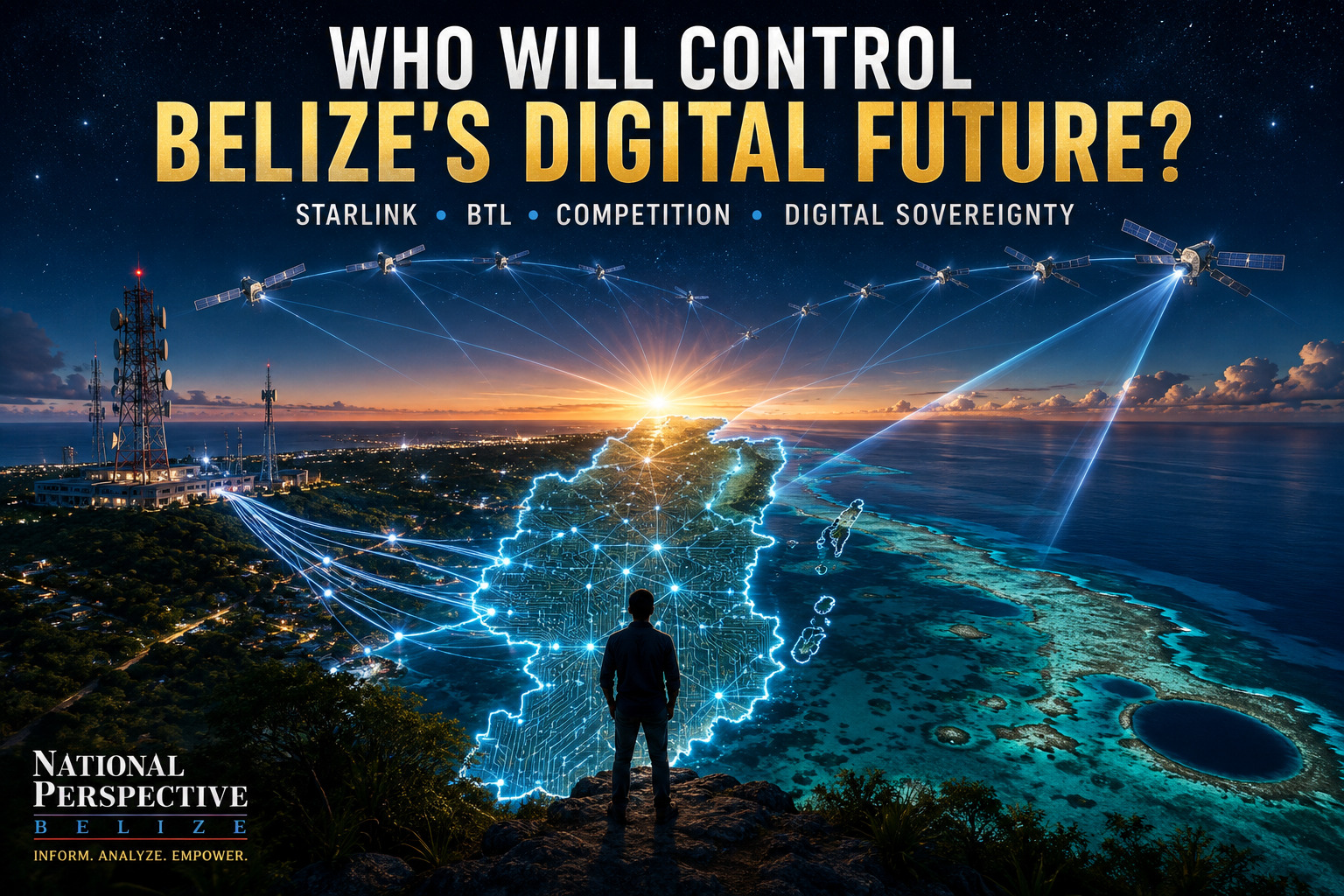

Belize's Next Great National Conversation
CHAPTER I
Belize City: Friday 7th August 2026: Throughout history, technological revolutions have consistently moved faster than governments' ability to regulate them. The steam engine transformed commerce before labour laws caught up.
- The automobile arrived long before comprehensive traffic legislation.
- Radio, television and the internet all expanded into society before lawmakers fully understood their social, economic and political implications.
Today, Belize finds itself standing at the threshold of another such transformation.
The conversation currently unfolding across the country centres on a single name—Starlink.
- For some, Starlink represents faster internet.
- For others, it symbolizes greater competition.
- To businesses, it may promise increased reliability.
- To rural communities, it offers the possibility of connecting places where traditional infrastructure has been slow or expensive to reach.
Yet if the national conversation ends there, Belize will have missed the larger opportunity.
The real issue before the country is not whether one company should receive a licence.
It is whether Belize possesses a comprehensive vision for governing the digital economy that will define the coming decades.
That distinction is fundamental.
- Telecommunications is no longer simply another commercial service.
- It has become the nervous system of the modern State.
- Government ministries exchange sensitive information through digital networks.
- Banks process billions of dollars electronically.
- Hospitals increasingly rely upon digital records and communication systems.
- Schools educate students through online platforms.
- Businesses depend upon uninterrupted connectivity to reach customers, suppliers and international markets.
Emergency services rely upon secure communications during hurricanes, floods and other national crises.
Even democratic participation has become inseparable from digital communication.
In such an environment, telecommunications policy can no longer be viewed merely through the lens of consumer pricing or commercial competition.
- It has become an issue of national development.
The timing of this discussion is equally significant.
Belize is not debating Starlink in isolation.
The country is simultaneously witnessing the proposed acquisition of Speednet Communications Limited (SMART) by Belize Telemedia Limited (BTL), one of the most consequential structural developments in the telecommunications sector in decades. That proposal has prompted regulatory review precisely because of its potential implications for market concentration, consumer welfare and competition.
Taken together, these two developments invite a broader national reflection.
- What should Belize's telecommunications market look like ten years from now?
- Should the country continue encouraging multiple competing providers?
- Should consolidation be viewed as strengthening national infrastructure?
- Should satellite broadband become an integral part of Belize's communications landscape?
- Or should existing regulatory structures continue to evolve cautiously as new technologies emerge?
These are not merely commercial questions.
- They are questions of national strategy.
Indeed, every modern nation must eventually decide how it wishes to balance innovation, competition, investment, public accountability and national resilience.
Those objectives often complement one another.
At other times, they compete.
- Greater competition may stimulate innovation while placing financial pressure on infrastructure investment.
- Consolidation may improve economies of scale while reducing consumer choice.
- Rapid technological adoption may increase connectivity while introducing new regulatory and cybersecurity challenges.
- Responsible governance requires recognizing these competing interests rather than reducing complex policy questions to simple slogans.
For Belize, the discussion extends beyond today's technologies.
Artificial intelligence, satellite communications, cloud computing, digital identity systems, cybersecurity and advanced data management are no longer distant possibilities.
They are becoming integral components of modern governance and economic development.
The decisions made regarding telecommunications today will influence Belize's readiness for those technologies tomorrow.
For that reason, Starlink should not be viewed simply as a company seeking access to Belize's market.
Rather, it should be understood as a catalyst for a much larger national conversation.
- Do Belize's existing laws adequately address the realities of satellite broadband?
- Is the current regulatory framework sufficiently adaptable to technologies that were unimaginable when many telecommunications policies were first developed?
- Should the nation begin designing a long-term digital strategy rather than responding to each new technological development individually?
These questions deserve careful public consideration because they concern far more than internet access.
- They concern the future competitiveness of Belize's economy.
- They concern the modernization of public administration.
- They concern education, healthcare, emergency management and national security.
Above all, they concern the country's capacity to shape its own technological future instead of merely reacting to innovations developed elsewhere.
Throughout Belize's history, there have been moments when the nation was called upon to make decisions that would influence generations yet unborn.
Political Independence was one such moment.
- The peaceful pursuit of the territorial claim before the International Court of Justice became another.
- The digital transformation now confronting Belize may prove to be no less consequential.
- The challenge before us is therefore not whether Belize should embrace technology.
That question has already been answered by history.
The real challenge is whether Belize will build the institutions, policies and regulatory vision necessary to govern that technology wisely, transparently and in the national interest.
Because in the twenty-first century, a nation's prosperity will depend not only upon the roads it builds or the ports it develops.
- It will also depend upon the digital infrastructure it creates, the rules by which it governs it, and the vision that guides it.
- That is why the Starlink debate is not simply about Starlink.
- It is about the Belize that future generations will inherit.
CHAPTER II
WHY WAS STARLINK RESTRICTED?
Understanding the Regulator Before Judging the Decision
- Public debate often begins with a conclusion.
- Public policy should begin with an understanding.
Since the announcement that Starlink was not granted unrestricted authority to operate as a nationwide Internet Service Provider in Belize, public discussion has largely divided into two opposing camps.
- One side argues that Belize is denying itself technological progress.
- The other contends that existing telecommunications infrastructure and regulatory safeguards must be protected.
Both positions reflect legitimate concerns.
- Neither, however, fully answers the more fundamental question.
Why would a regulator restrict a technology that much of the world is embracing?
To answer that question, Belizeans must first understand what the Public Utilities Commission was created to do.
- The PUC is not a ministry of government.
- It is not intended to function as a political institution.
- Nor is it established to promote the commercial interests of any particular company.
- Its statutory responsibility is considerably more demanding.
- It must regulate public utilities in a manner that balances competing public interests.
That includes promoting efficient services, protecting consumers, encouraging appropriate investment, maintaining fair competition, and ensuring that national infrastructure develops in an orderly and sustainable manner.
Those responsibilities become particularly challenging whenever a disruptive technology enters an established market.
Starlink is precisely such a technology.
Unlike conventional telecommunications providers, Starlink does not depend primarily upon underground fibre-optic cables, microwave transmission systems or extensive networks of cellular towers.
Its infrastructure exists largely in space.
Thousands of low-Earth orbit satellites communicate directly with user terminals on the ground, creating a fundamentally different model of broadband delivery.
- For consumers, this technological innovation may appear wonderfully simple.
- For regulators, however, it introduces entirely new questions.
- How should a satellite operator be licensed within a regulatory framework originally designed around terrestrial networks?
- How should national service obligations apply?
- How should consumer complaints be addressed?
- What mechanisms ensure compliance with Belizean law?
- How should emergency communications be coordinated?
- How should lawful interception requirements, where authorized by law, function within satellite-based systems?
- How should regulators maintain fair competition between companies investing heavily in domestic infrastructure and companies operating through global satellite constellations?
These are not uniquely Belizean concerns.
- They have confronted regulators across the world.
- Different countries have adopted different approaches.
- Some have embraced nationwide satellite broadband almost immediately.
- Others have proceeded gradually, imposing licensing conditions, geographic limitations or technical requirements while evaluating long-term impacts on domestic markets.
Belize's decision to authorize Starlink only within defined categories reflects one model of regulatory caution.
Whether that model ultimately proves to be the most effective is a question that deserves continued public discussion.
Yet there is another dimension that often escapes attention.
Telecommunications is no longer simply about communications.
- It is now critical national infrastructure.
Every financial transaction, electronic government service, online classroom, emergency response centre, hospital information system, airport operation and customs database depends upon reliable digital connectivity.
When a regulator evaluates a new market participant, it is not merely assessing a commercial application.
- It is considering part of the nation's strategic infrastructure.
That responsibility necessarily demands careful scrutiny.
At the same time, regulators must also guard against another danger.
- Regulation itself should never become an obstacle to innovation.
If technological change consistently advances more rapidly than regulatory adaptation, countries risk discouraging investment, slowing economic modernization and limiting consumer choice.
This is the delicate balance that every modern regulator must strike.
- Too little regulation may expose consumers and critical infrastructure to unnecessary risks.
- Too much regulation may unintentionally discourage innovation and competition.
The challenge is not to choose one over the other.
- The challenge is to achieve an equilibrium that serves the long-term public interest.
That is why the Starlink discussion should never be reduced to whether Belize is "for" or "against" one company.
- The larger issue concerns the adaptability of Belize's regulatory institutions themselves.
- Can laws written for twentieth-century telecommunications effectively govern twenty-first-century technologies?
- Can existing regulatory frameworks evolve quickly enough to accommodate satellite broadband, artificial intelligence, cloud computing and future digital innovations that have yet to emerge?
- These questions will not disappear after the Starlink debate concludes.
- They will become increasingly important as Belize continues its digital transformation.
- There is, however, one additional development that now makes these questions even more consequential.
At the very moment Belize debates how a new global satellite provider should fit within the national telecommunications framework, the country is also considering one of the most significant structural changes in its domestic communications market.
- The proposed acquisition of Speednet Communications Limited by Belize Telemedia Limited has the potential to reshape the competitive landscape in ways that extend well beyond today's licensing discussions.
The interaction between technological innovation and market structure is where Belize's most important policy questions now reside.
Because competition is not measured only by the number of companies operating.
It is also measured by the choices available to consumers, the incentives for innovation, the resilience of national infrastructure, and the ability of regulators to preserve a fair and dynamic marketplace.
Markets are not transformed only by the arrival of new technologies. They are also reshaped by changes in ownership, competition and regulation. As Belize considers both a more concentrated domestic market and the emergence of global satellite broadband, one question becomes unavoidable: what market structure will best serve the national interest in the decades ahead?
Those are the issues that now lead naturally into the next chapter.
Coming in Chapter III
WHEN COMPETITION BECOMES CONSOLIDATION
The BTL–SMART Acquisition and the Future Structure of Belize's Telecommunications Market
By: Omar Silva - Editor/Publisher @ www.nationalperspectivebz.com
- Log in to post comments