BEL: WHAT HAPPENED BETWEEN THE FIRST EMERGENCY AND THE SECOND EMERGENCY?
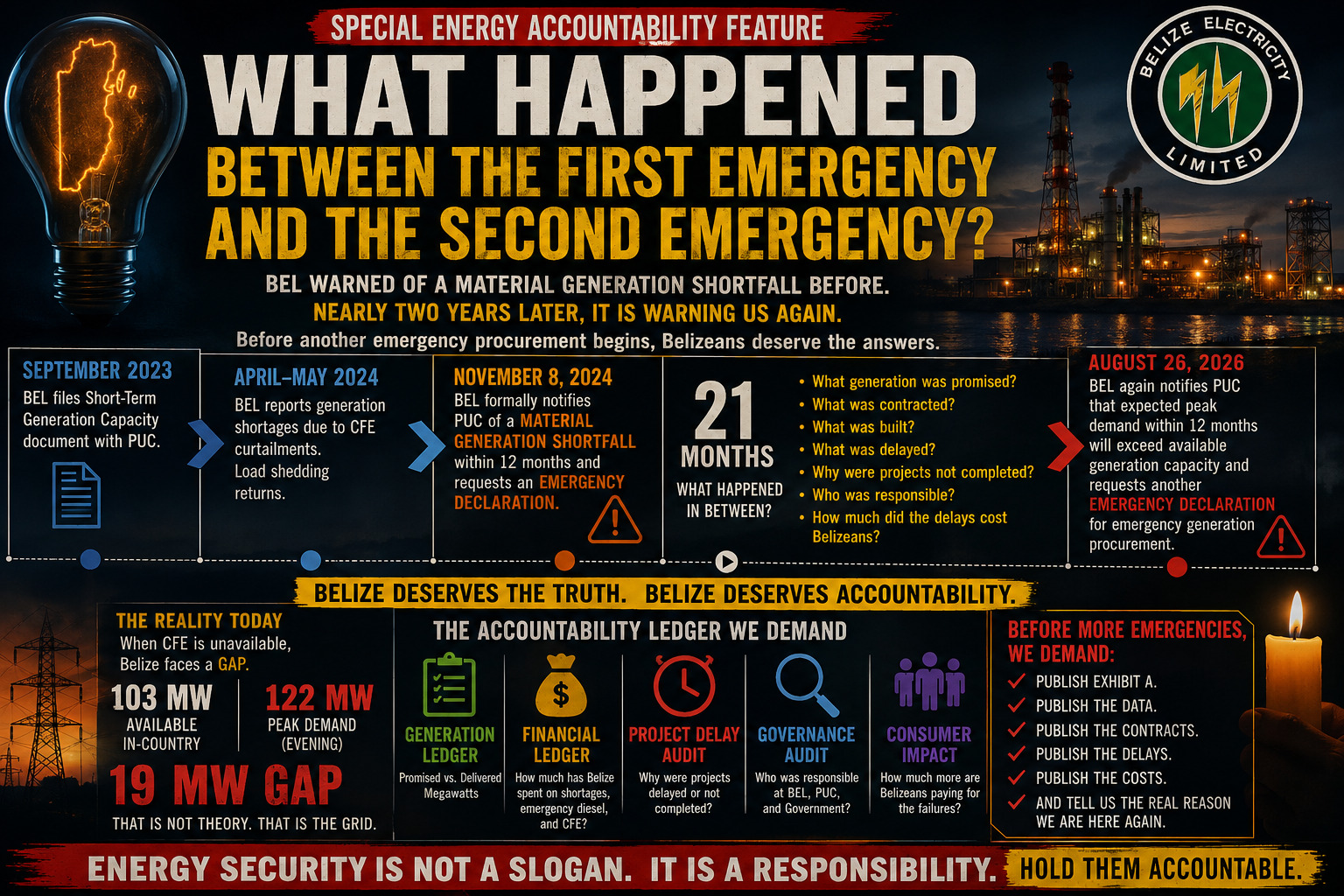

BEL warned of a material generation shortfall in November 2024. In August 2026, it returned to the PUC warning of another. Before Belize enters another round of emergency generation procurement, the country deserves an accounting of what happened in between.
SPECIAL ENERGY ACCOUNTABILITY FEATURE — PART I
The most important question raised by Belize Electricity Limited's August 26, 2026 letter to the Public Utilities Commission is not simply what Belize must do next.
It is:
WHAT HAPPENED AFTER THE LAST EMERGENCY?
That distinction changes the entire conversation.
BEL's latest letter warns that expected peak electricity demand during the next twelve months will exceed available generation capacity.
BEL therefore asks the PUC to secure Government approval for an emergency declaration so that emergency generation procurement can proceed.
Taken by itself, the letter sounds like an electricity utility confronting an approaching capacity problem and asking regulators to move quickly before that problem becomes a crisis.
But the letter cannot properly be read by itself.
Because this is not the first emergency warning.
And the generation vulnerability BEL now describes did not suddenly appear in August 2026.
THERE WAS ALREADY AN EMERGENCY WARNING
On November 8, 2024, BEL formally notified the PUC of an anticipated material shortfall in generation services and invoked the emergency mechanism contained in the Public Utilities Commission Request for Proposals Regulations.
That document is particularly important because BEL itself provided historical context.
The company identified generation-capacity shortages in 2019, 2023 and 2024 and referred to what it described as the:
“systemic failure of the generation procurement process to install new generation capacity on the grid.”
BEL further reported that the 2024 shortage had resulted in load shedding and significant interruptions to electricity consumers.
Those words now deserve to be read again.
Systemic failure.
That was BEL's characterization in 2024.
Not an opposition politician's.
Not a newspaper columnist's.
Not an angry consumer's.
BEL's.
And that creates the central question of this investigation:
WHAT WAS DONE TO CORRECT THAT SYSTEMIC FAILURE?
THE COUNTRY HAD ALREADY BEEN WARNED
The documentary trail goes further back.
In April 2024, amid CFE curtailments, BEL publicly acknowledged temporary generation shortages and announced measures intended to strengthen domestic capacity.
The company subsequently reported adding approximately 28 MW of generation capacity during 2024.
Yet by November of that same year, BEL was still formally projecting a material shortfall requiring an emergency response.
Now, in August 2026—approximately twenty-one months after that first formal emergency notification—BEL has returned to the regulator warning again that expected peak demand will exceed available generation capacity.
That chronology matters.
Because it makes one explanation increasingly difficult to sustain:
THAT BELIZE COULD NOT HAVE KNOWN IT FACED A GENERATION-CAPACITY PROBLEM.
The precise timing of CFE curtailments could not necessarily have been predicted.
The exact price of imported electricity could not have been known.
Fuel-price shocks could not have been calculated years in advance with precision.
But Belize's vulnerability arising from insufficient dependable domestic generation and significant reliance upon imported electricity was known.
BEL's own records demonstrate that.
THIS IS WHY “NOBODY COULD HAVE KNOWN” IS NOT ENOUGH
BEL Executive Chairman Lynn Young recently argued that decisions were made using the information available at the time and that nobody could reasonably have anticipated the difficulties CFE would eventually experience.
There is fairness in part of that argument.
No electricity planner possesses a crystal ball.
But national energy planning does not require one.
The purpose of system planning is precisely to prepare for events whose exact timing is unknown but whose risk is foreseeable.
What happens if CFE curtails supply?
What happens if drought reduces hydroelectric production?
What happens when bagasse generation falls outside the cane season?
What happens if diesel prices surge?
What happens as national peak demand continues increasing?
What reserve capacity must exist if a major generation source suddenly disappears?
Those are not extraordinary questions.
They are the foundation of electricity-system planning.
Therefore, the issue is not whether BEL should have predicted precisely what CFE would do in August 2026.
The issue is whether Belize's electricity institutions adequately prepared for the known consequences of losing access to a major external source of electricity.
That is a very different question.
AND BEL ALREADY HAD A PLAN
Belize has not been operating without electricity planning documents.
BEL developed its Least Cost System Expansion Plan.
Generation projects have been announced.
Solar generation has been proposed.
Battery storage has been planned.
Westlake generation has been expanded.
Additional generation has been discussed with Independent Power Producers.
Government has secured and pursued international financing for energy infrastructure.
And in January 2026, BEL, the Government of Belize and the International Finance Corporation announced development work toward as much as 80 MW of utility-scale solar generation.
Therefore, another fundamental question emerges:
WHAT HAPPENED TO THE MEGAWATTS?
Not the megawatts announced.
Not the megawatts proposed.
Not the megawatts contained in presentations.
Not the megawatts expected sometime in the future.
The question concerns the megawatts actually available to Belize's grid when demand reaches its peak.
That is the measurement that matters.
BEL'S AUGUST 26 LETTER CONTAINS A VERY IMPORTANT WORD
BEL tells the PUC that additional generation is necessary beyond what:
“currently exists or will realistically exist within the next year.”
Realistically.
That word deserves attention.
Because it suggests there may be a difference between generation projects that have been announced or planned and generation capacity BEL actually expects to be operational during the coming twelve months.
If that interpretation is correct, then the public deserves to know exactly which projects fall on either side of that distinction.
For every generation project announced since the first emergency notification:
What was promised?
What was contracted?
What was financed?
What was constructed?
What became operational?
What was delayed?
What remains pending?
And most importantly:
HOW MUCH DEPENDABLE GENERATING CAPACITY DID EACH PROJECT ACTUALLY ADD TO THE NATIONAL GRID?
That is the ledger Belize needs.
THE MISSING EXHIBIT A
There is another significant issue with the August 26 letter.
BEL expressly states:
“The analysis set out in Exhibit A of this Notice demonstrates that the expected peak electricity demand within the next twelve months will exceed available generation capacity…”
The publicly circulated letter therefore refers directly to the underlying analysis upon which BEL's emergency request is based.
That analysis is critical.
Exhibit A should be made public.
It should identify, among other things:
the projected peak demand;
available dependable generation;
CFE availability assumptions;
hydroelectric assumptions;
bagasse-generation assumptions;
Westlake capacity;
other thermal generation;
generation already under construction;
expected project completion dates;
battery-storage assumptions;
reserve requirements;
and ultimately—
THE NUMBER OF MEGAWATTS BEL SAYS WILL BE MISSING.
Without that information, the public has been presented with BEL's conclusion without being able to independently examine the calculation supporting it.
For an ordinary operational decision, that might be understandable.
For a declaration capable of triggering emergency generation procurement, it deserves much greater transparency.
EMERGENCY PROCUREMENT IS NOT AUTOMATICALLY WRONG
This distinction is essential.
If Belize genuinely faces a material generation shortfall within twelve months, then Government, BEL and the PUC have a responsibility to act.
No responsible public-interest argument should demand that the country risk blackouts merely to preserve ordinary procurement timelines.
Emergency procurement may therefore be necessary.
But necessity does not eliminate accountability.
It increases it.
Because accelerated procurement can potentially reduce the time available for ordinary competitive processes and public scrutiny.
Therefore:
EMERGENCY SHOULD MEAN FASTER PROCUREMENT — NOT LESS TRANSPARENCY.
If emergency generation is procured, Belizeans should be told:
Who submitted proposals?
What technology was offered?
How many megawatts?
At what price?
For what contractual period?
Using what fuel?
Under what evaluation criteria?
Who owns the successful company?
What is its beneficial ownership?
What guarantees are being provided?
What will electricity cost per kilowatt-hour?
And how will that cost eventually affect consumers?
Emergency procurement should withstand more scrutiny, not less.
BUT BEFORE THE SECOND EMERGENCY, ACCOUNT FOR THE FIRST
This is where the August 26 letter becomes much larger than its single page.
Before Belize simply moves from:
Emergency No. 1
to
Emergency No. 2,
there must be an accounting of what happened between them.
What corrective measures followed the November 2024 emergency?
What additional generation was procured?
How much became operational?
What projects missed their deadlines?
Why?
Were procurement processes delayed?
Were regulatory approvals delayed?
Were financing arrangements delayed?
Were projects commercially unviable?
Were contractors unable to deliver?
Did demand grow substantially faster than forecast?
Did CFE availability deteriorate beyond planning assumptions?
Or did Belize simply fail to implement generation expansion quickly enough?
These possibilities are not interchangeable.
The country needs to know which occurred.
THIS IS NOT BEL'S QUESTION ALONE
Accountability cannot stop at Belize Electricity Limited.
The Public Utilities Commission regulates the electricity sector.
Government establishes national energy policy.
Government is also the controlling shareholder of BEL.
BEL's board exercises corporate oversight.
BEL's executive management administers the company.
Different institutions therefore carry different responsibilities.
The investigation must determine who was responsible for what.
If BEL properly warned the regulator and Government but necessary action did not follow, that should be established.
If the PUC authorized necessary generation but implementation stalled elsewhere, that should be established.
If Government decisions delayed execution, that should be established.
If BEL management failed to execute approved plans, that should be established.
And if circumstances genuinely arose that could not reasonably have been anticipated or mitigated, that should also be established.
Accountability is not about selecting the guilty party before examining the evidence.
It is about refusing to allow institutional responsibility to disappear inside a circle where everyone can point toward somebody else.
BUILD THE GENERATION LEDGER
National Perspective Belize therefore calls for the publication of a Generation Accountability Ledger covering the period from the first emergency notification to the second.
For every major generation initiative, it should show:
PROJECT
PROMISED CAPACITY
CONTRACTED CAPACITY
INSTALLED CAPACITY
DEPENDABLE CAPACITY
ORIGINAL DELIVERY DATE
ACTUAL/EXPECTED DELIVERY DATE
PROJECT COST
FINANCING SOURCE
PROCUREMENT METHOD
CURRENT STATUS
REASON FOR DELAY, IF ANY
RESPONSIBLE INSTITUTION
Such a ledger would immediately separate political announcements from physical electricity.
Because Belize does not run on announcements.
It runs on megawatts.
AND THEN FOLLOW THE MONEY
There is another side to this story.
While generation adequacy has remained unresolved, consumers have continued financing the electricity system through their monthly bills.
Government has supported BEL financially.
Public money has been invested.
International financing has been secured.
BEL has accumulated significant obligations to CFE.
Emergency diesel generation has imposed extraordinary costs.
COPA has now appeared on consumers' bills.
And Government is again talking about substantial investment in future generation.
Therefore the generation ledger must be accompanied by a financial ledger.
How much has Belize spent responding to electricity shortages since 2023?
How much was spent on emergency thermal generation?
How much additional diesel was consumed?
How much did CFE curtailments cost?
How much Government financial assistance was provided?
How much has been borrowed for electricity infrastructure?
And how much would have been saved if dependable generation had arrived when originally planned?
That final number could prove enormously important.
Because Belize may not simply be experiencing an energy shortage.
BELIZE MAY BE PAYING A FINANCIAL PENALTY FOR DELAYED ENERGY SECURITY.
That must be measured.
THIS IS WHERE THE CONSUMER ENTERS THE STORY
Behind every megawatt, every procurement process, every loan, every emergency generator and every regulatory decision stands the person ultimately paying for the system.
The Belizean consumer.
And that consumer has recently been told about:
higher generation costs;
CFE problems;
expensive diesel;
COPA;
heat-driven consumption;
smart meters;
catch-up billing;
BEL's financial difficulties;
and now another prospective generation emergency.
At some point, consumers are entitled to ask:
AFTER ALL THE PLANNING, BORROWING, INVESTING AND PUBLIC OWNERSHIP, WHERE IS THE CONSUMER DIVIDEND?
Where is the greater affordability?
Where is the greater energy security?
Where is the reserve capacity?
Where is the reduced exposure to external shocks?
Those are not anti-BEL questions.
They are precisely the questions that should be asked of a publicly controlled national utility.
THE FIRST EMERGENCY WAS A WARNING
The second emergency is something different.
It is an opportunity to examine whether the warning produced the response Belize required.
That is why the August 26 letter cannot simply become another news story announcing that BEL wants emergency generation.
It should become the starting point of an accountability examination.
Because the decisive question is no longer:
DOES BELIZE NEED MORE GENERATION?
Clearly, it does.
The harder question is:
WHY, AFTER YEARS OF WARNING THAT BELIZE NEEDED MORE GENERATION, IS THE COUNTRY STILL ARRIVING AT ANOTHER EMERGENCY?
And before another emergency contract is signed, Belizeans deserve to see the record.
Show what was planned.
Show what was approved.
Show what was financed.
Show what was procured.
Show what was built.
Show what was delayed.
Show the missing megawatts.
Show Exhibit A.
Show the money.
And then—
SHOW WHO WAS RESPONSIBLE.
Because emergency after emergency cannot become an electricity policy.
At some point, the distance between the first emergency and the second emergency must be accounted for.
WHAT HAPPENED BETWEEN THE FIRST EMERGENCY AND THE SECOND EMERGENCY?
That is the question.
And this time, Belize deserves the documentary answer.
By: Omar Silva: Editorial Director @ www.nationalperspectivebz.com ©
- Log in to post comments