THE WORLD WAS LISTENING: BELIZE'S MISSED OPPORTUNITY AT UNGA 81
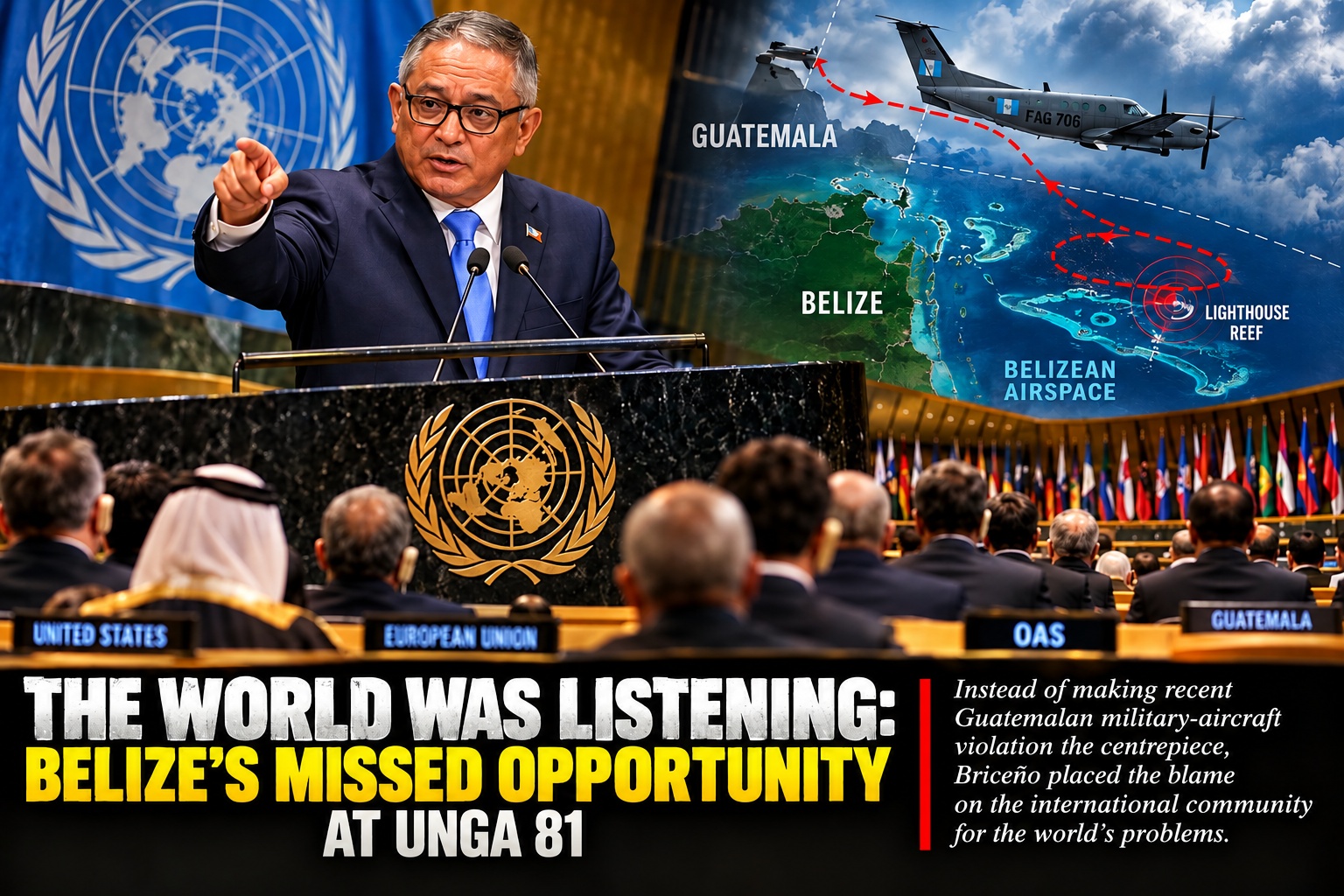
Belize's Prime Minister condemned the Guatemalan military-aircraft incursion before the United Nations. The issue is not that he remained silent. The question is whether, with Belize's sovereignty suddenly a live international issue, the country fully used the most powerful diplomatic platform it was likely to receive.
SUNDAY SPECIAL FEATURE
Belize City: Sunday 27th September 2026:
- The world was listening.
- Belize had the microphone.
- And rarely could the timing have been more consequential.
On Saturday, September 26, Prime Minister John Briceño stood before the 81st Session of the United Nations General Assembly in New York.
Barely two days earlier, according to Belizean defence authorities, a Guatemalan military aircraft had entered Belizean sovereign airspace without authorization, travelled deep into Belizean territory, circled in the vicinity of Lighthouse Reef and remained within Belizean airspace for approximately one hour and ten minutes.
- This was not a political rumour circulating on Facebook.
- It was not merely an unverified aircraft-tracking screenshot.
By Friday, Belize's own national defence authorities were publicly confirming the incursion.
Major (Ret'd) Francis Usher, Chief Executive Officer in the Ministry of National Defence and Border Security, said FAG706 entered Belizean airspace from the east at approximately 7:29 p.m. on September 24 and began circling near Lighthouse Reef. At approximately 8:07 p.m., according to Usher, the aircraft disappeared from Belize's secondary radar after its transponder stopped transmitting.
But it had not disappeared from Belize.
- Primary radar continued detecting it.
- Belizean authorities say the aircraft finally exited Belizean airspace at approximately 8:40 p.m., near the Sarstoon.
That chronology means the aircraft remained inside what Belize considers its sovereign airspace for approximately seventy minutes.
- And approximately 48 hours later, Belize's Prime Minister was standing before the world.
BRICEÑO DID NOT IGNORE GUATEMALA
- Let us establish this clearly because National Perspective Belize has no interest in manufacturing criticism where the facts do not support it.
- Prime Minister Briceño did raise the incident at the United Nations.
And his language was significant.
- He informed the General Assembly of what he called a “serious breach of international law” involving a Guatemalan military aircraft entering Belize's sovereign airspace.
- He invoked the Chicago Convention, international rules governing state aircraft, the UN Charter and Belize's territorial sovereignty.
- He connected the incident to continuing tensions involving Guatemalan state vessels and personnel in the Sarstoon.
- He demanded that Guatemala cease incursions by “air, land or sea.”
And he asked for heightened monitoring by the United Nations and the Organization of American States while the territorial dispute remains before the International Court of Justice.
Those were not insignificant words.
- They deserve to be reported accurately.
- But acknowledgement of what the Prime Minister said does not eliminate another legitimate question.
Did Belize fully exploit the moment?
- National Perspective Belize believes that is where the real discussion begins.
THIS WAS BIGGER THAN AN ITEM IN A SPEECH
- A national address to the United Nations is necessarily broad.
- Belize has legitimate interests far beyond Guatemala.
Briceño spoke about Haiti, Palestine, Cuba, Taiwan, reparatory justice, international financial reform, technological inequality, development, poverty and the vulnerabilities confronting small states.
- Those matters belong at the United Nations.
- This feature does not argue otherwise.
- Nor do we suggest that Belize should retreat from speaking about injustice elsewhere simply because it faces problems of its own.
- The question is one of diplomatic architecture and national priority.
Because this time Belize did not arrive at the United Nations merely carrying an old territorial dispute.
Belize arrived carrying a fresh incident.
A Guatemalan military aircraft had, according to Belize's own authorities, penetrated Belizean airspace.
- It allegedly remained there for approximately seventy minutes.
- It circled near Lighthouse Reef.
- Its transponder stopped transmitting.
- Primary radar continued tracking it.
- And Guatemala had not provided Belize with a satisfactory public explanation for what occurred.
That changed the context dramatically.
The incident could therefore have become much more than one segment of Belize's UN address.
- It could have become its spine.
BELIZE COULD HAVE MADE IT ABOUT EVERY SMALL COUNTRY
Imagine the diplomatic argument—not as belligerence against Guatemala, but as a defence of the international system itself.
- Belize is a country of roughly 23,000 square kilometres (8,867 square miles).
- It does not possess the military power of the United States, China, Russia or the major European states, neither of Guatemala..
- Its principal protection in the international system is therefore not overwhelming in military force.
It is law.
- International recognition.
- Treaties.
- Diplomacy.
- The Organization of American States.
- The United Nations.
And ultimately, in the present territorial dispute, the International Court of Justice.
That is precisely why the aircraft incident could have been transformed into something much larger than a Belize–Guatemala disagreement.
It could have been presented as a test of whether sovereignty means the same thing for the smallest states as it does for the largest.
Briceño himself provided the foundation when he told the Assembly: “Belize has chosen, and will always choose, law over force.”
- There was the centrepiece.
- Belize could have said to the international community:
- We are demonstrating precisely what law over force means.
- We are not responding militarily.
- We are documenting.
- We are protesting diplomatically.
- We are engaging regional institutions.
- We have placed our territorial dispute before the world's highest court.
And while that judicial process proceeds, our sovereign territory must be respected.
From there, virtually every other international subject in the Prime Minister's speech could have followed naturally.
- Palestine.
- Haiti.
- Cuba.
- Taiwan.
- Climate vulnerability.
- Reparatory justice.
- International financial inequality.
- The vulnerability of small states.
Different issues, different histories, different legal circumstances—but connected by one fundamental proposition: international rules cannot mean one thing for powerful states and something weaker for small ones.
- That could have been Belize's message to the world.
AND THE TIMING COULD HARDLY HAVE BEEN MORE POWERFUL
- Only three months ago, Belize and Guatemala jointly reaffirmed something remarkably relevant.
On June 24, 2026, both governments issued a declaration through the OAS reaffirming respect for the UN and OAS Charters, including sovereignty, territorial integrity, political independence, non-intervention, the prohibition of the threat or use of force and peaceful settlement of disputes.
- They also reiterated their commitment to international law, the ICJ process and existing Confidence-Building Measures.
Earlier, in January, the foreign ministers of Belize and Guatemala had again committed themselves to confidence-building, de-escalation, transparency and peaceful settlement through the OAS framework.
- Those were not dusty agreements buried in diplomatic archives.
- They were commitments reaffirmed this year.
- That provided Belize with an extraordinarily powerful diplomatic argument.
Belize did not need inflammatory language.
- It needed Guatemala's own signature.
- You agreed with us that sovereignty must be respected.
- You agreed that territorial integrity must be respected.
- You agreed that disputes must be settled peacefully.
- You agreed that confidence-building measures matter.
Then: Explain FAG706.
That would have been devastatingly simple diplomacy.
THE QUESTION THAT REMAINS: WHAT WAS FAG706 DOING?
National Perspective Belize will not speculate about the operational mission of that aircraft.
- There is presently insufficient publicly verified evidence to responsibly declare what its purpose was.
- But that does not make the unanswered questions disappear.
- Why did a Guatemalan military aircraft enter Belizean airspace?
- Why did it travel toward Lighthouse Reef?
- Why did it circle?
- Why did its transponder stop transmitting while Belizean authorities say it remained within Belizean airspace?
- Was the transponder deliberately disabled, as Prime Minister Briceño told the United Nations?
- What was the aircraft's mission?
- Who authorized that mission?
- Was the Guatemalan political leadership aware of the flight?
- Was Guatemala's military command aware of its location?
- Did Belize attempt to establish communications with the aircraft?
- Has Guatemala supplied Belize with its own military flight records?
And has Guatemala now formally acknowledged or denied the specific flight path identified by Belize?
- Those questions are not accusations.
- They are exactly the questions that an unexplained foreign military-aircraft incursion demands.
Guatemala's initial public response did not directly explain the reported flight. Its Defence Ministry instead stated generally that Guatemalan military operations comply with national and international law.
That does not resolve the central question: What was FAG706 doing in Belizean airspace?
THERE IS ALSO A DETAIL BELIZE SHOULD CORRECT
- Precision matters especially when a sovereign state places an international-law complaint before the United Nations.
- Published accounts quoting the Prime Minister's speech have him telling the General Assembly that the incident occurred on September 23.
- Belize's defence authorities, however, place the incursion on the evening of September 24, 2026.
That may prove to be nothing more than a drafting or speaking error.
But the official record should be precise.
If Belize intends this incident to form part of its diplomatic record with Guatemala, the OAS, the UN or any future documentation associated with the ICJ process, there should be no ambiguity about something as elementary as the date.
THIS IS NOT A CALL FOR CONFRONTATION
- There will inevitably be those who interpret any demand for a firmer Belizean diplomatic response as warmongering.
- That would miss the argument entirely.
- Belize has far more to gain from disciplined diplomacy than theatrical confrontation.
- The territorial, insular and maritime dispute is before the International Court of Justice.
Belize and Guatemala have established mechanisms for communication.
The OAS maintains an institutional role in preventing incidents, conducting verification when requested, facilitating dialogue and supporting confidence-building between both countries.
- Those mechanisms exist precisely because miscalculation between neighbouring states can become dangerous.
The objective therefore should not be escalation.
- It should be documentation, verification, accountability and prevention.
- Belize does not need to shout louder.
- Belize needs to build an impeccable record.
FACEBOOK IS NOT FOREIGN POLICY — BUT THE FRUSTRATION SHOULD NOT BE DISMISSED
- Much of the anger following the aircraft incident has inevitably migrated to social media.
- That reaction should be interpreted cautiously.
- Facebook comments are not an opinion poll, and the loudest voices online cannot automatically be presented as the voice of an entire country.
- But neither should the frustration simply be ridiculed as “Facebook warriors.”
- Ordinary Belizeans cannot issue diplomatic notes.
- They cannot summon ambassadors.
- They cannot request OAS verification.
- They cannot demand military flight records from Guatemala.
- They cannot place radar evidence before international organizations.
- They cannot establish national defence protocols.
Those responsibilities belong to the State.
For citizens, public expression is therefore one of the few immediate mechanisms available for demanding explanations from the institutions acting in their name.
Government does not have to govern according to Facebook.
- But it does have an obligation to keep the population adequately informed when national sovereignty is involved.
WHAT BELIZE SHOULD BE ASKING FOR NOW
- The opportunity at UNGA may have passed.
- The diplomatic opportunity has not.
- Belize should pursue a clear explanation from Guatemala of FAG706's mission and flight path.
- The radar evidence should be preserved meticulously.
- The relevant international and regional mechanisms should be appropriately informed.
- The OAS framework should be utilized wherever its verification and confidence-building mandate applies.
- And Belize should determine whether additional bilateral protocols are necessary to prevent another military-aircraft incident.
There may be operational information that legitimately cannot be released publicly for national-security reasons.
- That is understandable.
- But national security cannot become a blanket answer preventing Belizeans from knowing the fundamental facts of an incident involving their country's sovereign territory.
Government can protect sensitive capabilities while still explaining what occurred, what diplomatic steps were taken, what response Guatemala provided and what measures are being pursued to prevent repetition.
THE WORLD WAS LISTENING
Prime Minister Briceño did not remain silent.
- He condemned the incursion.
- He invoked international law.
- He demanded that incursions cease.
- He called for heightened UN and OAS monitoring.
- Those facts belong in any fair account of his address.
But National Perspective's question remains.
- What if Belize had gone further—not in hostility, but in diplomacy?
- What if the Prime Minister had taken those seventy extraordinary minutes over Belize and made them the lens through which the world was asked to understand the vulnerability of small states?
- What if Belize had placed its radar evidence, its restraint, its reliance on international law and its confidence in the ICJ process at the heart of the speech?
What if Belize had told the international community: This happened to us forty-eight hours ago.
- This is why small states need the United Nations.
- This is why the OAS matters.
- This is why international law matters.
- This is why sovereignty cannot depend upon the size of a country's military.
And then Belize could have spoken about Palestine.
- Haiti.
- Cuba.
- Climate change.
- Reparations.
- Development.
- Technology.
- International finance.
Not as disconnected subjects, but as components of one coherent argument: THE RULES MUST PROTECT THE SMALL AS WELL AS THE POWERFUL.
That was the opportunity.
- Not an opportunity to threaten Guatemala.
- Not an opportunity to inflame Belizeans.
- Not an opportunity for partisan politics.
An opportunity to transform an alarming incident involving one small Central American country into an international argument about sovereignty, law and the protection of every small state represented in that hall.
- Prime Minister John Briceño spoke for Belize.
- He raised the violation.
- He placed it on the international record.
That matters.
But for one extraordinary morning in New York, Belize possessed something that small countries rarely possess: the incident, the evidence, the timing and the world's microphone—all at once.
The world was listening.
Belize spoke.
The question history may eventually ask is whether, at that particular moment, we said enough.
By: Omar Silva – Editorial Director @ www.nationalperspectivebz.com
NATIONAL PERSPECTIVE BELIZE
- Log in to post comments