WHO DEFENDS BELIZE? FAG706 Exposed a Question Bigger Than One Guatemalan Military Aircraft
FAG706 Exposed a Question Bigger Than One Guatemalan Military Aircraft
Belize does not need to outgun Guatemala. But sovereignty cannot begin and end with a protest note.
SPECIAL ANALYSIS
Belize City: Saturday 26th September 2026: A Guatemalan military aircraft entered Belizean airspace.
According to Belize's own Ministry of National Defence, it was not there for a few accidental seconds.
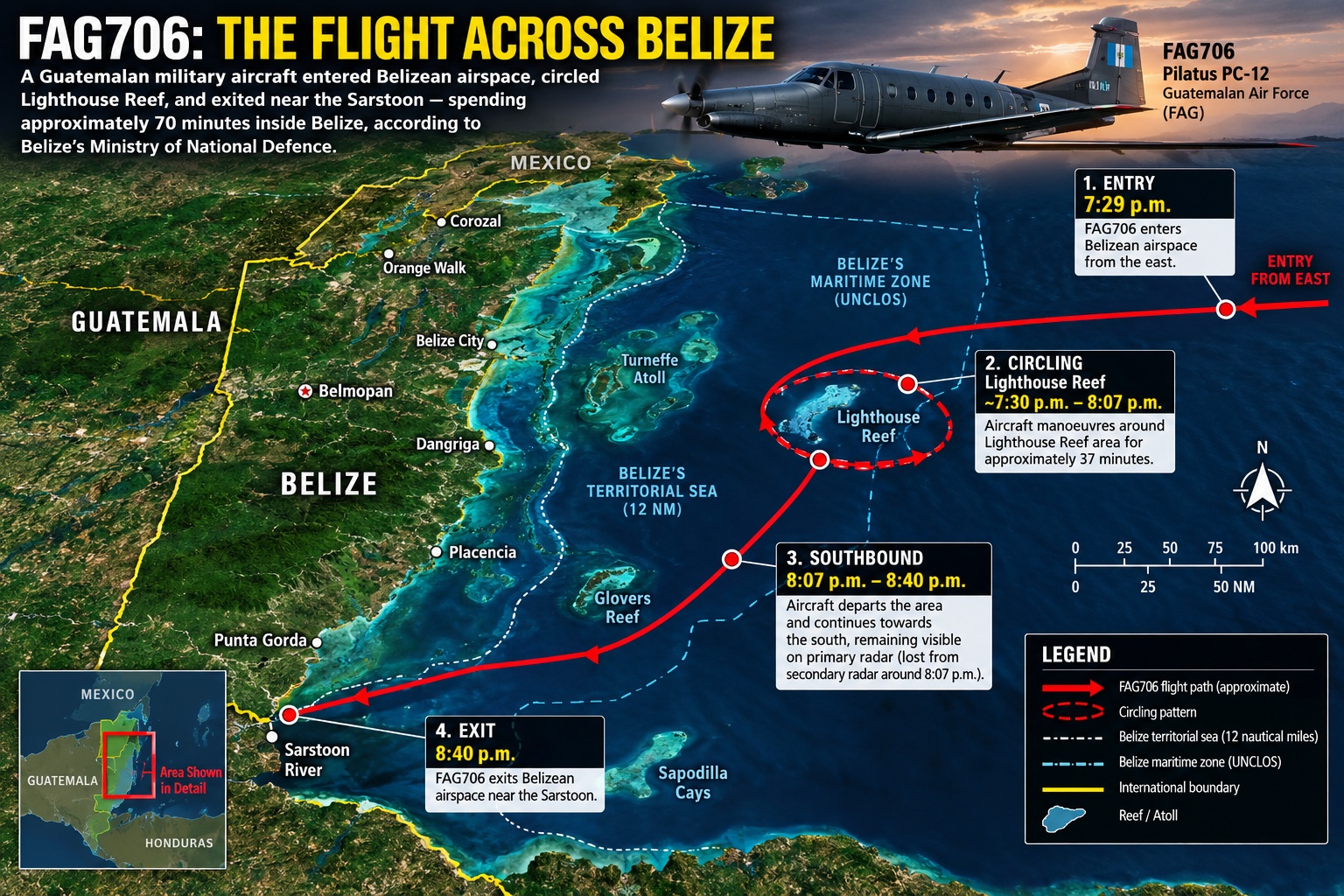
It entered from the east at approximately 7:29 p.m. on September 24, maneuvered around the Lighthouse Reef area, disappeared from secondary radar at approximately 8:07 p.m., remained detectable by Belize's primary radar, and finally departed Belizean airspace around 8:40 p.m. near the Sarstoon.
- Approximately seventy minutes.
- Belize says the flight was not authorized. Defence CEO Francis Usher said the aircraft appeared to be circling “as if though they were looking for something.” Foreign Affairs says Belize will provide Guatemala with coordinates and locations and demand an explanation.
- That is where the easy story ends.
The difficult story begins with one question: WHO DEFENDS BELIZE?
- Not who fires the first shot.
- Not why the Belize Defence Force did not scramble fighter aircraft Belize does not possess.
- And certainly not whether Belize should engage in reckless military confrontation with a neighbour possessing vastly greater conventional military resources.
Those would be distractions.
The real question is whether, in 2026, Belize possesses the intelligence, surveillance, early-warning, communications, diplomatic and international security architecture necessary to know what is approaching this country before it gets here — and to respond while an incident is unfolding rather than reconstructing it afterwards.
- That is a question Belizeans deserve answered.
GUATEMALA DID NOT GIVE BELIZE THE ANSWER
- Guatemala's first public response deserves very careful reading.
- Its Ministry of National Defence referred to information circulating in Belizean media and social networks about the alleged flight around Lighthouse Reef and Caye Caulker.
- But the communiqué did not publicly provide the aircraft's flight plan.
- It did not explain FAG706's mission.
- It did not provide its coordinates.
- It did not explain why a Guatemalan military aircraft appeared where Belize says it appeared.
Most importantly, the statement did not directly say: FAG706 did not enter Belizean airspace.
Instead, Guatemala declared broadly that all activities and operations of the Guatemalan Army are conducted in strict accordance with the national and international legal framework, while emphasizing professionalism, discipline and transparency.
Fine.
Then Belize should ask the obvious question: WHICH LAW?
- If Guatemala contends FAG706 never entered Belizean sovereign airspace, it should say so plainly and provide the flight data supporting that position.
- But if Guatemala accepts that its military aircraft travelled through the airspace Belize considers sovereign territory while maintaining that the operation complied with “national and international law,” then Guatemala should explain the international legal basis upon which it makes that assertion.
Those are profoundly different positions.
- Belize should not allow them to disappear inside diplomatic language.
THE FLIGHT PATH MATTERS
There is another reason this cannot be dismissed as an ordinary aviation incident.
- According to Belizean authorities, FAG706 did not simply clip Belize's western border.
- It reportedly entered from the east.
- It manoeuvred around Lighthouse Reef.
- It travelled through Belizean airspace.
And it eventually exited in the south around the Sarstoon.
That geography matters.
Belize and Guatemala are before the International Court of Justice over Guatemala's territorial, insular and maritime claim.
National Perspective Belize will therefore not declare, without evidence, that FAG706 was “remapping Belize.”
- But neither should Government dismiss the question.
- Belize should determine exactly what equipment was aboard FAG706.
- What was its mission?
- What cameras, sensors or surveillance equipment, if any, were operating?
- What were its altitude, speed and coordinates during those circuits?
- What information was collected?
- Why Lighthouse Reef?
- Why that flight path?
And why the Sarstoon?
Those are not conspiracy theories.
They are questions any serious sovereign state should ask when an unauthorized foreign military aircraft spends approximately seventy minutes inside its airspace.
BUT HERE IS THE QUESTION CLOSER TO HOME
- Where was Belize's intelligence architecture?
- We are not asking where were the guns.
- Where was the information?
- When did Belize first know FAG706 was approaching?
- When did Belize know it was a Guatemalan military aircraft?
- When did BDF headquarters at Price Barracks know?
- When was the Ministry of National Defence informed?
- When was Foreign Affairs informed?
Was Belize's National Security Council notified while the aircraft was still airborne?
- Was Guatemala contacted through established military-to-military channels while the aircraft was still inside Belizean airspace?
- Was the OAS Office in the Adjacency Zone contacted?
- Were Belize's international security partners asked for intelligence, identification or tracking assistance?
- Did any partner already possess information that could have been shared with Belize?
And, most importantly: DID BELIZE KNOW WHAT WAS HAPPENING WHILE IT WAS HAPPENING?
Those questions matter far more than political theatre about whether the BDF should somehow have intercepted a foreign military aircraft. We have nothing to incept the Guatemalan military aircraft with.
Belize is a small state.
Our defence strategy must therefore begin with something more attainable and arguably more valuable than matching Guatemala weapon for weapon: KNOWLEDGE.
- A small country may not be able to control every military development around it.
- But it can build systems designed to see, hear, identify, document, communicate and mobilize international support rapidly.
- The first weapon of a small state is situational awareness.
AND BELIZE IS NOT SUPPOSED TO BE STANDING ALONE
- This is where the incident becomes even harder to explain.
From August 31 to September 2 — barely three weeks before the FAG706 incident — OAS Secretary General Albert Ramdin and representatives of the Group of Friends of Belize and Guatemala visited the Adjacency Zone.
- Belize Foreign Minister Francis Fonseca and Guatemalan Foreign Minister Carlos Ramiro Martínez participated.
- The delegation included representatives from countries including Mexico, France, Germany, Italy, Spain, Türkiye, Panama and the European Union.
The stated purposes included assessing implementation of the Confidence-Building Measures, receiving briefings concerning recent developments and strengthening international technical and financial support for the OAS Mission.
The OAS says the existing Belize-Guatemala mechanism maintains a permanent communications channel between the foreign ministries and facilitates regular coordination between the two countries' armed forces.
- So Belizeans have every right to ask:
- What came out of those meetings?
- What threats were assessed?
- What security concerns did Belize raise?
- What commitments were made?
- What weaknesses were identified?
- What information-sharing mechanisms exist?
- What happens when one country's military aircraft unexpectedly appears inside the other's airspace?
And what exactly did all those confidence-building arrangements accomplish on the night of September 24?
- Those questions are not attacks on diplomacy.
- They are tests of whether diplomacy is working.
A PROTEST NOTE IS NECESSARY — BUT IT IS NOT A DEFENCE POLICY
- Belize should protest formally if its investigation establishes an unauthorized military incursion.
- That written protest matters.
- It establishes Belize's position.
- It creates a diplomatic record.
- It prevents silence from being interpreted as acquiescence.
And with an international territorial case underway, documentation should be meticulous.
But Belizeans should understand the difference between documenting an incident and possessing the capacity to deter, anticipate or rapidly respond to another one.
A protest note tells Guatemala: We object to what happened.
A functioning national-security architecture should also be capable of saying: We saw you coming. We identified you. We tracked you. We knew what you were doing. Our partners knew. And the appropriate authorities were responding before you left.
Those are very different levels of national preparedness.
BELIZE IS ENTERING A MORE DANGEROUS WORLD
- And this is why FAG706 cannot be treated as yesterday's news.
- The international environment around Belize is changing.
- Our territorial dispute remains before the ICJ.
- Military and security relationships in Central America are evolving.
- Major powers are competing for influence.
- Transnational organized crime operates across borders.
- Our economy remains deeply exposed to external energy, trade and financial shocks.
- Climate disasters can suddenly become national-security emergencies.
- Technology has transformed surveillance, intelligence and warfare.
And Belize cannot assume that because diplomacy preserved stability yesterday, the same arrangements automatically guarantee security tomorrow.
- None of this means Belize should militarize itself recklessly.
- It means Belize should prepare intelligently.
And preparation begins with telling the Belizean people what their country is preparing for.
GOVERNMENT CANNOT ASK BELIZEANS TO TRUST WHAT THEY CANNOT SEE
- National security obviously requires intelligence gathering capability and secrecy.
- Operational intelligence cannot be published like a Cabinet press release.
- Sources must be protected.
- Capabilities cannot simply be advertised to potential adversaries.
- But national-security secrecy is not the same thing as national-security silence.
Government needs to tell Belizeans what doctrine guides their country's defence.
- It can explain what agencies are responsible for early warning.
- It can explain what regional and international arrangements exist.
- It can tell the public whether lessons have been learned.
- It can tell Belizeans whether deficiencies identified after an incident are being corrected.
And it should explain what the Government means when it says violations of Belizean sovereignty will be “countered appropriately.”
- Belizeans do not need operational secrets.
- They need confidence that somebody has a plan.
THIS IS NOT ABOUT THE BDF SOLDIER
National Perspective Belize will not place responsibility for decades of national-security policy at the feet of the ordinary Belize Defence Force soldier.
- The BDF operates with the resources, equipment, intelligence and political direction the State provides.
- If Belize lacks capabilities, that is a question of national policy, investment, planning and political leadership.
- Do not ask a soldier to compensate with courage for capabilities the State never built.
- Do not ask a radar operator to create intelligence that was never shared.
And do not expect diplomacy after an incident to substitute permanently for preparedness before one.
- The responsibility ultimately belongs where national policy is made.
SO TELL BELIZE WHAT HAPPENED
- Government should publish as much of the FAG706 timeline as national security permits.
- Tell us when the aircraft was first detected.
- Tell us when it was identified.
- Tell us when command was informed.
- Tell us whether Guatemala was contacted in real time.
- Tell us whether international partners were contacted.
- Tell us what the OAS mechanism did.
- Tell us whether intelligence was received from another country.
- Tell us what Guatemala eventually says the mission was.
- Tell us what Belize learned.
And tell us what changes tomorrow morning because of what happened Thursday night.
That is accountability.
THE BIGGER WARNING
FAG706 may eventually have an explanation.
- Perhaps Guatemala will produce flight information and an account capable of resolving some of these questions.
- Evidence must determine that.
- But even the most benign eventual explanation cannot erase the national-security question the incident has exposed:
WAS BELIZE PREPARED?
Because the next warning may not be an aircraft slowly drawing a line across a radar screen.
- It could arrive at sea.
- It could emerge along the border.
- It could involve organized crime.
- It could be an energy emergency.
- It could be a cyberattack.
- It could be an economic shock.
- It could be a natural disaster compounded by regional instability.
- Or it could be something Belize has not yet imagined.
That is what national preparedness is for.
- Belize does not need leaders who frighten its population.
- Neither does it need a population kept comfortably in the dark.
Between panic and silence lies the responsibility of government: INTELLIGENCE.
- PREPAREDNESS.
- TRANSPARENCY.
- ALLIANCES.
- REAL LEADERSHIP.
Belize cannot outgun every potential threat.
- It does not have to.
But a sovereign nation must strive to ensure that nobody enters its land, territorial waters or airspace believing that Belize will only discover the full story after they have gone.
- A diplomatic note has its place.
- An ICJ case has its place.
- The OAS has its place.
- International friendships have their place.
But none of them relieves the Government of Belize of its most fundamental responsibility:
- KNOW WHAT IS COMING.
- KNOW WHEN IT ARRIVES.
- KNOW WHAT TO DO WHEN IT GETS HERE.
Because sovereignty is more than the lines Belize draws on a map.
Sovereignty is the capacity, preparedness and national will to know when those lines have been crossed.
By: Omar Silva – Editorial Director @ www.nationalperspectivebz.com
NATIONAL PERSPECTIVE BELIZE
- Log in to post comments