Honoured in Ceremony, Forgotten in Structure: Firefighters Serve Without a Fire Station
By: Omar Silva – Editor/Publisher
National Perspective Belize – Digital 2026
Belize City: Wednesday 18th February 2026
Feature Article
Just days ago, twenty-one members of Belize’s National Fire Service were honored for long service—some for as many as twenty-five years on the front line.
They were praised for sacrifice, dedication, and commitment to protecting lives and property.
But behind the applause lies a stark and uncomfortable truth:
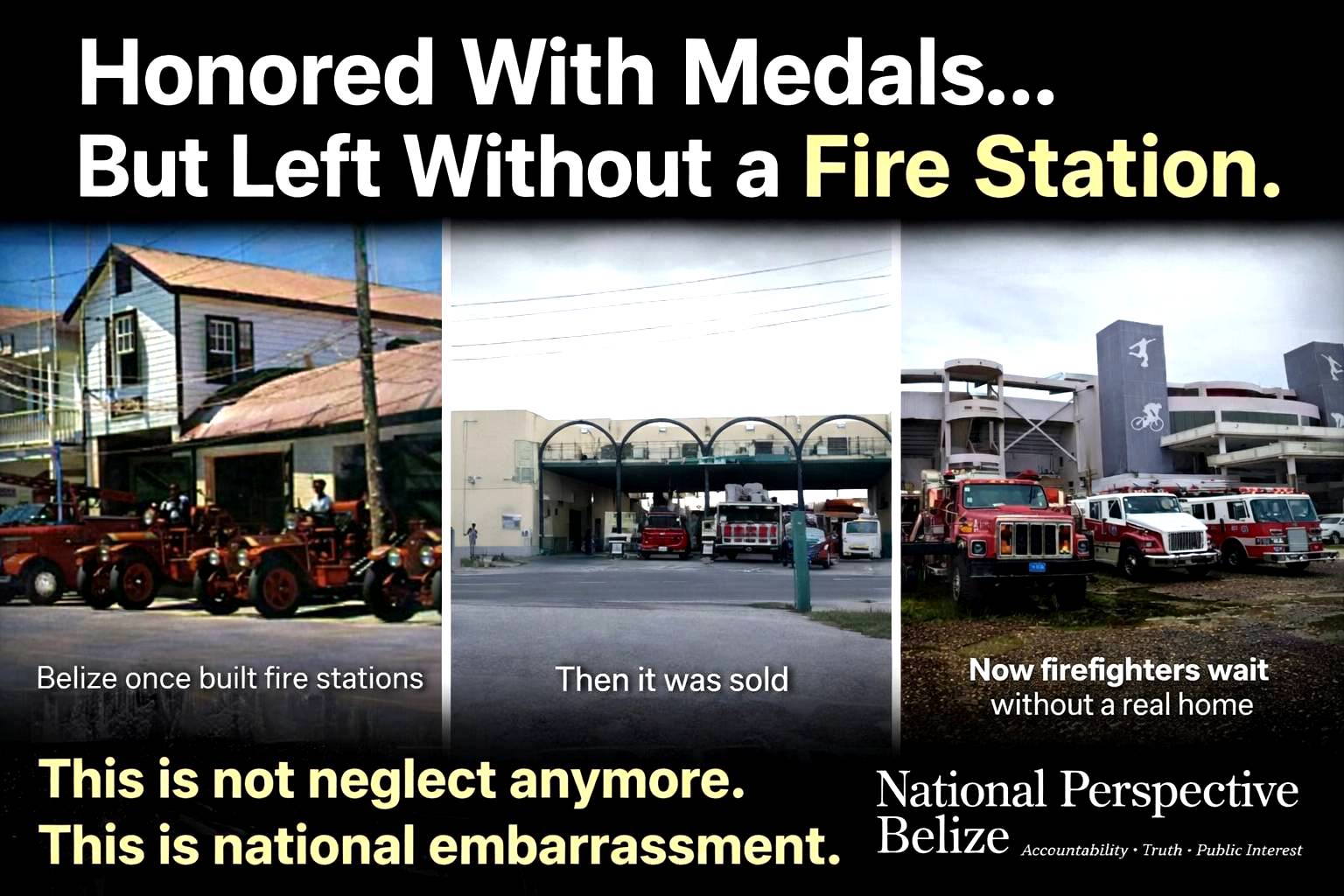
Belize City, the country’s largest urban center, still does not have a proper modern fire station.
The men and women entrusted with responding to fires, accidents, and national emergencies continue to operate from facilities that fall far short of what a national emergency service requires.
And this is not a new problem. It is the result of years of decisions—and years of promises.
The Station That Was Sold
For decades, the main fire station in Belize City stood on Cleghorn Street.
That property was sold during the previous UDP administration to make way for parking associated with Atlantic Bank Limited.
At the time, questions were raised about whether adequate replacement infrastructure had been secured before the sale.
The reality today suggests that it had not.
The result is a national emergency service operating without the kind of permanent infrastructure expected in any modern state.
A Promise Made—And Forgotten
During the 2020 general election campaign, the People’s United Party promised, under Plan Belize, that a modern fire station would be constructed.
Five years later:
- The promised national headquarters has not materialized.
- Plan Belize 2.0 makes little mention of the issue.
- Firefighters continue to operate with limited equipment and infrastructure.
Even as firefighters are honored publicly, the structural investments needed to protect Belizeans remain pending.
Three Engines, One City, Growing Risk
Reports indicate that:
- Only a small number of fire engines remain fully operational.
- Belize City continues to expand.
- High-density housing, commercial structures, and industrial areas increase fire risk every year.
In modern urban planning, fire protection is considered critical infrastructure—no less important than hospitals, policing, or electricity.
Yet Belize’s capital operates with resources that would strain even a small town.
Recognition Without Reinforcement
At the ceremony, Minister Henry Charles Usher acknowledged the dedication of firefighters and stated that government intends to invest in the service and eventually build a national headquarters.
These words were welcomed by those present.
But firefighters and the public alike have heard promises before.
And infrastructure, unlike speeches, cannot be built with intention alone.
The Firefighters Themselves
Fire Chief Colin Gillet highlighted something important:
Many firefighters have remained in service for decades, even during difficult conditions.
That level of dedication reflects a strong professional culture within the National Fire Service.
But dedication cannot substitute for:
- equipment,
- infrastructure,
- and institutional planning.
No emergency service should depend solely on the goodwill of its officers.
A Question of National Priorities
This situation raises a larger national question:
What does it say about governance when:
- luxury developments are approved quickly,
- administrative buildings are constructed,
- but critical emergency infrastructure is delayed year after year?
Fire protection is not ceremonial.
It is life-saving infrastructure.
Every minute lost responding to a fire can mean:
- lives lost,
- homes destroyed,
- businesses ruined.
A National Safety Issue, Not a Political Issue
This problem did not begin with one administration alone.
The sale of the original station occurred under one government.
The failure to rebuild under another.
This makes it not merely a political failure—but a systemic one.
Belize has struggled for decades to plan infrastructure in a way that matches national growth.
The Real Meaning of the Awards
The long-service awards presented last week represent something deeper than recognition.
They represent:
- decades of duty under difficult conditions,
- years of service without the facilities firefighters deserve,
- and a quiet resilience that has kept the country safe despite institutional neglect.
But recognition must eventually be matched by action.
Otherwise, ceremonies risk becoming substitutes for solutions.
Conclusion
Firefighters are often the last line between order and catastrophe.
They do not ask whether a building belongs to the rich or poor before entering a burning structure.
They go in because that is their duty.
The nation’s duty, in return, is to ensure they are equipped, housed, and supported to do their job safely and effectively.
Belize cannot continue to rely on courage alone.
Courage must be backed by concrete, steel, planning—and political will.
- Log in to post comments