FROM DIGITAL COURTS TO DIGITAL JUSTICE The Waiting Period Begins at the Magistrates' Court
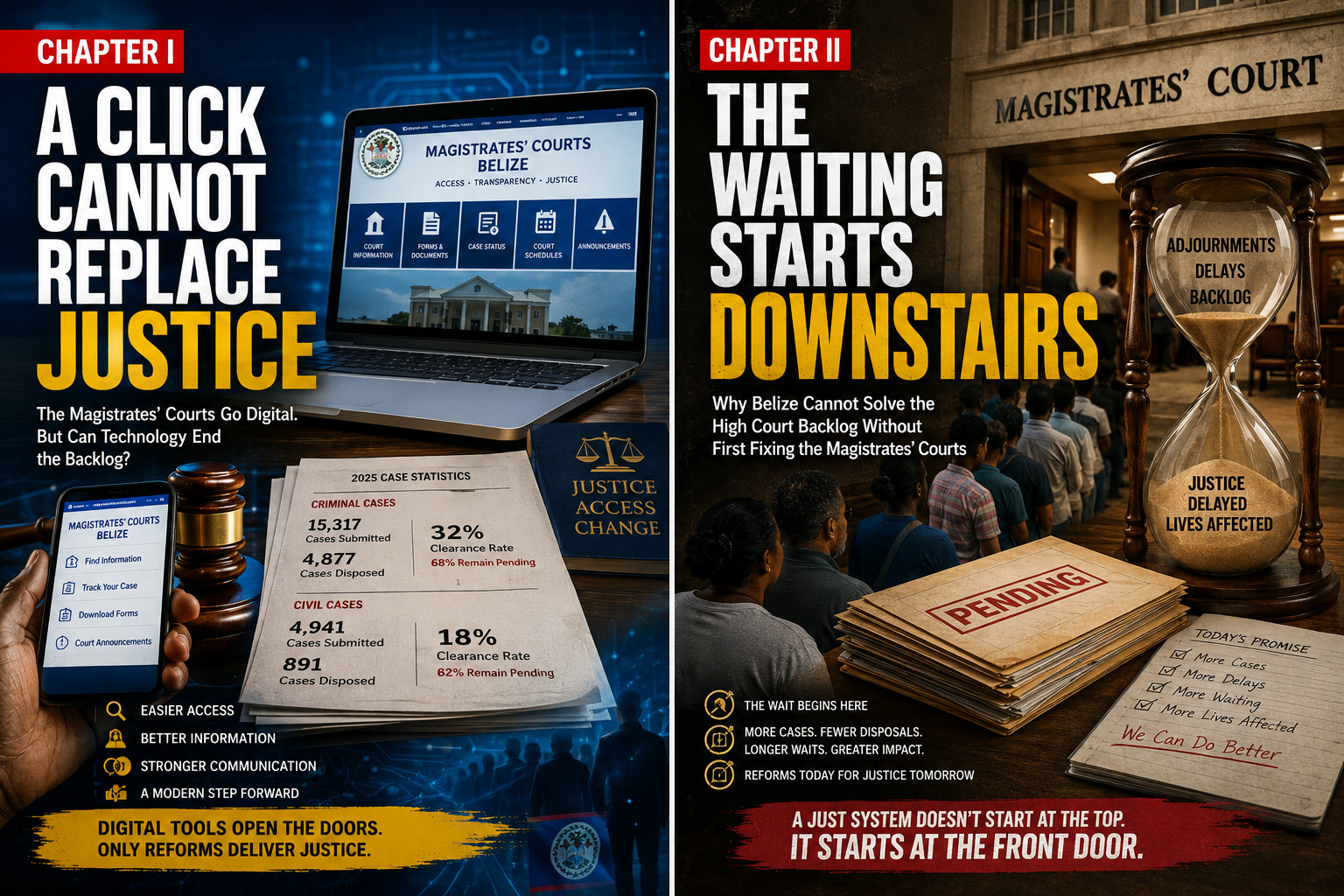
Belize City: Saturday 8th August 2026: The launch of a website may make the Magistrates' Courts easier to reach electronically.
But Belize must confront a considerably harder question:
How long does it take a person who enters the Magistrates' Court system to actually move through it?
That is where the national conversation about judicial backlog should begin.
A criminal defendant does not suddenly experience delay when a case reaches the High Court. The waiting period may have begun much earlier—from the first appearance before a magistrate, through disclosure, adjournments, preliminary procedures and other stages required before a matter can progress.
And every delay accumulated at the bottom of the judicial structure can eventually become pressure higher up.
The Magistrates' Court Is the Pressure Point
Consider the figures you provided for 2025.
15,317 criminal cases entered the Magistrates' Court system. Only 4,877 were disposed of during the reporting period.
That 32% clearance rate should immediately provoke a much larger institutional question:
What happens to the cases that are not disposed of?
- They do not disappear when the calendar changes.
To the extent they remain active, they become part of the workload carried forward while thousands of new matters continue entering the system.
The same concern becomes even sharper with civil cases: 4,941 submitted and only 891 disposed of—a clearance rate of approximately 18%.
- A new website can help citizens understand that system.
- It cannot by itself increase those clearance rates.
Follow the Journey of One Criminal Case
This is where National Perspective Belize can help readers understand what "backlog" actually means.
- Imagine someone is charged with a serious offence.
- The individual appears before the Magistrates' Court.
- The matter is adjourned.
The prosecution may require additional time.
- Disclosure may not yet be complete.
- A witness may be unavailable.
- Counsel may request another date.
- The court's calendar may already be overcrowded.
Another adjournment follows.
- Months accumulate.
- Then years can accumulate.
Meanwhile, depending on the circumstances, an accused person may be on remand awaiting the progression of a case in which guilt has not yet been established.
That distinction is fundamental.
Remand is not punishment following conviction.
- It is detention before the final determination of guilt.
- Consequently, prolonged delay is not merely an administrative inconvenience. It can engage fundamental questions of liberty, due process and the constitutional promise of a fair hearing within a reasonable time.
And There Is Another Side: The Victim
Judicial delay should never be examined exclusively from the perspective of the accused.
- A victim may also wait years.
- Families wait.
- Witnesses wait.
- Memories deteriorate.
- Evidence becomes harder to present.
- People relocate or die.
Eventually, cases can become more difficult to prosecute precisely because the system took too long to deal with them.
- So both sides can suffer from the same institutional weakness.
- The accused waits for justice.
- The victim waits for justice.
- And society waits for certainty.
This Is Why the 32% Figure Matters
A clearance rate is not simply an interesting statistic in an annual report.
- It can function like the vital signs of the justice system.
- If new cases consistently arrive substantially faster than existing cases are resolved, technology alone cannot solve the problem.
- Belize would need to examine the entire pipeline:
Police investigation → prosecution → Magistrates' Court → disclosure → adjournments → committal or other applicable procedures → High Court → trial.
The question therefore becomes not simply:
- "How many cases are before the courts?"
but:
- "Where exactly is the time being lost?"
That requires data Belizeans should be able to see.
- How many adjournments occur because police files are incomplete?
- How many because prosecution is not ready?
- How many because defence counsel is unavailable?
- How many because witnesses fail to appear?
- How many because there are insufficient magistrates or courtrooms?
- How long, on average, does a criminal case remain at Magistrates' Court level?
And perhaps most importantly:
How many people currently on remand have been waiting one year, two years, three years, four years—or longer—for their cases to reach final determination?
- Those numbers would tell Belize considerably more about the condition of justice than the number of visitors to a new website.
That Is Where Digitization Could Become Transformative
There is, however, a tremendous opportunity here.
The website could become the public-facing doorway to something much more ambitious: a genuinely digital case-management system.
Imagine a justice system where every case receives a digital timeline.
The system records when charges were filed, when disclosure became due, why each adjournment occurred, which agency caused a delay, how long an accused person has been on remand and when statutory or administrative time thresholds are approaching.
- Cases approaching unacceptable waiting periods could automatically be flagged.
- Court administrators could identify bottlenecks before they become multi-year delays.
That would move Belize from merely digitizing information to using technology to manage justice.
- And that distinction is enormous.
CHAPTER II
THE WAITING STARTS DOWNSTAIRS
Why Belize Cannot Solve the High Court Backlog Without First Fixing the Magistrates' Courts
The launch of Belize's new Magistrates' Courts website represents a welcome step into the digital age. It promises greater accessibility, easier navigation of court services, and a more modern interface between the judiciary and the public.
Those are important achievements.
But there is another side of the conversation that technology alone cannot answer.
It is a question that thousands of Belizean families have quietly asked for years:
How long must justice wait?
For many citizens, the journey through Belize's justice system does not begin in the High Court.
- It begins downstairs.
- It begins in the Magistrates' Court.
- It begins with a first appearance before a magistrate.
- And for many, that is where the waiting starts.
The Front Door of Justice
The Magistrates' Courts are often described as the foundation of Belize's judicial system because they are where the overwhelming majority of criminal prosecutions and civil disputes first enter the courts.
- Every day, magistrates deal with bail applications, remand hearings, domestic violence matters, maintenance disputes, traffic offences, preliminary criminal proceedings and numerous other matters affecting ordinary Belizeans.
- It is therefore impossible to understand the efficiency of the national justice system without first understanding what happens there.
- When the foundation slows, every level above it eventually feels the pressure.
When One Adjournment Becomes Ten
Every court must occasionally adjourn cases.
That is neither unusual nor improper.
- A witness may be unavailable.
- The prosecution may require additional disclosure.
- Defence counsel may need time to prepare.
- Forensic reports may still be outstanding.
- A magistrate may have a crowded docket.
- These realities exist in every justice system.
The concern arises when occasional adjournments become repeated adjournments.
- Weeks become months.
- Months become years.
- Another court date is scheduled.
- Another postponement follows.
- The parties return again.
- And again.
For many Belizeans, the phrase "come back next month" has become an all-too-familiar part of their experience with the justice system.
Eventually, delay ceases to be an isolated procedural necessity and begins to resemble a structural condition.
Waiting Is Experienced by Everyone
When discussions focus on court backlogs, public attention often centres on the accused.
But judicial delay affects every participant in the courtroom.
- The accused waits for the opportunity to answer the allegations.
- The victim waits for accountability and closure.
- Witnesses wait to give evidence while memories gradually fade.
- Families wait for certainty.
- Employers wait.
- Businesses wait.
- Communities wait.
Justice delayed is therefore not simply a legal issue.
- It is a social issue.
- It is an economic issue.
- It is a national governance issue.
The Cost of Delay
- Delay carries consequences that cannot always be measured in statistics.
- Victims may lose confidence that the system will ever provide closure.
- Witnesses relocate, become unavailable or struggle to recall events with precision.
- Evidence can become more difficult to present.
- Law enforcement officers are repeatedly required to revisit matters that should already have been concluded.
Citizens begin to lose confidence not merely in individual cases, but in the ability of institutions to deliver justice within a reasonable time.
Confidence, once lost, is difficult to restore.
Technology Is a Tool—Not the Solution
- This is why Belize should welcome the new website while remaining realistic about what it can accomplish.
- A website can explain procedures.
- It can publish forms.
- It can improve communication.
- It can reduce unnecessary visits to the courthouse.
- It can make information easier to obtain.
What it cannot do is hear evidence.
- It cannot reduce repeated adjournments.
- It cannot prepare police files.
- It cannot increase the number of magistrates.
- It cannot ensure that witnesses appear.
- It cannot write judgments.
Technology strengthens institutions only when the institutions themselves are adequately resourced, effectively managed and committed to continuous improvement.
Measuring Real Progress
The true success of judicial modernization will not be measured by how many people visit the website.
It will be measured by different questions.
- Are cases moving more quickly through the system?
- Are adjournments decreasing?
- Has the average time to dispose of a matter been reduced?
- Are fewer people waiting years for their day in court?
- Are victims receiving closure sooner?
- Are constitutional guarantees being fulfilled within a reasonable time?
Those are the indicators that define meaningful reform.
Beyond Digitization
Belize has taken an encouraging first step.
The challenge now is to ensure that digitization becomes more than an improvement in public access.
It should become the beginning of a broader transformation that examines case management, judicial resources, prosecution capacity, legal aid, courtroom scheduling, and institutional accountability across the entire justice system.
Because the waiting does not begin in the High Court.
- It begins downstairs.
And until the delays experienced at the Magistrates' Courts are systematically reduced, the backlog confronting the wider justice system will remain difficult to overcome.
A modern website may open the courthouse to the public with the click of a button.
Only an efficient and adequately supported justice system can open the door to timely justice.
By: Omar Silva: Editor/Publisher @ www.nationalperspectivebz.com
- Log in to post comments