“The Port of Entry or the Port of Leakage?”
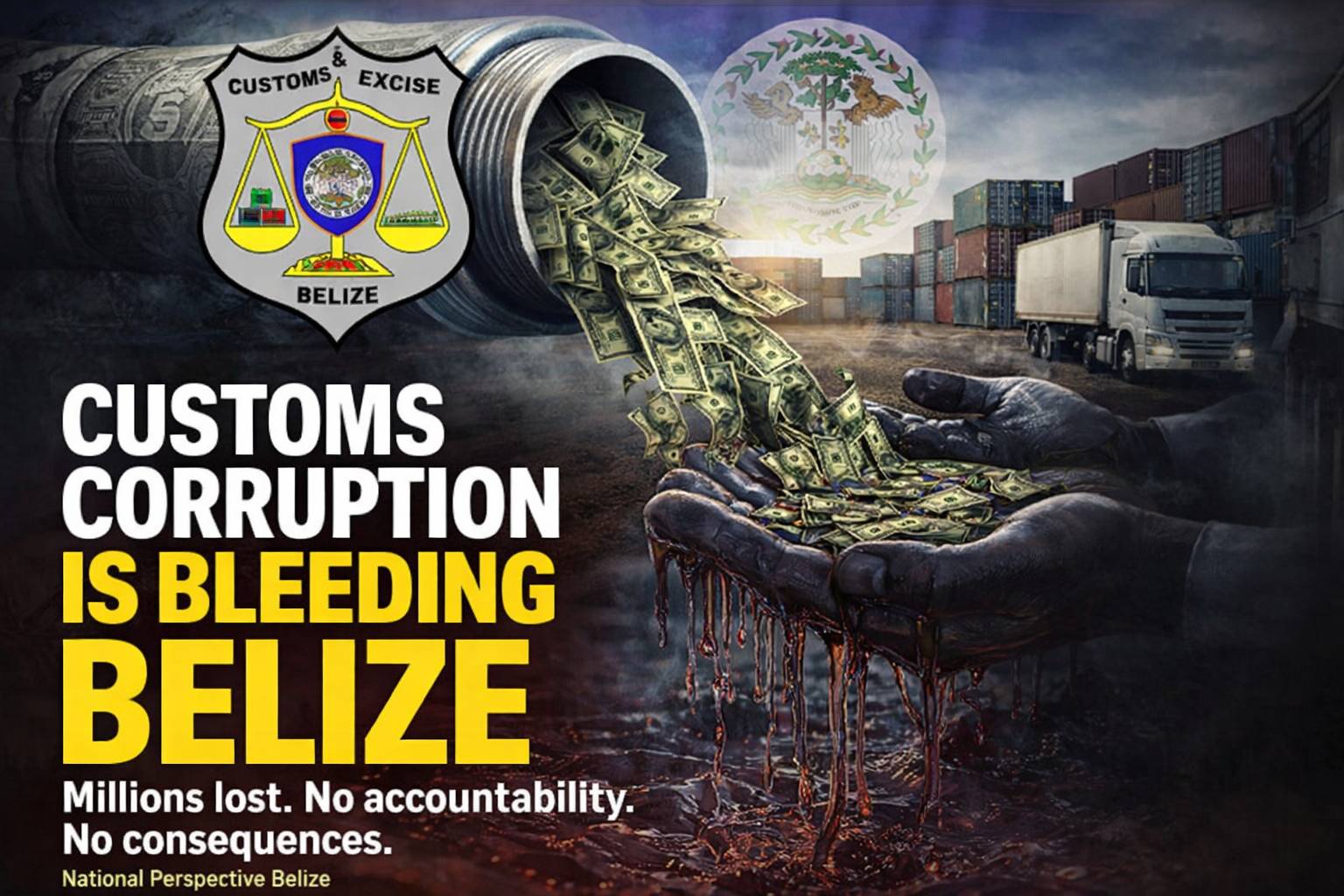
…How Decades of Corruption at Customs Continue to Drain Belize
By: Omar Silva – Editor/Publisher
NATIONAL PERSPECTIVE BELIZE Digital 2026
Belize City: Friday 13th February 2026
Feature Analysis
There are problems that appear suddenly—and there are problems that governments inherit, recognize, and then quietly allow to continue.
Corruption at Belize’s Customs Department falls squarely into the second category.
For more than two decades, senior officials have openly acknowledged that the department was deeply compromised. As far back as the early 2000s, a former Minister of Finance publicly warned that Customs was “infested with corruption” and proposed modernization measures, including tighter valuation systems and improved monitoring equipment.
Those reforms never fully materialized.
They were resisted, delayed, and quietly buried.
And today, Belize is paying the price.
The “Big Bite” That Became a System
Recent reports have exposed what insiders have long known:
A network of select brokers and cooperating officials has been extracting enormous informal payments—so large that in some cases private actors reportedly collected more money than the Government of Belize itself.
Think about that for a moment.
The state—whose duty it is to collect revenue for hospitals, schools, and infrastructure—was receiving less than the middlemen operating around it.
That is not merely corruption.
That is parallel taxation by private interests.
And it has reportedly been happening for years.
Acknowledging the Problem—But Only Looking Forward
The Prime Minister has acknowledged that the system was flawed and that abuses occurred.
But instead of announcing investigations, audits, or prosecutions, the official narrative has largely been:
“That was in the past. We are moving forward.”
This raises a fundamental question:
If millions were diverted from the public purse,
who is accountable for those losses?
Because public money does not simply disappear.
It is taken.
And when it is taken, someone benefits.
The Culture of Political Influence
Even more troubling are persistent reports that politically connected individuals have received preferential treatment at Customs.
One widely discussed incident involved a customs officer allegedly being instructed what decision to make—and facing consequences after refusing.
If true, this points to something far more dangerous than corruption.
It suggests political interference in revenue collection, which undermines the very foundation of governance.
A country cannot function when:
- laws apply differently to the powerful,
- enforcement depends on political instruction,
- and officers who follow the rules are punished.
That is not administration.
That is control.
The Real Cost to Belize
The losses from corruption at Customs are not abstract.
They translate directly into:
- higher taxes on honest importers,
- increased cost of living,
- reduced government revenue,
- greater national borrowing,
- and fewer resources for public services.
Every dollar lost at the border is eventually paid by citizens through higher prices and reduced opportunities.
Corruption at Customs is not a victimless crime.
It is a tax on the entire population.
The Deeper Problem: A System That Rewards Silence
Perhaps the most disturbing element is not the corruption itself.
It is the normalization of it.
When whistleblowers are criticized,
when media exposure is called “shameful,”
and when no serious prosecutions follow major revelations—
the message becomes clear:
- Expose corruption, and you are the problem.
- Commit corruption, and time will erase it.
That is how systems decay.
Not overnight—but slowly, through tolerated abuses and selective accountability.
The Question Belize Must Ask
Belizeans must now confront a hard but necessary question:
If corruption at Customs was known for decades,
and if millions were lost,
why has no major investigation ever been completed?
And more importantly:
Who benefited?
Until that question is answered, reforms will remain cosmetic, and the leakage will simply change shape.
“When corruption becomes policy, poverty becomes permanent.”
“Looking Forward Is Not Accountability”
It has become fashionable in Belizean politics to say:
“We are looking forward.”
But looking forward without looking back is not leadership.
It is avoidance.
If millions were lost through corruption, the public deserves:
- audits,
- investigations,
- and prosecutions where warranted.
Not explanations.
Not narratives.
Not political theater.
Accountability is not about yesterday.
It is about justice.
And justice delayed long enough becomes injustice accepted.
Belize deserves better than that.
- Log in to post comments