
BELIZE IS NO ONE’S BACKYARD, Before any foreign military base: disclose the terms, respect the Constitution, Belizeans must decide
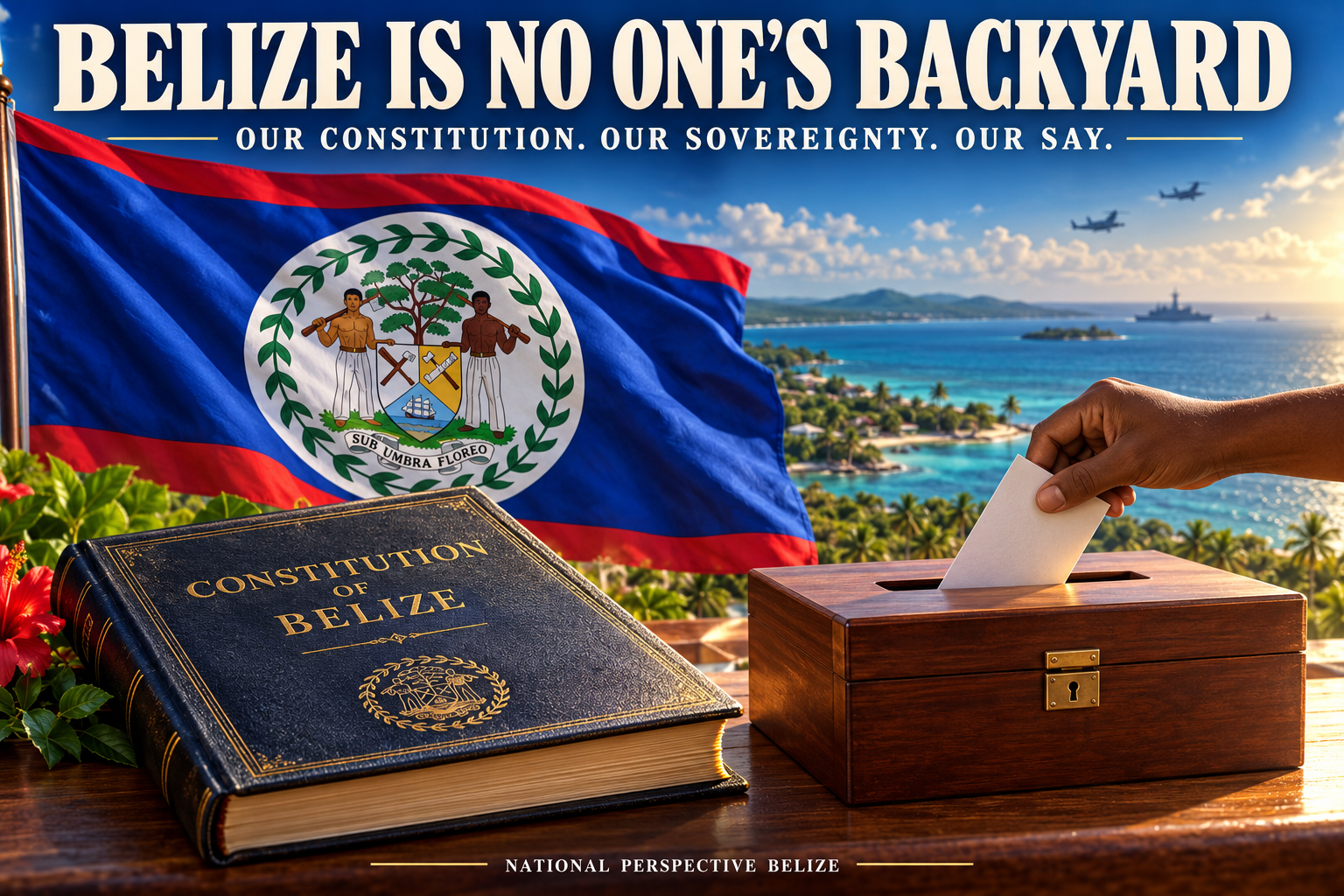
Before any foreign military base: disclose the terms, respect the Constitution, let Belizeans decide
Editorial and constitutional analysis | October 22, 2026
Belize City: Thursday 22nd October 2026: Belize’s need for security assistance deserves serious attention. So does the authority under which foreign soldiers might be permitted to operate here.
A government asking citizens to trust an expanded foreign military role must explain the mission, the powers involved, the limits and the means of ending it. Its duty is to demonstrate that Belize will remain in control.
- Our position is clear: before Belize agrees to establish a new foreign military base of operations, or grants an enduring arrangement with comparable operational powers, the complete proposal should face public scrutiny and a national referendum. That democratic requirement should be secured in law.
- This is the standard we advocate. It must be distinguished from what existing law already expressly requires.
What has actually been announced?
A local News Agency has reported on October 21 that Prime Minister John Briceño had directed senior security officials to explore military cooperation with their American counterparts. Equipment, intelligence and training were identified as possible needs. He left open the question of American personnel participating in operations. The report announced no agreement authorizing combat operations or a troop deployment on Belizean soil.
- That distinction matters. We cannot responsibly describe preliminary discussions as an established American military base. Equally, preliminary discussions are the right moment to demand limits—before negotiations produce commitments, citizens are then told cannot be changed.
The Constitution already contains a safeguard
Section 61A(2)(b) expressly assigns the Senate approval of the establishment in Belize of a military base of operations for foreign military forces. Section 61A(2)(a) assigns it authority to authorize treaty ratification. Section 44 makes Cabinet collectively responsible to the National Assembly. Section 2 establishes constitutional supremacy.
- These provisions impose limits on executive action. They do not make every visiting military contingent a base, or every memorandum a treaty requiring ratification. The legal character and substance of the arrangement must be examined.
- The immediate constitutional demand is therefore precise: publish what is proposed, identify its legal basis, explain which approvals apply and produce those approvals before taking steps for which they are required.
If a foreign base were established without the constitutionally required Senate approval, that would present a direct constitutional issue. The present reporting does not establish that this has occurred.
A public vote must be demanded honestly
We have not established a blanket legal rule requiring a referendum for every foreign military agreement. Pretending otherwise would weaken the defence of Belize.
- There is, however, an existing route to public participation. Section 2(1)(a) of the Referendum Act permits a referendum through a National Assembly resolution. Section 2(1)(b) provides a petition route requiring at least ten percent of registered electors on the approved voters’ list at presentation, with verification and procedural requirements. A petition is a legal process, not simply an online signature count.
- The distinction between a consultative vote and an enforceable legal restriction also matters. A referendum should be accompanied by legislation clearly defining its consequences. A vote cannot authorize a constitutional breach or replace a separately required Senate approval.
Government should bring forward that legal framework before any proposed new base is approved. Belizeans should be able to examine a specific agreement and understand exactly what their vote would decide.
Our history demands accuracy
Belize became independent in 1981, but the British military garrison did not depart immediately. In June 1995, Britain’s government told Parliament that Belize had assumed responsibility for its own defence on January 1, 1994, and that the garrison had been reduced to a training presence.
- The British Army describes BATSUB’s present work in terms of training and exercises, based at Price Barracks.
That history does not provide automatic permission for a different country, mission or set of operational powers. Nor should an existing British arrangement be exempt from scrutiny.
- The proper test is consistent: what does the agreement authorize, who controls it, which laws apply and how can Belize terminate it?
Today’s decision must survive tomorrow’s government
- The concern that today’s American arrangement might become tomorrow’s precedent for another country deserves attention.
An agreement with Washington would not automatically give Guatemala—or any other state—a right to deploy forces here. Each arrangement would need its own lawful basis.
- The institutional concern is broader. If Belizeans accept that sensitive operational powers can be negotiated without adequate disclosure and oversight, future governments may invoke that practice when seeking different arrangements.
- Safeguards should therefore apply to every foreign state. Their strength must not depend on which flag the visiting soldiers wear or which party occupies Belmopan.
A base must be assessed by what it does
Government should explain whether any proposal involves dedicated facilities, recurring troop rotations, weapons storage, operational planning or launch points for missions.
- None of these features alone conclusively determines whether an arrangement constitutes a military base of operations. Together, however, they identify matters requiring close legal examination.
The public deserves more than a reassuring label. Calling something a partnership, training program or temporary deployment does not answer questions about its actual powers and duration.
The questions government must answer
Before granting new operational powers, government should disclose:
- Mission and command: Who selects targets, approves operations and can order them stopped?
- Powers over people: Could foreign personnel search, arrest, detain, interrogate or transfer anyone?
- Use of force: What rules apply, and which Belizean authority oversees compliance?
- Accountability: Which courts have jurisdiction over misconduct, and what remedies exist for victims?
- Facilities and information: What access is granted to ports, airfields, communications and personal data?
- Costs and duration: Who pays, when does authorization expire and how can Belize withdraw?
- Regional limits: Could Belizean territory support operations against another country, and what separate authorization would be necessary?
Operational secrecy may justify protecting a particular mission’s timing. It should not become a blanket excuse for concealing the legal authority under which force may be used.
Examine the wider relationship—without inventing evidence
- The biometric data-sharing memorandum and the safe-third-country asylum agreement warrant scrutiny alongside military discussions because each raises distinct questions about state authority, public safeguards and accountability.
- Their existence does not prove that Washington coerced Belize, that they form a single bargain, or that military cooperation is a condition of development funding.
- Government itself says the biometric arrangement is governed by Belizean law and restricts onward transfer. The public should be able to inspect and test those assurances.
- Likewise, scrutiny of asylum transfers must address costs, consent, capacity and the rights of the people transferred. Asylum seekers must not be presumed criminals.
Our reporting will be stronger when documentary evidence establishes the connections we describe.
Security must strengthen Belize’s own institutions
- Cartels and organized crime cannot be answered by slogans. Belize needs capable investigators, effective border and maritime surveillance, reliable equipment, properly supported personnel and institutions able to prosecute crime.
- Foreign assistance should be measured by the capability and control it leaves in Belizean hands. Government should publish its assessment of alternatives, including assistance that does not require a new foreign operational base.
A claim that Belize needs help does not settle which form of help best serves the nation.
The public demand
- National Perspective Belize calls for publication of the proposed framework; public hearings; an explanation of constitutional approvals; and a legally defined referendum before any new foreign military base or enduring arrangement with comparable operational powers is established.
Where documents reveal unlawful action, the appropriate legal challenge should identify the decision, the provision breached and the remedy sought. A court case must rest on evidence.
- The Prime Minister should answer plainly: will his administration commit to those safeguards before granting such powers?
Belize’s independence carries responsibilities. Among them is the obligation to ensure that the means chosen to protect the nation remains accountable to its people.
The Constitution sets limits. Government must respect them. And before a new foreign military base becomes a commitment made in Belize’s name, Belizeans should have their say.
By: Omar Silva – Editorial Director @ www.nationalperspectivebz.com ©
National Perspective Belize | ©
- Log in to post comments
