BELIZE AT 45: THE CLAIM THAT INDEPENDENCE DID NOT END
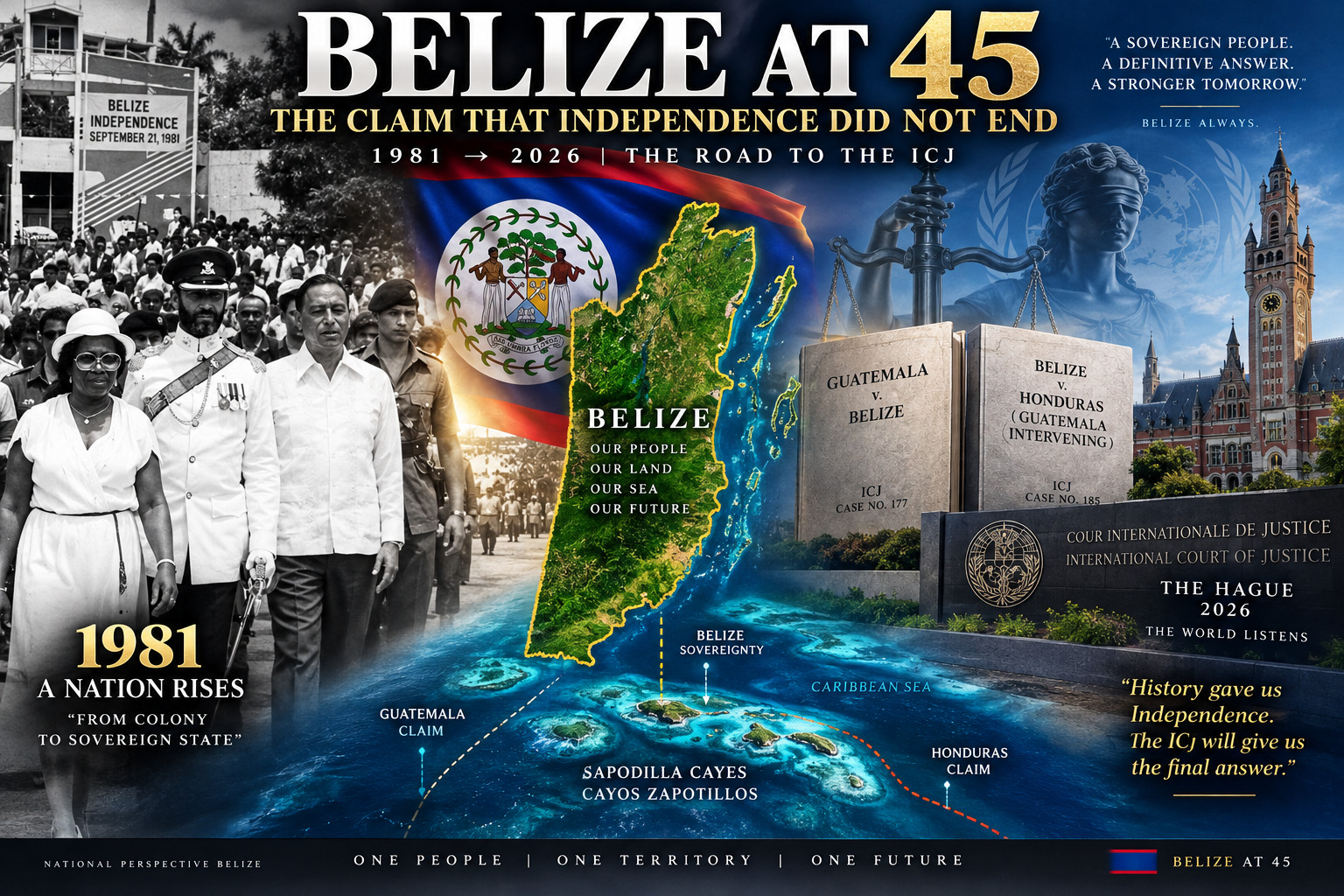
SEPTEMBER 21, 2026 — AS BELIZE CELEBRATES 45 YEARS OF INDEPENDENCE, ANOTHER CLOCK IS TICKING AT THE INTERNATIONAL COURT OF JUSTICE
SPECIAL REPORT
Belize City : Saturday 12th September 2026:
On September 21, 1981, the Union Jack came down and the Belizean flag rose over a new independent nation.
Forty-five years later, on September 21, 2026, Belize will again raise that flag.
- There will be parades.
- There will be music.
- There will be fireworks.
- There will be speeches about sovereignty, independence and the Belizean nation.
But thousands of kilometres away, at the International Court of Justice in The Hague, another Belizean story will be unfolding.
And this one goes directly to the unfinished territorial business that Independence itself did not settle.
September 21, 2026 is also the deadline established by the International Court of Justice for Belize and Honduras to submit written observations on Guatemala's Written Statement following Guatemala's intervention in the separate case concerning sovereignty over the Sapodilla Cayes.
That does not mean that the ICJ will decide the Guatemala-Belize territorial claim on Independence Day.
- It does not mean that Guatemala has won anything.
- And it does not mean that Belize's territorial integrity suddenly changes on September 21.
But it does mean something important: BELIZE AT 45 IS APPROACHING ONE OF THE MOST CONSEQUENTIAL LEGAL PERIODS SINCE SEPTEMBER 21, 1981.
- And Belizeans deserve to understand why.
TWO CASES. THREE COUNTRIES. ONE TERRITORIAL PUZZLE.
- Much public discussion treats “the ICJ case” as though there were only one proceeding.
- There are now two cases that Belizeans must distinguish.
CASE ONE: GUATEMALA v. BELIZE
This is the enormous one.
Its formal title is: Guatemala's Territorial, Insular and Maritime Claim (Guatemala/Belize).
- The question submitted to the Court is extraordinarily broad.
Under the 2008 Special Agreement, the ICJ was asked to determine Guatemala's legal claims against Belize concerning land territory, insular territory and maritime areas pertaining to those territories, to declare the rights of both countries and ultimately determine their boundaries.
- This is therefore not simply a disagreement about a line through the jungle.
- It encompasses the territorial claim itself, islands and the maritime consequences flowing from sovereignty.
The written pleadings have progressed through Guatemala's Memorial, Belize's Counter-Memorial, Guatemala's Reply and Belize's Rejoinder.
What has not yet happened publicly is the decisive oral phase.
- As of this publication, the ICJ has not publicly announced the dates for oral hearings in the principal Guatemala-Belize case.
Belize therefore waits.
- But another case has complicated the picture.
CASE TWO: BELIZE v. HONDURAS
Its formal title is: Sovereignty over the Sapodilla Cayes (Belize v. Honduras).
Belize brought this proceeding to obtain a judicial determination of sovereignty over the Sapodilla Cayes.
- Then Guatemala stepped forward.
- Guatemala asked the ICJ for permission to intervene.
Why?
- Because Guatemala argues that a judgment concerning sovereignty over those cayes could affect legal interests Guatemala itself asserts.
- And on March 19, 2026, the International Court of Justice unanimously permitted Guatemala to intervene under Article 62 of the Court's Statute.
That decision needs to be understood precisely.
GUATEMALA WAS ALLOWED TO INTERVENE AS A NON-PARTY.
- The Court did not rule that Guatemala owns the Sapodilla Cayes.
- It did not rule that Guatemala has sovereignty over Belizean territory.
- It did not determine Guatemala's territorial claim against Belize.
- But neither should Belizeans dismiss the intervention as meaningless.
The Court concluded that Guatemala had demonstrated an interest of a legal nature which may be affected by the eventual decision in the Belize-Honduras proceeding.
- That is why Guatemala is now inside that proceeding as an intervener.
- And that brings us directly to September 21.
JUNE 19, 2026: GUATEMALA PUTS ITS ARGUMENTS ON THE TABLE
- Following the Court's decision allowing intervention, Guatemala submitted its Written Statement on June 19, 2026.
That statement concerns the legal interests Guatemala says it possesses in relation to the Sapodilla Cayes and how Guatemala believes those interests should be protected when the Court eventually decides the Belize-Honduras dispute.
- The full statement has not been made publicly available.
That confidentiality itself means Belizeans should be careful about anyone claiming to know precisely what Guatemala has argued unless those arguments are subsequently released by the Court or the governments.
- But procedurally, something very important followed.
The Court gave Belize and Honduras until September 21, 2026 to present written observations on Guatemala's statement.
Think about that date.
- SEPTEMBER 21.
- Not September 20.
- Not September 22.
- September 21, 2026.
Exactly forty-five years after Belize became independent.
THE HISTORICAL IRONY IS IMPOSSIBLE TO IGNORE
- On September 21, 1981, Belize declared before the world:
- We are sovereign.
On September 21, 2026, Belize reaches an ICJ procedural deadline in a case in which Guatemala has been allowed to place before the Court its claimed legal interests concerning cayes Belize regards as its territory.
- The coincidence is accidental.
- The symbolism is enormous.
And it tells us something uncomfortable but necessary about Belizean history: INDEPENDENCE ESTABLISHED THE BELIZEAN STATE.
BUT INDEPENDENCE DID NOT MAKE THE GUATEMALAN CLAIM DISAPPEAR.
For generations Belize managed that reality through diplomacy, international support, confidence-building measures and regional and international institutions.
- Eventually, Belize and Guatemala chose adjudication.
- The destination became The Hague.
HOW DID WE GET HERE?
The decisive modern instrument was the Special Agreement signed on December 8, 2008.
Belize and Guatemala agreed to ask the International Court of Justice to determine Guatemala's territorial, insular and maritime claims and the respective boundaries of the two countries.
- But governments could not simply send such an historic national question to the Court without their peoples.
Referenda followed.
- Guatemala voted in 2018.
- Belize voted on May 8, 2019.
- Belizeans said YES.
The dispute entered the ICJ.
And from that point forward, something fundamental changed.
- The territorial dispute was no longer principally a political negotiation over whether Belize should surrender territory.
- It became a legal proceeding in which each side had to prove its case according to international law.
That distinction remains critical today.
WHAT EXACTLY HAS BELIZE AGREED TO?
- This is perhaps the part every Belizean should understand before celebrating September 21.
The 2008 Special Agreement states that the parties shall accept the ICJ's decision as: FINAL AND BINDING.
They further committed themselves to complying with and implementing the judgment fully and in good faith.
And there is more.
The agreement provides that within three months after judgment, Belize and Guatemala are to agree upon the composition and terms of reference of a Binational Commission responsible for carrying out boundary demarcation in accordance with the Court's decision.
- If they cannot agree within those three months, either country may ask the Secretary General of the Organization of American States to appoint the members and establish the Commission's terms of reference.
- That means the story does not end when the judges read their judgment.
- A second phase begins.
- Implementation.
- And both governments are already talking about it.
THE JUNE 24, 2026 DECLARATION MAY BE MORE IMPORTANT THAN MANY BELIZEANS REALIZED
Belize and Guatemala met in Panama during the 56th General Assembly of the Organization of American States.
- On June 24 they issued a remarkable Joint Declaration.
- Both governments reaffirmed their obligation to accept the eventual ICJ decision as final and binding and implement it fully and in good faith.
But they went considerably further.
- They discussed the post-judgment architecture.
- They called for continued OAS involvement.
- They addressed maintaining the OAS Office in the Adjacency Zone until judgment.
- They contemplated strengthening national and bilateral capabilities needed to implement the ruling.
And among the areas expressly identified was: TERRITORIAL DEMARCATION.
- That deserves attention.
- It does not tell us what the Court will decide.
- It does not mean Belize has agreed to surrender territory.
- But it tells us that both governments and the OAS are no longer thinking only about getting to judgment.
- They are preparing for the morning after judgment.
That is a significant evolution.
THE OAS IS PREPARING FOR WHAT COMES NEXT
- For more than two decades the OAS Office in the Adjacency Zone has served as a stabilising mechanism.
- It verifies incidents.
- It facilitates communication.
- It supports confidence-building.
- It helps prevent individual border incidents from escalating into confrontations between states.
- The June declaration asks that this institutional presence continue through the ICJ process and potentially evolve after judgment.
- The two countries also want OAS assistance mobilising resources necessary for implementation.
- Why would that matter?
- Because an ICJ judgment may settle law.
It does not automatically move monuments, survey boundaries, establish maritime coordinates, reorganise administrative arrangements or eliminate decades of distrust.
- Implementation is physical.
- Implementation is political.
- Implementation is diplomatic.
- And implementation can be expensive.
THEN THERE IS THE SARSTOON
This is where legal proceedings in The Hague collide with everyday Belizean reality.
- For residents far removed from southern Belize, the Guatemala claim can sometimes feel abstract.
- For Belizean security forces, fishers and communities operating around the Sarstoon, it is anything but abstract.
- Incidents and competing assertions of authority have repeatedly demonstrated why a judicial settlement matters.
- An ICJ judgment therefore has consequences far beyond maps displayed in court.
- Eventually the legal determination must meet geography.
- Rivers.
- Forests.
- Border monuments.
- Cayes.
- Territorial seas.
- Fishing grounds.
- Communities.
- Security forces.
- And people.
WHY THE SAPODILLA CAYES MATTER SO MUCH
Look at Belize's southern maritime geography and the strategic importance becomes obvious.
- Islands are not merely pieces of land protruding from water.
Under the applicable law of the sea, sovereignty over maritime features can have consequences for maritime entitlements and delimitation.
- That is precisely why the Sapodilla proceeding cannot be treated as an obscure side case.
- Belize says the cayes belong to Belize.
- Honduras has asserted a competing sovereignty claim that Belize wants the Court to resolve.
- Guatemala says its legal interests may also be affected.
- Three states therefore appear in the legal architecture surrounding one strategically important area of the Caribbean.
- That does not mean the three claims possess equal legal merit.
- That will be for legal argument and ultimately judicial determination where appropriate.
- But it explains why the Sapodilla Cayes have become one of the most important pieces on the board.
THE TWO ICJ CASES MUST NOT BE CONFUSED — BUT NEITHER CAN THEY BE COMPLETELY SEPARATED
This is perhaps the most important lesson.
- Guatemala v. Belize concerns Guatemala's territorial, insular and maritime claim against Belize.
- Belize v. Honduras concerns sovereignty over the Sapodilla Cayes.
- Guatemala is not a party to the second dispute.
- It is an intervening non-party.
- Yet Guatemala persuaded the Court that legal interests it asserts may be affected by the judgment concerning the cayes.
- And sovereignty over the Sapodilla Cayes also sits within the broader territorial geography implicated by Guatemala's claims against Belize.
Therefore: THESE ARE TWO DIFFERENT CASES.
BUT THEY OCCUPY PART OF THE SAME GEOPOLITICAL CHESSBOARD.
- That is the development Belizeans should be watching.
WHAT COULD HAPPEN NEXT?
- September 21 should not be portrayed as Judgment Day.
It isn't.
- The immediate question is procedural.
- Belize and Honduras have been given until that date to submit observations regarding Guatemala's intervention statement.
- Afterwards, the Court determines subsequent procedure.
- Separately, Belize continues awaiting the scheduling of oral hearings in the principal Guatemala-Belize case.
- When those hearings are eventually announced, that will represent one of the most consequential moments in Belizean diplomatic history.
For the first time, Belizeans will be able to watch their country's lawyers publicly defend Belize's legal position before the principal judicial organ of the United Nations against Guatemala's arguments.
After hearings conclude, the judges deliberate.
- Then comes judgment.
- There is no responsible basis at present for declaring what that judgment will be.
- And National Perspective Belize will not manufacture certainty where none exists.
BUT HERE IS WHAT WE ALREADY KNOW
Whatever judgment ultimately comes, Belize and Guatemala have agreed that it will be final and binding.
- They have committed themselves to implementing it in good faith.
- They have contemplated a Binational Commission.
- They are discussing the post-judgment role of the OAS.
- They are discussing territorial demarcation capacity.
- The OAS is being positioned to help prevent conflict and assist implementation.
- And meanwhile Guatemala has been admitted as a non-party intervener in the separate Sapodilla Cayes case.
These are not the actions of governments treating judgment as some distant theoretical possibility.
THE INSTITUTIONAL MACHINERY FOR THE POST-ICJ ERA IS ALREADY BEGINNING TO TAKE SHAPE.
- That may be the most important development hiding in plain sight.
WHAT BELIZEANS SHOULD NOT BE TOLD
- This issue is too important for political propaganda from either direction.
- Belizeans should not be frightened with claims that Guatemala has already won territory.
It has not.
3. Belizeans should not be told that Guatemala's intervention in the Sapodilla proceeding establishes Guatemalan sovereignty.
It does not.
4. Belizeans should not be told that September 21 is the date the ICJ decides Belize's territorial future.
It isn't.
5. But Belizeans should equally not be lulled into believing nothing significant is happening.
Something significant is happening.
- The principal territorial case has advanced through its written stages.
- A related sovereignty dispute involving the Sapodilla Cayes is proceeding.
- Guatemala has entered that second proceeding as an intervener.
- Belize and Guatemala are openly discussing preparations for the implementation of the eventual territorial judgment.
- And the next Sapodilla procedural deadline happens to fall on Belize's 45th Independence Day.
SEPTEMBER 21, 1981
Forty-five years ago Belize won something infinitely larger than a ceremony.
- It achieved international legal personality as a sovereign state.
- The Belizean flag represented territory.
- Government.
- People.
- Jurisdiction.
- Nationhood.
- And international recognition.
But one neighbouring state maintained its claim.
- For decades Belize answered that claim through diplomacy and internationalisation.
- Today the answer is being pursued through international adjudication.
- That makes September 21, 2026 different.
- We will celebrate what happened in 1981.
- But simultaneously we should understand what is happening in 2026.
BELIZE AT 45 MUST BE A CELEBRATION WITH ITS EYES OPEN
Independence cannot merely mean waving the flag.
- Sovereignty requires understanding what that flag legally represents.
- Every Belizean schoolchild should understand why the country is before the International Court of Justice.
- Every Belizean should know the difference between the Guatemala-Belize case and the Belize-Honduras Sapodilla case.
- Every Belizean should understand what Guatemala's intervention means—and what it does not mean.
And every Belizean should understand the enormous significance of the words: FINAL AND BINDING.
Because after generations of British colonial diplomacy, Guatemalan claims, Belizean resistance, internationalisation, independence, OAS mediation, referenda and litigation, the dispute is moving toward something Belize has never previously possessed:
- A FINAL INTERNATIONAL JUDICIAL DETERMINATION.
THE UNEXPECTED IS NOT THAT SOMETHING HAPPENS ON SEPTEMBER 21
The deeper story is what September 21 reveals.
The process has quietly moved beyond arguments about whether Belize and Guatemala should go to court.
We are already there.
- It has moved beyond whether the peoples should authorize the process.
They already did.
- It has moved beyond written pleadings in the principal case.
Those have been submitted.
- And diplomatic attention is increasingly turning toward what happens after the judges speak.
That is the phase Belize must now begin preparing its people to understand.
- Not with fear.
- Not with triumphalism.
- Not with partisan politics.
- But with national maturity.
45 YEARS LATER, THE FLAG STILL HAS A QUESTION TO ANSWER
On the morning of September 21, Belizeans will look upward as the red, white and blue flag rises again.
- Children born decades after Independence will wave it.
- A generation that never experienced colonial Belize will celebrate beneath it.
And somewhere behind the fireworks sits an extraordinary historical reality:
Forty-five years after Independence, the international legal process intended finally to dispose of Guatemala's territorial, insular and maritime claim is approaching its decisive stages.
September 21, 1981, told the world: BELIZE IS INDEPENDENT.
The proceedings now before the International Court of Justice are intended to answer, finally and judicially, the territorial questions that Guatemala continued to raise after Independence.
- Whatever comes next must therefore belong not merely to a government, a political party or a generation.
It belongs to Belize.
- SEPTEMBER 21, 2026.
- BELIZE AT 45.
- THE FLAG WILL RISE.
- THE COUNTRY WILL CELEBRATE.
AND AT THE HAGUE, THE UNFINISHED BUSINESS OF HISTORY WILL STILL BE MOVING TOWARD ITS ANSWER.
NATIONAL PERSPECTIVE BELIZE
To be continued:
THE ROAD TO THE ICJ JUDGMENT — WHAT BELIZE COULD FACE THE DAY AFTER THE COURT SPEAKS.
By: Omar Silva – Editorial Director @ www.nationalperspectivebz.com ©
NATIONAL PERSPECTIVE BELIZE — ©
- Log in to post comments