THE IMF RECOMMENDATIONS: WHAT HAS BELIZE IMPLEMENTED, AND WHAT REMAINS UNFINISHED?
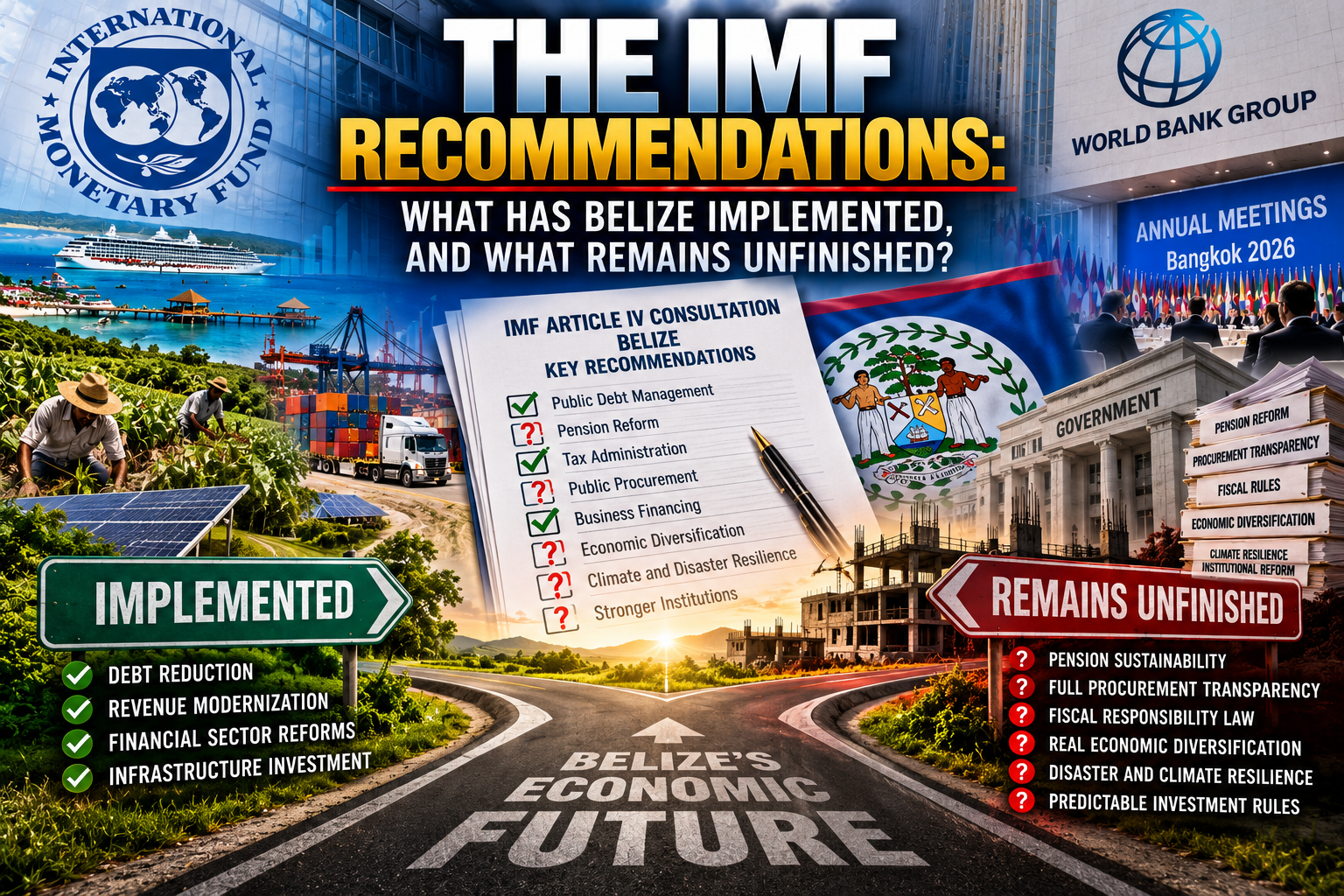
From public debt and pension reform to taxation, procurement transparency and economic diversification—one year after the IMF's recommendations, Belize must examine what has changed, what remains unresolved, and what the future demands.
INTRODUCTION — THE DIFFERENCE BETWEEN RECEIVING ADVICE AND DELIVERING RESULTS
Belize City: 14th October 2026 | Every year, international financial institutions examine the economic performance of developing countries, identify weaknesses and recommend corrective measures.
- Governments receive their assessments, acknowledge their recommendations and frequently announce their commitment to responsible fiscal management, economic growth and institutional reform.
But there is a question that receives considerably less public attention:
- What happens after the recommendations are delivered?
In September 2025, the International Monetary Fund concluded its Article IV consultation with Belize, acknowledging the country's substantial recovery from the COVID-19 pandemic while identifying persistent weaknesses requiring attention.
- The IMF recognized economic growth, declining public debt and improvements in certain social and financial indicators.
But it also recommended further action on fiscal management, pension sustainability, tax administration, public-sector efficiency, business financing, economic diversification and resilience to natural disasters.
- More than a year later, those recommendations provide a useful foundation for a national accountability examination.
- Which reforms have been implemented?
- Which have advanced only partially?
- Which have been delayed?
And, equally important, which IMF proposals should Belize examine critically before accepting them as appropriate national policy?
These questions are particularly timely as Prime Minister John Briceño participates in the IMF and World Bank Annual Meetings in Bangkok, Thailand.
- The government is entitled to explain its achievements. The public is equally entitled to examine the evidence.
An IMF recommendation is not a binding command simply because it comes from an international financial institution.
- But when a government identifies reform as a priority, its implementation becomes a legitimate matter of public accountability.
I. THE IMF'S ECONOMIC ASSESSMENT — PROGRESS WITH UNFINISHED BUSINESS
The IMF's September 2025 assessment documented several important developments in Belize's economic recovery.
2024 real GDP growth
8.1%
2024 public debt / GDP
61.1%
FY2024 primary surplus / GDP
1.7%
Historical figures reported in the IMF's September 2025 Article IV consultation—not current October 2026 measurements.
- Public debt had declined significantly from its 2020 peak of 103.3% of GDP.
This improvement was supported partly by debt restructuring arrangements, including the debt-for-marine-protection transaction and the negotiated discount on Petrocaribe obligations.
These developments represent meaningful improvements in Belize's fiscal position.
- But the IMF also projected that economic growth would settle near 2% over the medium term and that public debt could remain around 58% of GDP through 2030 under its baseline assumptions.
That created a fundamental policy challenge.
- Could Belize convert its post-pandemic recovery into lasting economic transformation, or would its economy return to relatively modest growth while remaining exposed to external shocks?
- The distinction matters because fiscal stabilization, although important, is not equivalent to expanding national productive capacity.
II. PUBLIC DEBT — HAS BELIZE BUILT A SUSTAINABLE FISCAL FOUNDATION?
The IMF recommended that Belize pursue a fiscal strategy capable of reducing public debt to below 50% of GDP.
Its July 2025 mission statement advised gradually increasing the primary fiscal surplus to 2% of GDP by fiscal year 2026.
- The primary balance measures government revenue minus non-interest expenditure. A primary surplus can support debt reduction, although interest costs, economic growth, exchange-rate conditions and other factors also affect the debt ratio.
- The government's own medium-term ambition, as recorded by the IMF, was to reduce debt toward 50% of GDP by 2029 while maintaining primary surpluses of at least 1.5% of GDP.
There is therefore an important distinction between the government's proposed fiscal path and the IMF's preferred adjustment.
- Belizeans should understand both.
The essential accountability questions are straightforward:
- Has the government achieved the fiscal balances projected in its budgets?
- Is debt reduction being driven by sustainable fiscal performance, economic growth, restructuring benefits, or a combination of these factors?
- Are debt-servicing obligations limiting expenditure on essential infrastructure and public services?
- And are fiscal targets being pursued without compromising investment in education, health, productive infrastructure and social protection?
Reducing public debt is an important achievement. But the durability of that achievement depends on the policies and institutions supporting it.
The IMF's 2025 assessment documented substantial progress. Updated fiscal accounts are required to establish the full position in October 2026.
III. PENSION REFORM — THE UNFINISHED QUESTION OF PUBLIC-SECTOR SUSTAINABILITY
- Among the IMF's more consequential recommendations was reform of the Pension Plan for Public Officials.
- The Fund identified growing pension expenditure as a source of fiscal pressure and recommended changes intended to reduce future liabilities.
- Its 2025 staff report explicitly acknowledged delays in reforming the pension arrangements.
This is not merely an accounting issue.
- Pension reform concerns the financial security of public employees, the obligations of the state, intergenerational fairness and the long-term sustainability of government expenditure.
A responsible examination must therefore consider the interests of current pensioners, serving employees, future public officers and taxpayers.
- The government should be able to explain whether actuarial assessments have been updated, whether reform proposals have been formally introduced, and how any proposed changes would affect accrued benefits and future entitlements.
It must also distinguish the public-official pension arrangements under discussion from the wider Social Security system.
- The IMF's assessment established that reform had been delayed as of 2025. That historical finding alone does not establish the status of every reform measure in October 2026.
Nevertheless, the underlying question remains significant:
- Can Belize place its public pension obligations on a sustainable footing while protecting legitimate employee rights and maintaining confidence in the public service?
IV. TAX REFORM — MORE REVENUE, BUT FROM WHOM?
The IMF recommended strengthening government revenue through improved tax administration, broadening the General Sales Tax base, and considering changes to selected taxes and fees.
- The government reported plans to improve electronic invoicing, strengthen tax collection and modernize revenue administration.
These recommendations warrant careful examination because their economic and social consequences differ.
- Improving compliance among businesses already legally obligated to pay taxes is not the same as imposing additional tax burdens on low-income households.
Similarly, eliminating unjustified exemptions may improve fairness, while removing exemptions from essential goods could create affordability concerns.
Belize must therefore distinguish between three objectives: collecting taxes already owed, improving the fairness and efficiency of the tax system, and increasing the overall burden of taxation.
These are related but not identical policies.
The relevant questions include whether electronic invoicing is operating effectively, whether administrative modernization has improved compliance, and whether any changes have increased costs for small enterprises or consumers.
There is also a wider economic issue.
- If the government seeks higher revenue, how much additional fiscal capacity is being directed toward productive investment, public services and poverty reduction?
- Tax reform should be evaluated not only by the revenue it raises, but also by its fairness, efficiency and contribution to national development.
V. PUBLIC PROCUREMENT — THE CONNECTION BETWEEN FISCAL RESPONSIBILITY AND ACCOUNTABILITY
Public procurement is among the most consequential areas of government financial management.
The IMF's recommendations concerning transparency and public financial management raise questions that extend well beyond budget arithmetic.
- When government purchases goods, commissions infrastructure or contracts private companies to deliver public services, public money is being converted into public obligations.
- The integrity of that process depends on competition, transparent rules, accurate records, effective oversight and enforceable consequences for wrongdoing.
The IMF's 2025 report recorded that Belizean authorities planned to improve the centralization of procurement and strengthen the management of public resources.
- The wider reform agenda also calls for stronger procurement transparency, including public access to information about government contracts and the interests behind companies receiving them.
For National Perspective Belize, this presents an important accountability question:
- How can government credibly claim progress in public financial management without demonstrating that procurement decisions are sufficiently transparent, competitive and independently reviewable?
- A meaningful assessment should examine whether contracts are published, whether procurement exceptions are documented, whether beneficial ownership information is accessible, and whether audit recommendations are acted upon.
These are tests of institutional practice, not grounds for presuming misconduct in any particular contract.
The principle is simple.
- Public financial discipline cannot be measured solely by how much government spends. It must also be measured by how public money is authorized, awarded, monitored and accounted for.
VI. THE FISCAL RESPONSIBILITY LAW — WILL DISCIPLINE SURVIVE CHANGES OF GOVERNMENT?
One of the IMF's recommendations deserves particular attention because it concerns the institutional framework governing future administrations.
The Fund called for a medium-term fiscal strategy with measurable targets, supported by a properly designed Fiscal Responsibility Law.
- The objective is to establish a more predictable system for managing deficits, debt, expenditure and fiscal risks.
According to the 2025 IMF report, Belize's Cabinet had approved the development of a Medium-Term Fiscal Framework and a Fiscal Strategy Plan Policy, with World Bank support.
- That represented a policy-development step, not proof that a fully functioning fiscal responsibility framework had been enacted.
The distinction matters.
- A government can announce fiscal discipline through annual budget statements. A credible institutional framework should make that discipline more transparent, measurable and subject to public scrutiny.
But fiscal rules also require careful design.
- Rigid expenditure limits can become counterproductive during natural disasters, severe economic contractions or other emergencies.
Effective rules therefore need credible safeguards, transparent exceptions and independent monitoring.
- The question is whether Belize is building fiscal institutions capable of supporting stability beyond the tenure of any particular administration.
VII. ACCESS TO FINANCING — CAN BELIZEAN ENTERPRISES OBTAIN THE CAPITAL TO GROW?
The IMF's structural reform agenda also identified constraints affecting access to finance.
There was documented progress.
- The Movable Property Security Rights Act was enacted in 2024, and a collateral registry was launched. The Central Bank licensed a credit bureau in June 2025.
The Development Finance Corporation also secured additional Caribbean Development Bank financing intended to improve credit access for important sectors, including micro, small and medium-sized enterprises.
- These developments matter because smaller businesses frequently struggle to obtain affordable financing, particularly when they lack conventional real-estate collateral.
A functioning movable-property registry can potentially allow businesses to use eligible equipment, inventory and other assets to secure credit.
- But establishing the legal infrastructure does not automatically guarantee that businesses will obtain affordable loans.
The next stage of accountability should measure actual lending outcomes.
- Have more enterprises obtained financing?
- Have borrowing costs declined?
- Are agricultural producers, manufacturers and young entrepreneurs benefiting?
- Are women-owned businesses receiving improved access?
- And is financing flowing toward activities that expand Belize's productive and export capacity?
The distinction is important.
- Financial-sector modernization should ultimately be judged by whether it expands real economic opportunity, not merely by the number of institutions established.
VIII. INVESTMENT AND MINISTERIAL DISCRETION — A RECOMMENDATION THAT DESERVES NATIONAL ATTENTION
Perhaps one of the most revealing observations in the IMF's 2025 implementation review concerned the business environment.
- The IMF recorded that further work was required to replace ministerial discretion in business-related processes with more predictable, rules-based arrangements.
- It also acknowledged the introduction of draft insolvency and bankruptcy legislation and improvements in public access to the judiciary.
This recommendation touches a fundamental question about how investment decisions are administered in Belize.
- Investors require clear laws, transparent procedures, predictable approvals and effective dispute resolution.
- Domestic investors require those protections just as much as foreign investors.
When business decisions depend excessively on discretionary administrative processes, uncertainty can increase costs and discourage investment.
- Discretion itself is not necessarily improper. Governments legitimately exercise judgment in many regulatory decisions.
The issue is whether that judgment operates within transparent, consistent and reviewable rules.
- A credible reform programme should establish how licensing, investment incentives, land administration and business approvals are governed.
- It should also explain whether similarly situated applicants receive consistent treatment.
This is particularly relevant to the national discussion about economic sovereignty.
- Belize cannot strengthen domestic entrepreneurship without ensuring that investment opportunities are governed by predictable institutions rather than personal access to decision-makers.
IX. ECONOMIC DIVERSIFICATION — THE RECOMMENDATION THAT CONNECTS EVERYTHING
Fiscal management, taxation, pensions, procurement and financial-sector reform are important.
- But none independently resolves Belize's underlying productive-capacity challenge.
The IMF's 2025 assessment projected medium-term growth of approximately 2%, identifying structural constraints and the need for reforms to improve competitiveness and investment.
This brings us directly back to Part I of our investigation, Belize's Economic Reality Check: The Past, the Present, and a Cautious Future.
- Belize's development strategy must address the relationship between what the country produces, what it consumes, what it exports and what it imports.
- That means examining the commercial viability of agro-processing, manufacturing, renewable energy, logistics, technology-enabled services and regional trade.
- It also requires investment in workforce development and infrastructure.
The IMF has identified constraints affecting tourism capacity, labor participation and the broader business environment.
- But the selection of national industrial priorities ultimately belongs to Belize.
- International institutions can provide financing, technical assistance and economic analysis.
- They cannot substitute for a coherent domestic development strategy.
- The fundamental development question is not simply how Belize can achieve a better fiscal balance. It is how Belize can expand the productive economy that makes stronger public finances and higher living standards sustainable.
X. BANGKOK — A NEW DEVELOPMENT, BUT NOT YET A NEW AGREEMENT
As this investigation is being prepared, a substantive development has emerged from Prime Minister Briceño's participation in the 2026 IMF and World Bank Annual Meetings.
- On October 13, Belizean media reported that the Prime Minister met with Inter-American Development Bank President Ilan Goldfajn.
- The discussions addressed electricity costs, renewable energy expansion, transmission infrastructure, regional electricity integration through SIEPAC, support for Belize Electricity Limited and the submarine cable upgrade serving San Pedro.
- They also examined the sargassum crisis, including possible waste-to-energy initiatives and additional technical cooperation.
This development is relevant to our investigation because energy security and infrastructure investment are closely connected to economic competitiveness.
- Lower and more predictable electricity costs could benefit households and productive enterprises alike.
- Regional electricity integration could create additional supply options, although the actual benefits would depend on pricing, infrastructure costs and regulatory arrangements.
- Sargassum management also has significant implications for tourism, public health and coastal communities.
Nevertheless, a meeting and an expression of willingness to explore cooperation are not equivalent to a signed financing agreement.
The information reported so far does not establish a new approved loan amount, financing conditions, implementation timetable or binding commitment arising from these discussions.
- Those details remain necessary before the public can assess the financial and economic significance of the engagement.
Bangkok may produce meaningful opportunities.
- But the test will be what Belize secures, on what terms, and what measurable benefits follow.
XI. THE ACCOUNTABILITY RECORD — WHAT THE EVIDENCE CURRENTLY SUPPORTS
The following assessment distinguishes progress documented in the IMF's 2025 review from questions that require updated verification.
Reform area
Documented position
October 2026 accountability question
Public debt
Substantial reduction through 2024
Is the reduction continuing sustainably?
Fiscal framework
Development approved
Has a functioning legal framework been established?
Pension reform
Delays acknowledged in 2025
What reforms have since advanced?
Tax administration
Modernization underway
What is operational and what has improved?
Procurement
Stronger management planned
Are contracts and decisions more transparent?
Credit access
Registry launched; credit bureau licensed
Are businesses obtaining more affordable financing?
Investment regulation
Some legal progress; discretion remains a concern
Have approval processes become more predictable?
Economic diversification
Structural constraints identified
What measurable productive gains have occurred?
Historical implementation evidence: IMF 2025 Article IV Staff Report, particularly Annex II. This is an accountability checklist, not a verified October 2026 compliance rating.
The distinction between announced action, completed reform and demonstrated results is essential.
- A law can be passed without being effectively enforced.
- A new institution can be established without delivering its intended service.
- A financing arrangement can be approved without generating the expected economic benefits.
Equally, a reform may produce meaningful progress before all its objectives have been achieved.
- An independent assessment must recognize these differences.
XII. THE BIGGER QUESTION — WHO DECIDES BELIZE'S ECONOMIC FUTURE?
Belize's relationship with the IMF and other international financial institutions should be understood within the broader context of economic sovereignty.
- Membership in international financial institutions does not eliminate national policy choice.
- Governments may accept, modify or decline policy recommendations, subject to any specific obligations they voluntarily undertake under financing arrangements.
- An Article IV consultation is principally an economic surveillance and policy-assessment process. It is not, by itself, a loan agreement imposing new borrowing conditions.
This distinction must remain clear.
- Some IMF recommendations may support Belize's long-term interests.
- Others may require careful adjustment to reflect domestic circumstances, social priorities and implementation capacity.
A responsible government should be prepared to explain both the recommendations it accepts and those it does not.
- For example, debt sustainability and procurement transparency can strengthen public institutions.
- But proposals affecting taxation, pensions and public expenditure require an assessment of their distributional consequences.
The question should never be whether Belize must agree with every recommendation issued by an international institution.
- The question is whether Belize has a credible, transparent and measurable economic strategy of its own.
- International advice can inform that strategy.
- It should not replace democratic accountability for national policy decisions.
CONCLUSION — RECOMMENDATIONS ARE NOT RESULTS
One year after the IMF's 2025 assessment, Belize has an opportunity to examine the difference between economic recovery and institutional transformation.
- The IMF documented significant improvements in growth and public debt.
- It also identified important unfinished work.
Some reforms had advanced.
- Others had been delayed.
- Still others required additional legislation, administrative capacity or implementation.
The challenge now is to establish how much has changed since that assessment.
- That requires updated fiscal accounts, legislative records, implementation reports and measurable economic outcomes.
The government's participation in Bangkok provides a timely opportunity to explain its economic direction, but international meetings cannot substitute for domestic accountability.
- Nor should an IMF recommendation be treated as the final authority on what constitutes successful national development.
- Belize must evaluate economic policy against its own long-term interests, including fiscal sustainability, social welfare, productive investment, institutional integrity and resilience to external shocks.
The public deserves to know not merely what international institutions have recommended, but what the government has implemented and what those actions have achieved.
- The IMF can recommend. The government must decide. Public institutions must implement. And the Belizean people deserve the evidence by which to judge the results.
That is the unfinished business of economic accountability.
By: Omar Silva – Editorial Director @ www.nationalperspectivebz.com
National Perspective Belize
NATIONAL PERSPECTIVE BELIZE
Independent Journalism | Economic Accountability | October 14, 2026
Editorial note: This feature examines the IMF's 2025 recommendations and documented implementation record. It does not represent a completed audit of all government actions through October 2026. Additional verified developments from the Bangkok meetings will be incorporated into a subsequent accountability update.
Principal documentary sources: IMF Executive Board — 2025 Belize Article IV Consultation; IMF Country Report No. 25/262 — Full Staff Report; 2026 Annual Meetings Program.
- Log in to post comments