When Government Begins Regulating the Digital Public Square A Constitutional Examination of Freedom of Expression in Belize's Digital Age
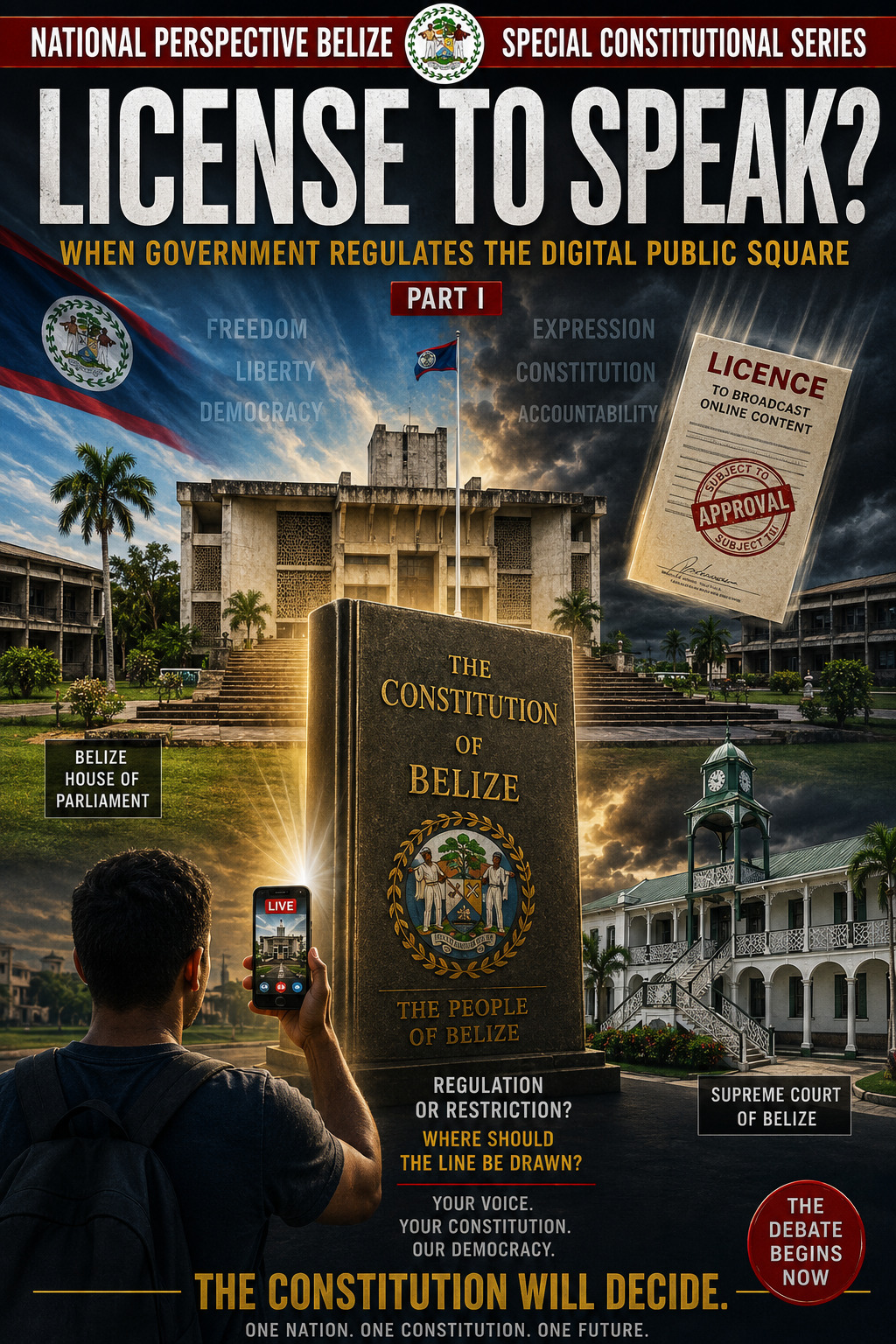
LICENSE TO SPEAK?
SPECIAL CONSTITUTIONAL SERIES
DEMOCRACY, DIGITAL RIGHTS & THE BELIZE CONSTITUTION
PART I
NATIONAL PERSPECTIVE BELIZE
"Freedom is rarely surrendered all at once. More often, it is narrowed one regulation, one licence, one exception, and one justification at a time."
EDITORIAL
The Constitution Was Written for Times Like These
Belize City: Thursday 23rd July 2026: There are moments in the life of every constitutional democracy when the nation is called upon to pause—not because a crisis has already arrived, but because the decisions being contemplated today may shape the liberties of tomorrow.
Belize now appears to be approaching one of those moments.
The Government has announced its intention to modernize the country's broadcasting laws by expanding regulation into areas of digital communication that scarcely existed when earlier broadcasting legislation was enacted. Officials have indicated that the proposed framework would encompass certain online broadcasters, podcasters, livestream operators, and other digital content creators through a system of licensing, regulatory oversight, and compliance requirements.
Government has stated that its objective is to modernize broadcasting regulation in response to technological change.
- Many citizens, however, have raised broader constitutional questions about what such regulation could mean for freedom of expression, independent journalism, and the future of public debate in Belize.
- Those questions deserve thoughtful consideration.
- This Special Constitutional Series is not written to defend any political party, nor is it written to condemn one.
- Its purpose is far more enduring.
It seeks to examine whether the constitutional balance between governmental authority and individual liberty is being maintained in an era where every citizen with a mobile phone, a camera, and an internet connection may become a publisher of ideas.
This discussion therefore reaches well beyond podcasters.
- It concerns journalists.
- Community organizations.
- Churches.
- Students.
- Teachers.
- Researchers.
- Political commentators.
- Independent media.
- Future generations.
Ultimately, it concerns every Belizean who values the ability to exchange ideas freely within a democratic society.
A Question Larger Than Broadcasting
Throughout history, governments have possessed legitimate authority to regulate certain activities.
- They regulate aviation for safety.
- Banking for financial stability.
- Medicine for public health.
- Construction for structural integrity.
These forms of regulation generally concern activities that carry technical, professional, or public safety implications.
Speech occupies a different constitutional position.
- In a democracy, political expression does not simply represent another regulated activity.
- It is one of the foundations upon which democratic government itself rests.
Without the ability to question public officials, investigate public spending, criticize public policy, expose misconduct, or debate national direction, elections become less informed, accountability weakens, and public confidence in institutions may diminish.
That is why constitutional democracies traditionally approach restrictions on political expression with particular care.
- The issue before Belize is therefore not whether government may regulate broadcasting in some respects.
- Rather, it is whether the proposed regulatory framework appropriately balances legitimate public interests with the constitutional protections afforded to freedom of expression in the digital era.
Technology Has Changed Faster Than Law
When Belize's earlier broadcasting legislation was enacted, public communication generally flowed through a limited number of licensed radio and television stations using scarce broadcast frequencies allocated by the State.
The internet transformed that landscape.
Today, a fisherman in Punta Gorda, a teacher in Corozal, a student in Belmopan, or an entrepreneur in San Pedro may publish commentary to thousands of viewers without occupying any public broadcast frequency.
The digital public square has become decentralized.
This transformation raises legitimate policy questions.
Should traditional broadcasting rules apply equally to internet-based communication?
If so, to what extent?
- If not, what constitutional distinctions should be maintained?
These are not questions unique to Belize.
Courts, legislatures, and constitutional scholars throughout democratic societies continue to wrestle with them.
The Constitution Remains the Supreme Law
Before opinions divide the country, one legal principle should unite it.
The Constitution is the supreme law of Belize.
Neither Parliament nor Cabinet may enact ordinary legislation that is inconsistent with constitutional protections unless the Constitution itself authorizes such limitations.
That principle protects every Belizean equally.
- It protects supporters of the Government.
- It protects critics of the Government.
- It protects today's majority.
- It protects tomorrow's minority.
Constitutions are designed precisely for moments when public opinion may be sharply divided.
- They ensure that enduring rights do not depend solely upon the political preferences of the government of the day.
The Questions Belize Must Now Ask
- This series will not begin with accusations.
- It will begin with questions.
Among them:
- Does requiring a licence before certain forms of online broadcasting affect constitutionally protected expression?
- Are licensing fees proportionate when many independent content creators generate little or no income?
- How should any future Code of Conduct be drafted to provide clear, objective standards while respecting constitutional rights?
- What safeguards ensure that regulatory decisions remain independent and free from political influence?
- What role should the courts play if constitutional concerns arise after legislation is enacted?
These are legal and constitutional questions that deserve careful examination through evidence, statutory language, and constitutional principles.
The Road Ahead
This publication does not ask its readers to accept conclusions without examination.
Instead, it invites every Belizean to travel together through the Constitution itself.
Over the coming chapters we will examine:
- the constitutional text;
- the meaning of freedom of expression;
- the doctrine against prior restraint;
- comparative Commonwealth jurisprudence;
- the distinction between regulating broadcasting infrastructure and regulating political speech in digital spaces;
- and the legal avenues available to citizens if constitutional questions remain unresolved.
The purpose is not confrontation for its own sake.
The purpose is constitutional literacy.
For a democracy is strengthened not merely by the right to vote every few years, but by a citizenry that understands both the powers granted to government and the freedoms reserved to the people.
- Log in to post comments