THE BATTLE BELIZE INHERITED: 1798, 10th September and the unfinished journey from colonial memory to Belizean consciousness
1798, September 10 and the unfinished journey from colonial memory to Belizean consciousness
10th SEPTEMBER SPECIAL FEATURE
Belize City: Thursday 10th September 2026: There are moments when a country must do something more difficult than celebrate its history.
It must examine it:.
September 10 occupies a unique place in the Belizean imagination. Generations have grown up hearing about the Battle of St. George’s Caye, the Baymen, the Spanish fleet, September 10, 1798, and the celebrated idea that people of different status and colour fought “shoulder to shoulder” to preserve the settlement that eventually became Belize.
- There is documentary evidence that a military confrontation took place.
- But that is no longer the only question worth asking.
The much larger question is this:
How did an eighteenth-century confrontation between rival European imperial interests eventually become one of the central national stories of a twenty-first-century independent Belize?
- And now, on the eve of September 10, 2026, former Prime Minister Said Musa has reopened that question from inside Belize's own nationalist political tradition.
- Speaking with Channel 5, Musa described September 10 as a “colonial construct.”
- His words deserve considerably more attention than a disagreement over which September holiday Belizeans should prefer.
- Musa was not, on the evidence before us, arguing that the military events of 1798 never occurred.
He was challenging something deeper:
- the national meaning subsequently attached to them.
That distinction changes everything.
FIRST, WHAT DOES THE HISTORICAL RECORD ACTUALLY ESTABLISH?
We should begin where serious historical inquiry must begin — with the evidence.
The surviving record does support the existence of a Spanish military expedition against the British settlement in the Bay of Honduras in 1798.
Lieutenant Colonel Thomas Barrow, Superintendent of the settlement, and Captain John Ralph Moss of HMS Merlin produced reports describing the preparations, movements and military encounters. Their accounts eventually appeared in the London Gazette, the British government's journal of record.
- The record also shows that this was not simply a single spectacular naval battle appearing suddenly on September 10.
- The confrontation unfolded over several days.
By June 1798 British authorities were already receiving reports that Spain might attack. On July 20, a Public Meeting discussed mobilising the settlement's available manpower. The surviving record specifically refers to bringing into the defence men “of whatever class or color” and bringing labourers in from the mahogany works.
The Spanish fleet was sighted in early September.
- Engagements or attempted penetrations occurred around September 3, 4, 5 and ultimately September 10.
- Barrow later reported that, on September 10, the defenders suffered not a single man hurt and no noteworthy damage to their vessels. He believed the Spanish side had suffered casualties and damage, although historians have long debated the actual extent of those losses.
- That immediately introduces one of the peculiarities of the story.
- For an event later presented as an almost existential battle for the destiny of Belize, the surviving British report records an extraordinarily light cost to the defending side.
- That does not mean there was no military engagement.
- It means we must resist turning military history into mythology simply because mythology is easier to celebrate.
THE FIRST DISTINCTION BELIZE MUST MAKE
We therefore arrive at an essential distinction:
The evidence for an engagement is considerably stronger than the evidence for every later interpretation attached to that engagement.
Those are two completely different propositions.
- One concerns what happened in 1798.
- The other concerns what later generations decided 1798 meant.
And it is the second question that may be the more important one.
- 1798 WAS NOT AN INDEPENDENCE WAR
- This point deserves to be stated plainly.
- Belize did not exist in 1798 as an independent sovereign state fighting against foreign occupation.
- The confrontation occurred within the much larger eighteenth-century imperial struggle between Britain and Spain.
British settlers were exploiting timber resources in territory over which Spain claimed sovereignty while diplomatic agreements had permitted British subjects limited settlement and logging rights.
The defence of that settlement therefore took place within the geopolitical architecture of European empire.
Whatever courage individual participants displayed, the political objective in 1798 was not the establishment of an independent Belizean nation, parliamentary democracy or sovereign Belizean nationhood.
- It was the survival of the British settlement.
- That settlement eventually became part of the historical pathway through which modern Belize emerged.
- But the survival of a colonial settlement and the birth of an independent nation are not the same historical event.
This distinction has been blurred for generations.
THEN THERE IS THE MOST DIFFICULT PART OF THE STORY: "SLAVERY"
The traditional September 10 narrative often speaks beautifully about unity.
But history forces us to ask:
- Unity between whom, and under what conditions?
- The settlement defending itself in 1798 was a slave society.
Official Belizean historical material shows that enslaved Africans constituted approximately three quarters of the population around 1790. An ISCR/NICH historical compilation places the enslaved population at 2,177 in one 1790 return, approximately 75 percent of the population.
These were not marginal figures standing outside the society.
- They were the overwhelming majority of the labouring population on which the timber economy depended.
- The historical preparations for the Spanish attack also indicate that Black men were incorporated into the defence.
That contribution deserves recognition.
- But recognition should not be confused with romanticisation.
- Because when the confrontation ended on September 10, enslavement did not end on September 11.
- The Africans who participated did not awaken the following morning as equal citizens of a Belizean nation.
- They remained within a social and economic order in which human beings could still be legally treated as property.
Full legal emancipation in Belize would not come until August 1, 1838 — forty years after the battle.
And when emancipation finally came, Britain compensated slave owners for losing what had legally been regarded as their human property.
- The formerly enslaved received no comparable compensation. Belize's National Assembly has itself acknowledged this history in its reparatory-justice deliberations.
- This complicates the beloved phrase “shoulder to shoulder.”
- People may indeed have defended the same physical territory.
- But they did not occupy equal positions within the society they were defending.
That distinction cannot simply be wished away.
Standing beside another man during a military emergency does not automatically make you his social, legal or political equal when the guns fall silent.
- That is where historical consciousness must replace patriotic simplification.
THE REALLY REMARKABLE DISCOVERY COMES A CENTURY LATER
Perhaps the most revealing fact in the entire September 10 story is this:
The large institutionalised commemoration did not simply arise spontaneously in 1798.
- The centenary celebrations were organised in 1898 — one hundred years after the military events.
A public meeting was held at Riverside Hall on North Front Street on April 6, 1898. Resolutions were adopted calling for the battle to be commemorated annually and for September 10 to become a public holiday. The colonial administration subsequently declared September 9 and 10 public holidays for the centenary.
Now examine the language used at the time.
A Colonial Guardian editorial described the battle as one of the greatest and most glorious events in the territory's history and credited it with securing civil and religious liberty and good government for the Baymen and their successors.
- That language is extraordinarily revealing.
- Because this was not simply historical remembrance.
It was political storytelling.
The centennial interpretation was explicitly celebrating the virtues of the British colonial inheritance.
- And here Said Musa's phrase suddenly acquires considerably greater historical substance.
- When Musa calls September 10 a “colonial construct,” the archival record allows us to understand what such a statement can mean.
It need not mean:
- “1798 never happened.”
It can instead mean:
- the national commemorative architecture surrounding 1798 was constructed inside colonial British Honduras.
That proposition has strong historical support.
AND 1898 ITSELF DESERVES CLOSE EXAMINATION
Scholarly research adds another fascinating dimension.
- Historian Anne Macpherson and other scholars have examined how race, class and emerging Creole identity interacted with political culture in British Honduras during the late nineteenth century.
- Research drawing upon the Clarion and Colonial Guardian archives suggests that commemorations surrounding September 10 developed within a broader struggle over identity, race and colonial belonging.
- There is even evidence that the emergence of Battle commemorations during this period intersected with Emancipation commemorations.
- Macpherson's research, as cited in subsequent Belizean historical discussions, notes that a People's Committee marking the battle anniversary developed partly in reaction to an Emancipation Jubilee celebration in August 1888.
Think about what this means.
- Two possible historical memories were competing for national attention.
- One remembered emancipation from slavery.
- The other remembered the defence of the British settlement.
- Eventually September 10 became institutionalised as the great national celebration.
- That does not automatically prove a deliberate colonial conspiracy.
But it raises a legitimate and profound historical question:
- Which memory did colonial Belize choose to elevate—and why?
- That is exactly the kind of question an independent society should be capable of asking.
- THE STORY OF SIMON LAMB IS MORE COMPLICATED TOO
- Belizeans have often been taught that Simon Lamb was essentially the father of the September 10 celebrations.
There is truth behind his association with the commemoration.
But the archival picture is more nuanced.
Historical research cited from the 1898 Clarion indicates Lamb was apparently not listed among the formal members of the 1898 Centennial Committee, although he was deeply associated with patriotic mobilisation and later remembrance.
- Even more interestingly, Simon Lamb had earlier been associated with an Emancipation Jubilee.
- So even some of the personalities surrounding September 10 cannot be reduced to the simple national narrative subsequently constructed around them.
- History is almost always messier than commemorative mythology.
- FROM BAYMEN TO “FIRST BELIZEANS”
Another transformation occurred gradually.
The protagonists of 1798 were increasingly reinterpreted not merely as inhabitants of a British settlement, but as precursors of the Belizean nation.
This is understandable.
Every country searches its past for foundational stories.
But it creates a danger known to historians everywhere:
- retrospective nationalism.
That is when a later nation projects its modern identity backwards onto people who did not necessarily understand themselves in those terms.
- The people fighting in 1798 could not have been fighting for the sovereign state called Belize created in 1981.
That state did not yet exist.
- They could have been defending their homes.
- Their families.
- Their economic interests.
- Their freedom from Spanish domination.
- Their master's property.
- Their own survival.
- The British settlement.
- Perhaps several of these things simultaneously.
But to transform all those complicated motives into a single modern proposition — “they fought for Belizean independence” — would be historically unsound.
- GEORGE PRICE SAW THE CONTRADICTION
- And this is where Said Musa's account takes us to George Cadle Price.
- Price's relationship with September 10 was not one of simple rejection.
Indeed, the Belize Archives preserve National Day speeches delivered by Price on September 10 throughout the 1960s and 1970s. Records exist for 1965, 1969, 1973, 1974 and 1976, among others.
That tells us something important.
- Price did not attempt to erase September 10 from Belizean historical consciousness.
- He reinterpreted the political meaning surrounding it while moving Belize toward something larger.
A declassified American diplomatic cable describing Price's September 10, 1974 National Day address records him arguing that Belizeans had developed their own culture, government and history — while declaring colonialism morally indefensible and saying Belize was ready for independence.
Read that contradiction carefully.
- On the very day inherited from colonial commemoration, the leader of Belize's nationalist movement was standing before the country and declaring colonialism itself morally indefensible.
That is extraordinary.
- George Price was effectively transforming the platform.
- September 10 had once celebrated the survival of the British settlement.
- Price increasingly used the national stage to proclaim the emergence of a Belizean people demanding sovereignty from Britain itself.
- That is decolonisation occurring almost before our eyes.
SEPTEMBER 21 COMPLETED THAT TRANSFORMATION
On September 21, 1981, something fundamentally different occurred.
Belize became legally and internationally sovereign.
George Price led the country into independence. NICH today describes him as the foremost symbol of Belize's movement toward self-government and independence.
That is why Said Musa's explanation matters.
- According to the interview supplied, Price recognised that an independent country needed a national reference point that was not ultimately anchored in colonial rule.
- September 10 remembered an event within empire.
- September 21 marked Belize's political emergence from empire.
- One celebrates the survival of a settlement.
- The other establishes the sovereignty of a nation.
- They need not be enemies.
- But they are not interchangeable.
THIS DOES NOT REQUIRE BELIZE TO CANCEL SEPTEMBER 10
And here is where this discussion can become genuinely transformative rather than destructive.
Decolonising history does not mean burning archives, dishonouring ancestors or pretending 1798 never happened.
Quite the opposite.
- It requires us to know more history, not less.
- September 10 can remain historically important.
- The Spanish expedition mattered.
- The military resistance mattered.
- The African presence mattered.
- The Baymen mattered.
- The naval geography mattered.
- The consequences for the settlement mattered.
But we can recognise all of these things without requiring 1798 to perform historical work it cannot perform.
- We do not need to transform an Anglo-Spanish imperial confrontation into Belizean independence.
- We already possess a genuine independence story.
- It happened on September 21, 1981.
AND WHAT ABOUT THE MARITIME QUESTION?
There is another aspect that deserves care because it has raised legitimate public scepticism.
Belize's reef, shoals and channels are difficult waters.
- Even modern vessels frequently require specialised local navigation.
- But today's maritime conditions cannot simply be projected backwards to conclude that eighteenth-century ships could not have navigated the approaches.
- Modern cruise ships are vastly larger, deeper-draft vessels than the schooners, brigs, gunboats and other craft operating in 1798.
- The historical record itself indicates that the geography played an important defensive role.
Spanish vessels attempted to negotiate the approaches around Montego Caye shoals, while defenders used shallow-water positions and smaller craft to their advantage.
- So the reef does not necessarily disprove the confrontation.
- It may help explain why the Spanish numerical advantage could not easily be translated into victory.
- That deserves further hydrographic study using eighteenth-century charts, vessel drafts and reconstructed channels.
But based upon the evidence presently available, the strongest historical critique is no longer:
- “There could not have been a battle.”
It is:
- “What kind of military engagement actually occurred, and what did later generations turn it into?”
That is a far more powerful question.
THE EVENT AND THE MYTH ARE NOT THE SAME THING
This may ultimately be the most important lesson.
- A myth does not necessarily mean a lie.
- In historical studies, national mythology often means something different.
- It means a true event has accumulated layers of symbolism, simplification, heroism and political meaning until the story being remembered becomes much larger than the event itself.
- The American Revolution has myths.
- The French Revolution has myths.
- Latin American independence movements have myths.
- Caribbean societies have myths.
- And Belize is entitled to examine its own.
The mature question therefore is not whether Belizeans should feel pride.
- It is whether national pride should ever require national innocence.
- It should not.
THE ENSLAVED AFRICAN CANNOT REMAIN A FOOTNOTE
If Belize is serious about historical consciousness, then the African majority of the settlement cannot remain supporting characters in somebody else's national story.
The existence of slavery fundamentally changes how 1798 must be understood.
An enslaved African defending the settlement occupies a profoundly different historical position from a Bayman protecting property, commercial interests and British settlement rights.
Yet both may have stood inside the same defensive effort.
- That contradiction should not be hidden.
- It should become part of what Belizeans learn.
- Because history becomes considerably richer when we stop demanding that every participant have the same reason for being there.
NOR SHOULD THE MAYA DISAPPEAR FROM THE FRAME
- There is another silence in the traditional story.
- This land did not begin with the Baymen.
Long before Britain and Spain contested imperial influence across the region, Maya peoples occupied and shaped the territory that would eventually become Belize.
- A genuinely decolonised national history therefore cannot begin conveniently in 1798.
- September 10 may be part of Belize's political genealogy.
- It cannot reasonably be treated as the beginning of human history, civilisation or belonging in this territory.
- That recognition does not diminish Creole history.
- It expands Belizean history.
- And a multi-ethnic nation should be strong enough to accommodate all of it.
SAID MUSA HAS THEREFORE OPENED A MUCH BIGGER DOOR THAN PERHAPS EVEN THE INTERVIEW SUGGESTS
When a former Prime Minister says: “The tenth is a colonial construct,”
- we should not reduce the statement to another PUP-versus-UDP political exchange.
- The historical question reaches far beyond contemporary party politics.
It forces Belize to confront the difference between:
- colonial history and national history;
- territorial survival and sovereignty;
- participation and equality;
- commemoration and historical truth;
- inheritance and identity.
And perhaps most importantly: remembering the past and allowing the past to define us.
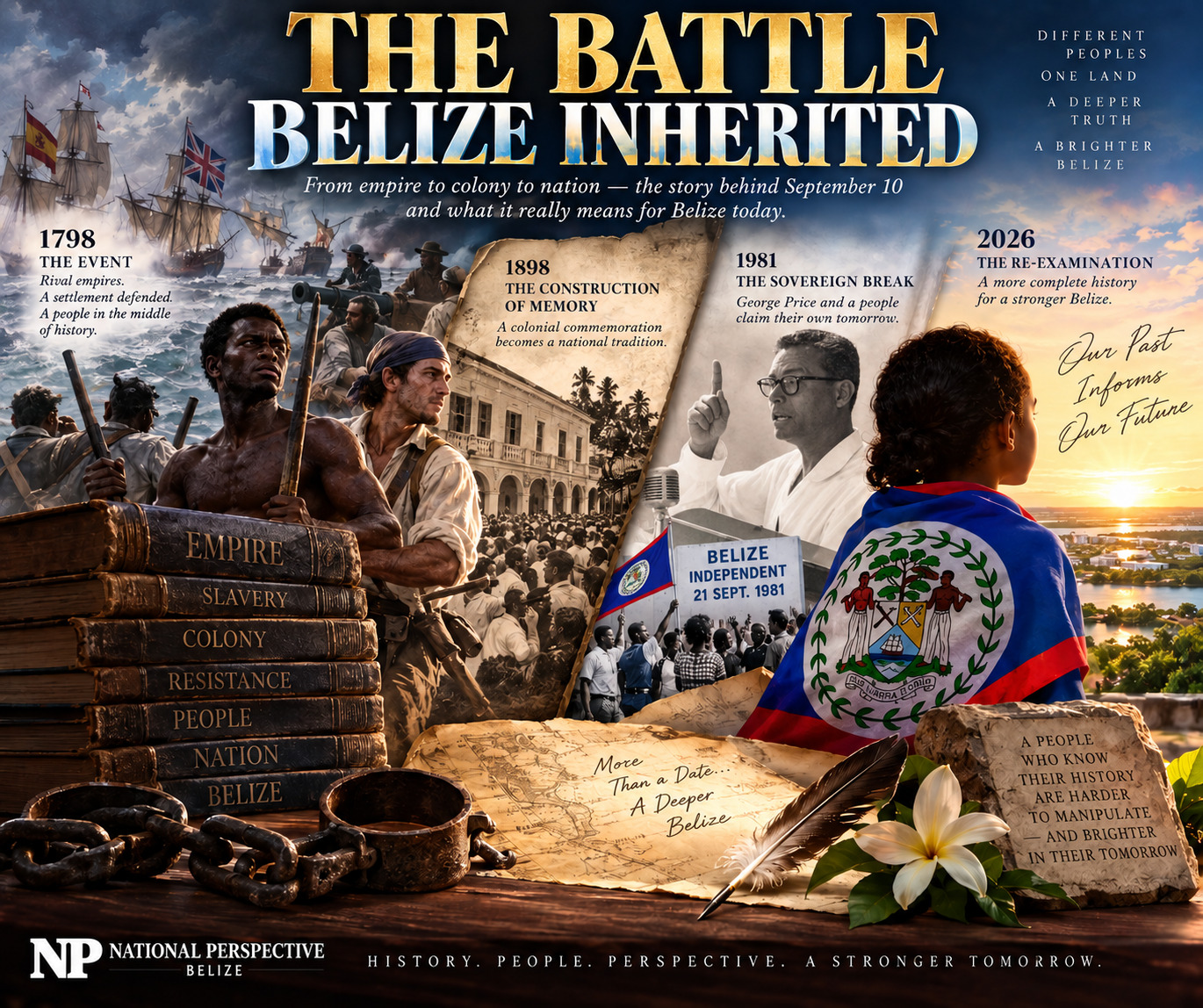
1798 → 1898 → 1981 → 2026
- Seen properly, four dates tell the story.
1798 — THE EVENT
- British settlers, African inhabitants and British military forces participate in the defence of the settlement against a Spanish expedition.
1898 — THE CONSTRUCTION OF COMMEMORATION
2. A century later, colonial British Honduras institutionalises September 10 as an annual patriotic celebration and public holiday. The language surrounding the centenary explicitly praises British-derived liberty and governance.
1981 — THE SOVEREIGN BREAK
3. Belize becomes independent under George Price.
The national centre of political gravity moves decisively from the survival of the colonial settlement to the sovereignty of the Belizean nation.
2026 — THE RE-EXAMINATION
Said Musa calls September 10 a “colonial construct.”
And perhaps, 228 years after the confrontation and 45 years after independence, Belize is finally mature enough to examine all four layers together.
THE BATTLE BELIZE INHERITED
Perhaps that is ultimately what September 10 represents.
- Not a story Belize must destroy.
- Not a story Belize must blindly worship.
- But a story Belize inherited.
- Part military history.
- Part colonial memory.
- Part Creole cultural identity.
- Part African history.
- Part imperial rivalry.
- Part patriotic mythology.
- Part genuine national tradition.
- And now, increasingly, part of a much larger conversation about decolonisation.
Every generation inherits stories.
But no generation is obligated to inherit them without examination.
BELIZE DOES NOT LOSE ANYTHING BY KNOWING MORE
There is sometimes fear that revisiting national history divides people.
The opposite can be true.
- A fragile nationalism requires uncomplicated heroes.
- A confident nation can accommodate complexity.
- It can recognise that Africans fought while still being enslaved.
- It can respect Baymen without transforming them into twentieth-century Belizean nationalists.
- It can acknowledge British influence without romanticising colonialism.
- It can recognise September 10 without allowing September 10 to overshadow September 21.
- It can honour Creole heritage while recognising Maya antiquity, Garifuna arrival and resistance, Mestizo migration, East Indian, Chinese, Lebanese, Mennonite and every other contribution to the Belize that eventually emerged.
That is not dismantling Belizean identity.
That is completing it.
THE FINAL QUESTION IS THEREFORE NOT WHETHER WE SHOULD CELEBRATE
- Belizeans will celebrate.
- Traditions have meanings of their own.
- Families will attend ceremonies.
Flags will fly.
- The Queen of the Bay tradition will continue.
- Children will hear the story.
- Music will play.
- September 10 will remain embedded in Belizean culture.
But perhaps the next generation should hear something more alongside the familiar account.
- Tell them about Barrow and Moss.
- Tell them about the Spanish expedition.
- Tell them about the reef and the gunboats.
- Tell them about the Baymen.
But also tell them that the settlement was a slave society.
- Tell them why enslaved Africans were there.
- Tell them emancipation came forty years later.
- Tell them that the great annual commemoration was institutionalised a century after the event.
- Tell them what the Colonial Guardian said in 1898.
- Tell them about Emancipation celebrations.
- Tell them about George Price transforming the meaning of National Day.
- Tell them why Belize ultimately chose September 21 for sovereignty.
- And now tell them that one of Price's political successors, former Prime Minister Said Musa, has described September 10 as a colonial construct.
Then allow the young Belizean to think.
- Because education should not manufacture conclusions.
- It should manufacture consciousness.
AND PERHAPS THAT IS THE REAL WORK OF INDEPENDENCE
- Independence is not completed when one flag comes down and another goes up.
- Political independence happened on September 21, 1981.
- But intellectual independence is an ongoing process.
A people must eventually acquire sufficient confidence to examine the stories handed down by colonial institutions, political parties, churches, schools, families and governments and ask:
- What happened?
- What was later added?
- Whose voice is missing?
- Who benefited from the interpretation?
- What should we preserve?
- And what should we reinterpret now that we belong to ourselves?
- That is not disrespect.
- That is sovereignty of the mind.
And 228 years after the events around St. George's Caye, perhaps Belize has reached the point where September 10 can survive something far more powerful than unquestioning celebration:
the truth in all its complexity.
NATIONAL PERSPECTIVE BELIZE'S CONCLUSION
- The evidence does not compel us to declare that nothing happened in September 1798.
- Quite the opposite.
- Something consequential occurred.
- But neither does the evidence require us to accept every layer of meaning that colonial British Honduras subsequently placed upon it.
There lies the distinction.
- 1798 belongs to our history.
- 1898 tells us how colonial Belize chose to remember that history.
- 1981 tells us when Belize became sovereign.
- 2026 gives us the opportunity to reconsider what all of it means.
Said Musa's words therefore deserve neither reflexive acceptance nor reflexive condemnation.
- They deserve investigation.
- And investigation leads us toward a conclusion considerably more interesting than either side of the old argument:
The Battle of St. George's Caye may have helped preserve the settlement from which Belize eventually emerged. But the nation called Belize was still almost two centuries away.
- September 10 can therefore remain part of the Belizean inheritance.
- But September 21 is the day Belize finally became its own author.
And if we are truly a conscience-driven people looking toward the future, we should never fear turning around occasionally and reading the earlier chapters again.
Because a people who understand how their history was made are much harder to manipulate with the way their history is told.
THE BATTLE BELIZE INHERITED
- We do not have to erase it.
- We have to understand it.
By: Omar Silva – Editorial Director @ www.nationalperspectivebz.com ©
NATIONAL PERSPECTIVE BELIZE — ©
- Log in to post comments