DR. NAUN BONILLA: MURDER, MOTIVE, OR MERELY ALLEGATION? Understanding the Law, the Police Theory, and What Belizeans Must Know Before Judging the Case.
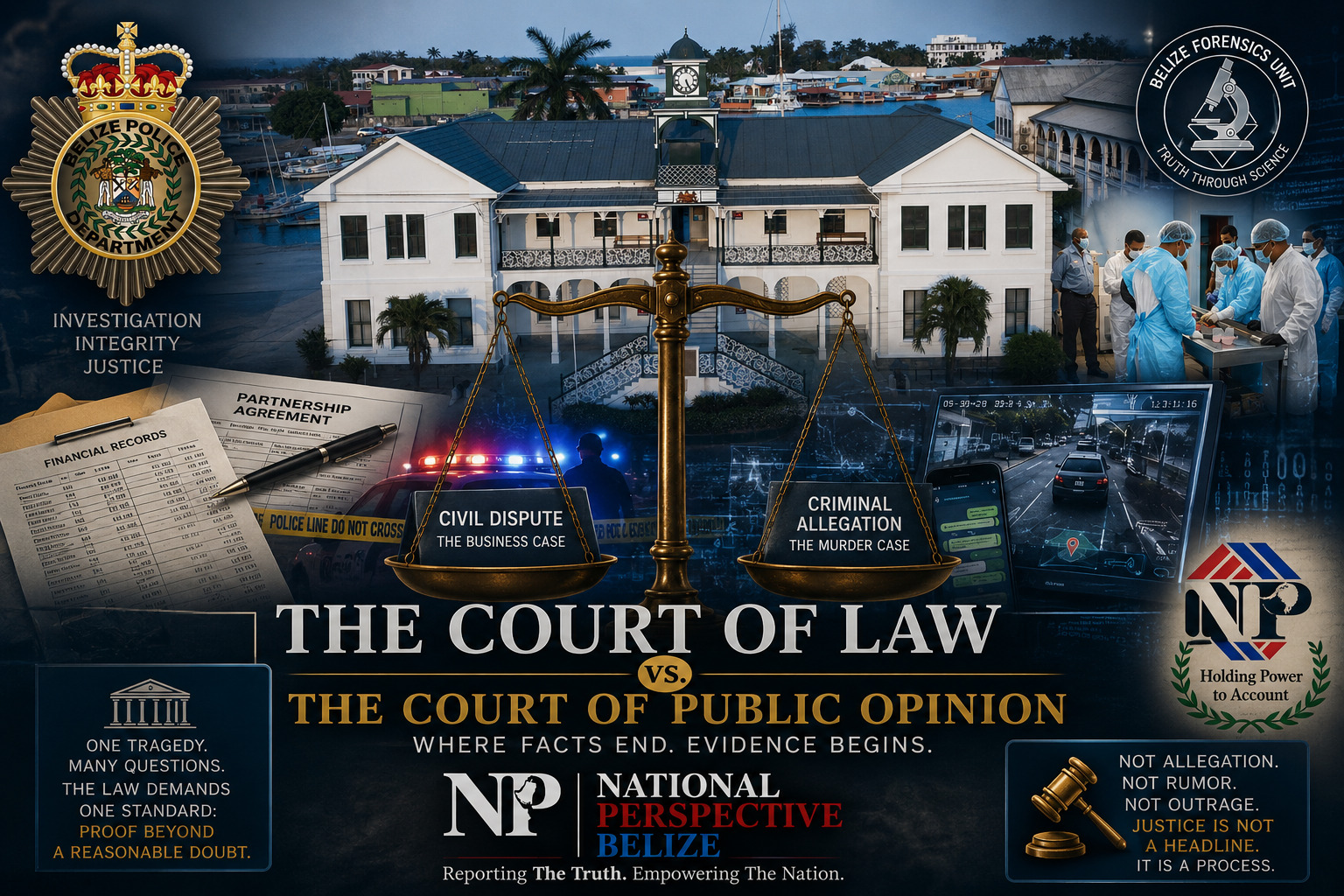
Belize City: Sunday 7th June 2026: The tragic murder of Dr. Naun Ulices Bonilla has shocked Belize.
A respected medical professional, entrepreneur, son, brother, colleague, and healthcare provider was gunned down in broad daylight. Within days, police announced the arrest of two individuals: laboratory scientist Hannah Foreman and Edwin Bethran Jr.
Since then, Belize has been inundated with thousands of words of commentary from police officials, attorneys, journalists, social media commentators, family members, and legal analysts.
Yet amid the emotion, grief, and public outrage, one critical question remains:
What exactly is the case before the courts?
To answer that question Belizeans must understand that there are actually three separate legal matters intertwined within this tragedy.
The First Case: The Civil Business Dispute
Before there was a murder investigation, there was a business dispute.
According to publicly available information, Dr. Bonilla and Hannah Foreman were business partners.
The allegations now being discussed publicly include:
- Misappropriation of partnership funds;
- Improper financial transactions;
- Alleged forgery of signatures;
- Ownership disputes;
- Disagreements regarding a National Health Insurance contract;
- Claims of exclusion from management;
- Litigation seeking dissolution of the partnership.
These are fundamentally civil matters.
Civil law exists to resolve disputes between private individuals.
The remedies available are not imprisonment but rather:
- damages,
- injunctions,
- dissolution of partnerships,
- accountings,
- compensation,
- restoration of ownership rights.
Attorney Audrey Matura's analysis focuses heavily on this aspect.
Her position appears to be that Dr. Bonilla had gathered evidence of alleged wrongdoing and was preparing to pursue legal remedies.
Whether those allegations are true remains unproven.
Importantly, no court has yet ruled on the allegations contained in either party's civil filings.
The civil dispute was still in its infancy.
The Second Case: Potential Criminal Financial Conduct
Attorney Matura also points to allegations which, if proven, could potentially move beyond civil law.
These include:
- theft,
- fraud,
- forgery,
- misappropriation.
The public should understand an important legal principle:
The same conduct can create both civil liability and criminal liability.
A person who allegedly steals partnership funds may face:
- a civil lawsuit for recovery of money, and
- a criminal investigation for theft or fraud.
One does not exclude the other.
However, as of this writing, public reports indicate no criminal theft charges had been filed regarding the partnership dispute itself.
That distinction is important.
The allegations existed.
But allegations are not convictions.
The Third Case: The Murder Investigation
This is where the matter changes dramatically.
The police are not prosecuting a business dispute.
The police are prosecuting a homicide.
Their burden is entirely different.
They do not need to prove who was right in the partnership dispute.
They do not need to prove who owned the laboratory.
They do not need to prove who deserved the NHI contract.
Their task is much narrower.
They must prove:
Who planned the murder?
Who facilitated the murder?
Who participated in the murder?
Who carried out the murder?
And can these facts be proven beyond reasonable doubt?
That is the actual case before the court.
Why Police Keep Focusing on Motive
Many Belizeans are asking why police continue referencing the business dispute.
The answer is simple:
Motive.
In criminal investigations, motive helps explain why a crime may have occurred.
It does not prove guilt.
But it helps investigators understand relationships and possible reasons behind conduct.
Police appear to be arguing the following sequence:
Business dispute → legal conflict → escalating tensions → murder.
That is their theory.
Whether it is correct remains for the courts to determine.
What Attorney Audrey Matura Is Actually Saying
Some Belizeans misunderstand Matura's comments as declaring guilt.
That is not what she appears to be doing.
Her legal analysis focuses on motive.
Her argument can be summarized as follows:
If Dr. Bonilla had evidence of financial wrongdoing and intended to pursue legal action, then investigators would naturally ask whether those circumstances created a motive for someone to silence him.
That is a reasonable legal observation.
However, motive is not proof.
A person can have motive and still be innocent.
Courts require evidence connecting motive to action.
What Attorney Arthur Saldivar Is Actually Saying
Attorney Arthur Saldivar's comments reflect a different legal duty.
He is a criminal defense attorney.
His role is not to solve the crime.
His role is to ensure due process.
His statements focused on:
- thorough investigations,
- proper procedure,
- evidence,
- presumption of innocence.
These are not technicalities.
They are constitutional protections.
The criminal justice system does not ask whether the public believes someone is guilty.
It asks whether guilt can be proven according to law.
Saldivar's position can be summarized as follows:
If the police arrested the correct individuals and the evidence supports the charges, justice will follow.
If not, acquittal is also justice.
That is how the rule of law functions.
The Importance of Joint Enterprise
The most significant legal phrase introduced by police is "joint enterprise."
Many Belizeans have never heard the term before.
Yet it may become the central legal issue of this case.
Joint enterprise is a legal doctrine recognized throughout common-law jurisdictions.
It essentially means that where two or more persons agree to commit a crime, each participant may be responsible for the actions of the others.
In practical terms:
A person does not necessarily have to pull the trigger to be guilty of murder.
If prosecutors prove that a person:
- planned the act,
- financed the act,
- directed the act,
- encouraged the act,
- facilitated the act,
that person may face the same criminal liability as the shooter.
This appears to be the legal theory police are pursuing.
Why the FIU and Digital Forensics Matter
One of the most interesting aspects of the police briefing was the repeated reference to:
- the Financial Intelligence Unit,
- digital forensics,
- cybercrime investigators,
- surveillance footage.
Experienced observers immediately recognized the significance.
Police rarely highlight these resources unless they believe they are important to the evidentiary chain.
This suggests investigators may be examining:
- financial transactions,
- communication records,
- digital messages,
- phone data,
- location data,
- electronic transfers.
Again, none of this proves guilt.
But it helps explain why investigators appear confident in the charges they have laid.
What Happens Next?
Many Belizeans incorrectly believe the arrest is the hard part.
In reality, the difficult part is just beginning.
The prosecution must now establish:
- admissible evidence,
- reliability of witnesses,
- continuity of exhibits,
- credibility of investigators,
- authenticity of digital evidence,
- connections between alleged conspirators.
The Défense will challenge each of these areas.
That is precisely what the adversarial system is designed to do.
What Could Happen Before the Courts?
Several outcomes remain possible.
Scenario One: Conviction
If prosecutors prove planning, coordination, facilitation, or execution beyond reasonable doubt, convictions may follow.
Scenario Two: Partial Convictions
One accused may be convicted while another is acquitted.
This frequently occurs in conspiracy cases.
Scenario Three: Lesser Offenses
Evidence may support lesser charges than originally alleged.
Scenario Four: Acquittal
If reasonable doubt exists, acquittal must follow regardless of public sentiment.
This is not a failure of justice.
It is the legal system operating according to constitutional principles.
What Belizeans Should Remember
At present, there are four things we know.
First, Dr. Naun Bonilla is dead.
Second, a serious business dispute existed.
Third, police believe the dispute evolved into a murder conspiracy.
Fourth, those allegations have not yet been tested in court.
Everything else remains subject to proof.
- The family deserves justice.
- The accused deserve due process.
- The public deserves facts.
And the courts deserve the opportunity to determine the truth without interference from speculation, rumour, or emotion.
That is how justice is supposed to work.
- Not in Facebook comments.
- Not in political discussions.
- Not in media headlines.
But in a courtroom where evidence, and evidence alone, ultimately determines guilt or innocence.
EDITOR'S NOTE
The purpose of this feature is not to determine guilt, innocence, or liability. That responsibility belongs exclusively to the courts of Belize.
In an era dominated by social media reactions, emotional commentary, and instant conclusions, National Perspective Belize has chosen a different approach.
Rather than speculate on what may ultimately happen before a judge and jury, we believe the Belizean public is better served by understanding the legal principles, investigative procedures, and judicial safeguards that govern a case of this magnitude.
The murder of Dr. Naun Bonilla has generated intense public interest, not only because of the tragic loss of a respected medical professional, but because the allegations touch on issues rarely discussed in the public sphere: partnership law, civil litigation, alleged financial misconduct, digital forensics, financial intelligence investigations, conspiracy, and the doctrine of joint enterprise.
Much of the public discussion has understandably focused on personalities, emotions, and allegations. Our objective is different.
We seek to explain how the law views the facts, how investigators build a case, how defense attorneys challenge that case, and how courts ultimately separate suspicion from proof.
Justice is not measured by the volume of public outrage, nor by the popularity of a narrative. Justice is measured by whether the evidence presented in court satisfies the legal standard required for conviction.
Likewise, due process is not a technical obstacle to justice. It is justice. The same constitutional protections that safeguard an accused person today protect every Belizean tomorrow.
For that reason, National Perspective Belize has intentionally focused this feature on understanding rather than speculation, legal analysis rather than rumor, and public education rather than public prosecution.
The public may draw its own conclusions. The courts will ultimately draw theirs.
Until then, it remains the responsibility of serious journalism to illuminate the process rather than influence the outcome.
Omar Silva — Editor
National Perspective Belize
- Log in to post comments