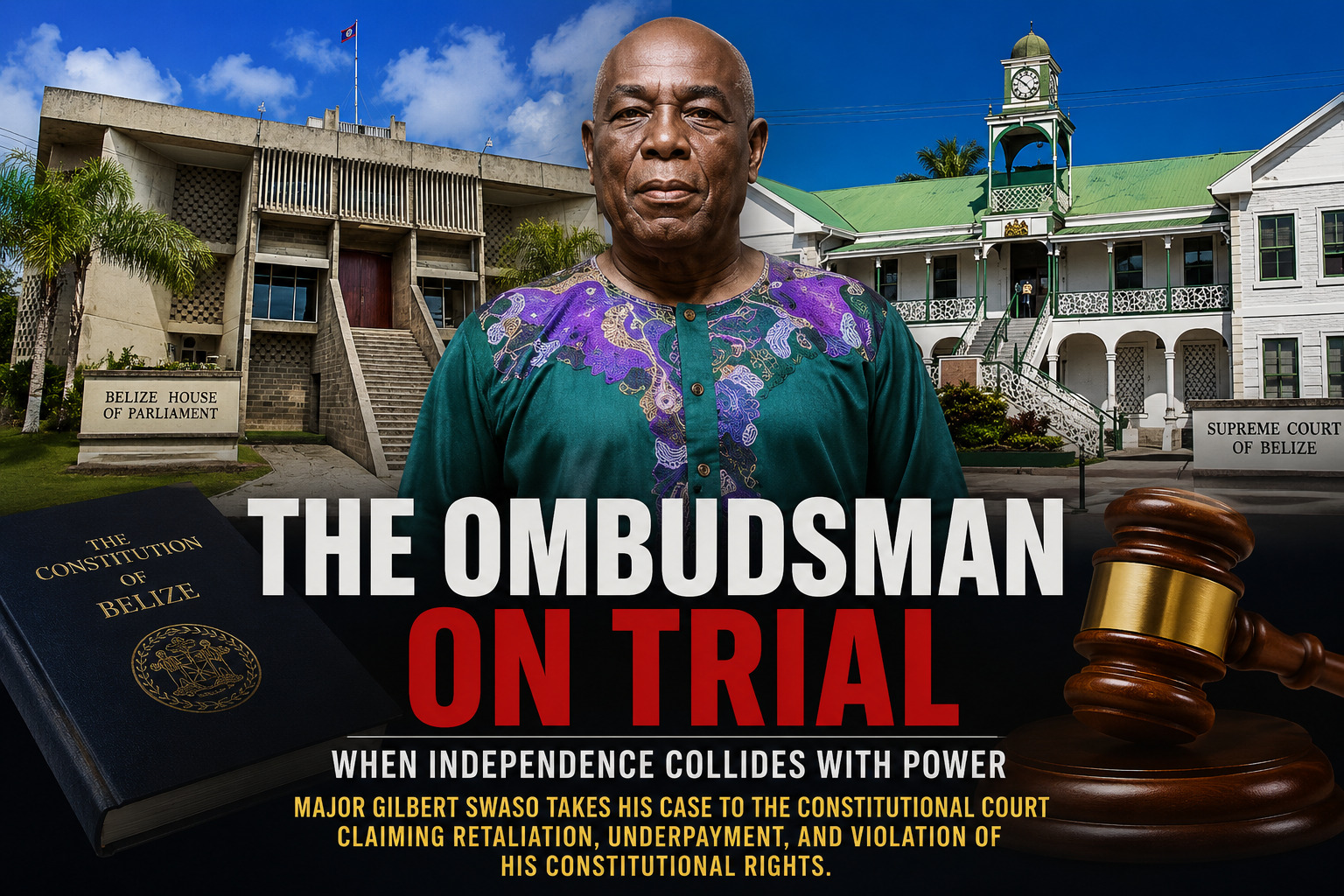
"THE OMBUDSMAN ON TRIAL: WHEN INDEPENDENCE COLLIDES WITH POWER"
SPECIAL FEATURE:
Belize City: Tuesday, 9th June 2026: Belizeans should not make the mistake of viewing Major Gilbert Swaso's constitutional lawsuit as merely another disagreement between a former public officer and the Government of Belize.
This case is potentially much bigger.
It goes directly to the survival of constitutional oversight in Belize.
At stake is not simply a contract.
At stake is whether independent constitutional offices can truly function independently when their decisions become politically inconvenient.
The constitutional lawsuit filed by former Ombudsman Major (Retired) Herman Gilbert Swaso raises uncomfortable questions that every Belizean, regardless of political affiliation, should be asking.
If an Ombudsman can be removed, pressured, marginalized, or denied lawful remuneration after making an adverse ruling against the government of the day, then what protection exists for future Ombudsmen?
More importantly:
What protection exists for ordinary citizens who depend on those institutions?
WHAT IS AN OMBUDSMAN SUPPOSED TO DO?
The Office of the Ombudsman was never intended to be a ceremonial post.
The Ombudsman exists as a constitutional safeguard.
The office serves as an independent referee between citizens and the state.
- When ministries refuse information.
- When government agencies abuse authority.
- When public officers exceed their powers.
- When citizens have nowhere else to turn.
The Ombudsman is supposed to act without fear or favour.
That principle only works if the office itself is insulated from political influence.
An Ombudsman who fears losing his job is no longer truly independent.
He becomes vulnerable.
And once vulnerability enters the equation, public confidence disappears.
THE FREEDOM OF INFORMATION RULING
The dispute appears to center around a Freedom of Information matter involving activist Jeremy Enriquez.
The request sought disclosure of public funds used by the Government to pay private attorneys and law firms involved in the redistricting litigation.
Swaso's position was straightforward.
Taxpayer money belongs to the people.
If public funds were spent on private legal representation, citizens have a legitimate interest in knowing how much was spent and to whom.
From a democratic governance perspective, this is hardly a radical position.
Transparency regarding public expenditure is a cornerstone of accountability.
Indeed, many constitutional democracies presume disclosure of public spending unless there is a compelling legal reason for secrecy.
The ruling therefore touched upon a highly sensitive issue:
How much public money was spent defending government positions in court?
THE DECEMBER MEETING
Perhaps the most explosive aspect of the lawsuit concerns the December 22, 2025 meeting between Swaso and Minister Henry Usher.
Swaso alleges that concerns were expressed regarding the ruling.
He further claims that accusations were made questioning whether he authored his own decision.
Minister Usher has publicly stated that he may have questioned whether Swaso wrote the letters himself but denies raising concerns regarding the adverse ruling.
The courts will ultimately determine whose version is accepted.
However, the larger constitutional concern remains.
Why was an Ombudsman discussing a completed ruling with a senior political figure at all?
Even the appearance of political engagement surrounding an independent decision can undermine public confidence.
Constitutional offices survive not merely through actual independence.
They survive through the perception of independence.
THE CHRISTMAS EVE LETTER
Two days after the meeting came the letter.
December 24.
Christmas Eve.
Notification that his tenure would conclude on December 31.
Again, the Government is legally entitled to make appointments and decide whether appointments are renewed.
No one disputes that.
But Swaso argues that the timing, context, and surrounding circumstances reveal retaliatory conduct.
The Government will undoubtedly present its own explanation.
The court will determine the facts.
But politically, the optics are troubling.
Independent constitutional officers should never leave office under circumstances that create suspicion that political displeasure influenced the outcome.
THE SALARY ISSUE MAY BE EVEN BIGGER
Lost amid the political controversy is another potentially significant legal issue.
Swaso alleges that throughout his entire tenure he was paid less than the law required.
The Ombudsman Act reportedly provides that the Ombudsman's remuneration shall not be less than that of a Supreme Court Judge.
If this allegation is proven, the implications extend beyond Swaso personally.
It would suggest a prolonged failure by the State to comply with statutory requirements governing a constitutional office.
The courts may ultimately have to determine:
- Whether the remuneration provisions were breached.
- Whether constitutional independence was compromised through underfunding.
- Whether damages are warranted.
THE BROADER CONSTITUTIONAL QUESTION
This case arrives at a time when Belize is already facing growing debates about institutional independence.
Questions have emerged regarding:
- Judicial appointments.
- Electoral reform.
- Redistricting.
- Freedom of Information.
- Constitutional amendments.
- Public accountability.
The Swaso case now joins that broader conversation.
Because if constitutional watchdogs are perceived as vulnerable to political pressure, the public inevitably begins asking:
Who watches the watchdogs?
And who protects those who are supposed to protect the public?
WHY THIS CASE MATTERS TO EVERY BELIZEAN
This lawsuit is not about Major Swaso alone.
Governments change.
Political parties rise and fall.
Prime Ministers come and go.
Opposition Leaders come and go.
But institutions remain.
The true test of democracy is not how government treats those who agree with it.
The true test is how government treats independent officers when they disagree with it.
If constitutional officers are free to make unpopular decisions without consequence, democracy grows stronger.
If they are punished for those decisions, democracy grows weaker.
That is why Belizeans should follow this case carefully.
Because the final judgment may determine far more than the fate of one former Ombudsman.
It may determine how independent Belize's constitutional institutions truly are.
- Log in to post comments