SOLIDARITY BEYOND BORDERS Why the Struggle of the Garifuna People in Honduras Matters to Every Belizean “GARINAGU LIDAN UBAU”
By: Omar Silva – Editor/Publisher
National Perspective Belize
Belize City: Wednesday 15th July 2026:
"An attack on the ancestral rights of one Garifuna community is felt across the entire Garifuna Nation."
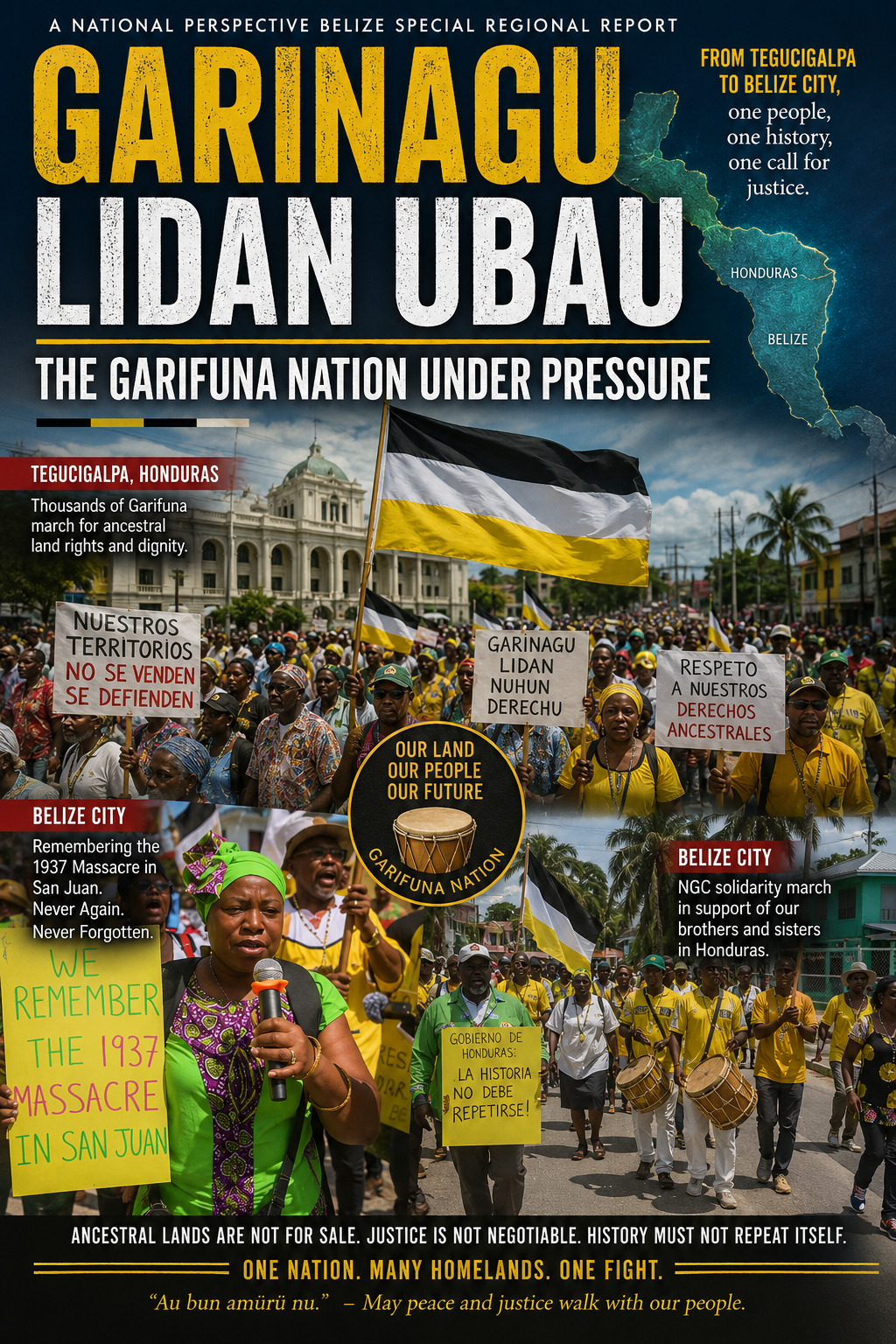
From the streets of Tegucigalpa to the avenues of Belize City, Garifuna communities are raising one united voice in defense of ancestral lands, cultural survival, and the rights of Indigenous and Afro-descendant peoples. This Special Regional Report examines the historical roots of the conflict, the legal questions surrounding ancestral territories, and why Belize's solidarity March is part of a much larger struggle for justice across Central America.
On the streets of Belize City, the unmistakable rhythm of Garifuna drums echoed far beyond Princess Margaret Drive.
They carried a message that transcended politics, geography and national borders.
The demonstration organized by Belize's National Garifuna Council (NGC) was not merely a local protest. It was a declaration that the Garifuna people, despite being citizens of different countries, remain one people bound by a common history, shared ancestry and an enduring struggle to preserve their lands, culture and identity.
For many Belizeans unfamiliar with Garifuna history, the protest may have appeared to concern only developments taking place hundreds of miles away in Honduras.
In reality, the issues unfolding there reach directly into Belize's own history and future.
One People, Five Nations
The Garifuna Nation predates the political boundaries of modern Central America.
The Garinagu emerged on the Caribbean island of Yurumein (Saint Vincent), where African survivors of slave ships and Indigenous Kalinago and Arawak peoples forged a unique civilization distinguished by its language, customs, spirituality and resilience.
- Following military defeat by the British in 1797, thousands of Garifuna were forcibly deported from Saint Vincent to the island of Roatán, off the coast of Honduras.
- From there, Garifuna communities gradually established settlements along the Caribbean coast of Honduras before expanding into present-day Belize, Guatemala and Nicaragua.
When the first Garifuna families arrived in southern Belize during the early nineteenth century, they came from Honduras—not as strangers, but as members of a people rebuilding their lives after forced displacement.
Their descendants helped shape the cultural identity of Belize.
- Today, the Garifuna language, music, dance and traditions are recognized by UNESCO as a Masterpiece of the Oral and Intangible Heritage of Humanity.
Yet despite that international recognition, many Garifuna communities continue to fight for the most fundamental of human rights—the right to remain on the lands of their ancestors.
Why Belize's Garifuna Community Took to the Streets
The National Garifuna Council organized its demonstration in response to reports from Honduras alleging intensified efforts to remove Garifuna communities from ancestral coastal lands, particularly in and around San Juan and neighboring communities.
According to the NGC, these lands are increasingly coveted for tourism development, commercial investment and agricultural expansion.
The Council expressed concern that communities with centuries of continuous occupation now face mounting pressure from powerful economic interests supported by state institutions.
NGC President Alex Nolberto warned that this struggle is not unique to Honduras.
He noted that Belize has experienced similar tensions surrounding Garifuna communities, including concerns raised in Hopkins, Sittee and Seine Bight, where expanding tourism and increasing coastal property values have generated disputes over land ownership and community rights.
His message was clear:
What is happening in Honduras today serves as a warning for Belize tomorrow.
The Heart of the Conflict
At first glance, the issue appears to concern property ownership.
In reality, it concerns something much deeper.
For indigenous and traditional peoples, land represents far more than an economic asset.
It embodies:
- ancestral burial grounds;
- spiritual heritage;
- food security;
- cultural survival;
- language preservation;
- community identity;
- the living connection between generations.
When Garifuna leaders say, "Our ancestors are buried here," they are expressing a legal, cultural and moral relationship with the land that differs fundamentally from conventional commercial ownership.
The lands now attracting investors are often the same coastal areas that Garifuna communities protected and sustained for generations, long before they acquired commercial value.
As tourism, luxury developments and infrastructure projects expand across the Caribbean coast, those same lands have become highly desirable.
This creates a difficult question that many governments across the Americas continue to confront:
- How should economic development proceed without sacrificing the rights of the communities that have historically occupied those territories?
A History That Cannot Be Forgotten
One of the strongest messages delivered during Belize's demonstration was a reminder of history.
Speakers recalled the violence suffered by Garifuna communities in Honduras during the twentieth century and warned against allowing tensions to escalate once again.
Particular concern was expressed over reports and videos showing a significant military and security presence in Garifuna communities.
The National Garifuna Council emphasized that militarization of land disputes increases the risk of confrontation.
Its appeal was therefore not simply political.
It was humanitarian.
The Council urged the Honduran Government to resolve disputes through dialogue, lawful procedures and respect for internationally recognized human rights rather than through intimidation or force.
International Law Is Clear
This issue is no longer viewed solely through domestic law.
Across the Americas, indigenous and Afro-descendant communities increasingly rely upon international legal protections.
These include:
- the United Nations Declaration on the Rights of Indigenous Peoples (UNDRIP);
- the American Convention on Human Rights;
- jurisprudence of the Inter-American Court of Human Rights recognizing traditional collective land rights;
- international principles requiring consultation with indigenous communities before developments affecting their ancestral territories proceed.
These standards reflect a growing international consensus that development and human rights must coexist.
Economic progress should never require the destruction of the cultures that have protected these lands for centuries.
Belize's Responsibility
Belize occupies a unique position.
The country is internationally respected for recognizing Garifuna Settlement Day as a national holiday and for celebrating Garifuna language, music and traditions as an integral part of Belizean identity.
But celebrating culture must also include defending the rights that allow that culture to survive.
- The concerns expressed by Belize's National Garifuna Council deserve thoughtful national discussion—not because Belize and Honduras share identical legal systems, but because both nations face similar pressures arising from tourism expansion, coastal investment and competing claims over increasingly valuable lands.
The question before Belize is not whether development should occur.
- Development is both necessary and desirable.
The real question is whether development can proceed while respecting history, protecting indigenous rights and ensuring that the communities who preserved these lands are not displaced by the very prosperity they helped make possible.
More Than a Protest
Measured only by attendance, the demonstration in Belize City was modest.
Measured by its significance, it represented something much greater.
- It reaffirmed that the Garifuna Nation extends beyond political frontiers.
- It reminded Honduras that the international community is watching.
- It informed Belizeans that the struggle for indigenous rights remains very much alive.
- And it demonstrated that solidarity is not measured by numbers, but by principle.
The Garifuna people have survived forced deportation, colonialism, discrimination and displacement.
- Their history is one of extraordinary resilience.
- That resilience deserves not only admiration but also protection.
A Call for Peace, Justice and Dialogue
National Perspective Belize joins all those who believe that disputes involving ancestral lands should be resolved peacefully, transparently and in accordance with the rule of law.
We support meaningful dialogue among the Honduran Government, Garifuna communities, civil society and regional partners, with full respect for due process and internationally recognized human rights.
The future of development in Central America should not be measured solely by new resorts, highways or investments.
- It should also be measured by whether governments possess the wisdom to protect the peoples whose history has shaped these coastlines long before modern borders were ever drawn.
- For Belize, the message carried by the drums on Princess Margaret Drive was unmistakable.
The struggle of the Garifuna people does not end at the border.
Neither should our commitment to justice, dignity and the preservation of one of the Caribbean's most remarkable living cultures.
"Au bun amürü nu."
- Log in to post comments