BEYOND THE FLOODWATERS What the Belmopan Flood Revealed About Belize's Infrastructure, Planning and National Preparedness
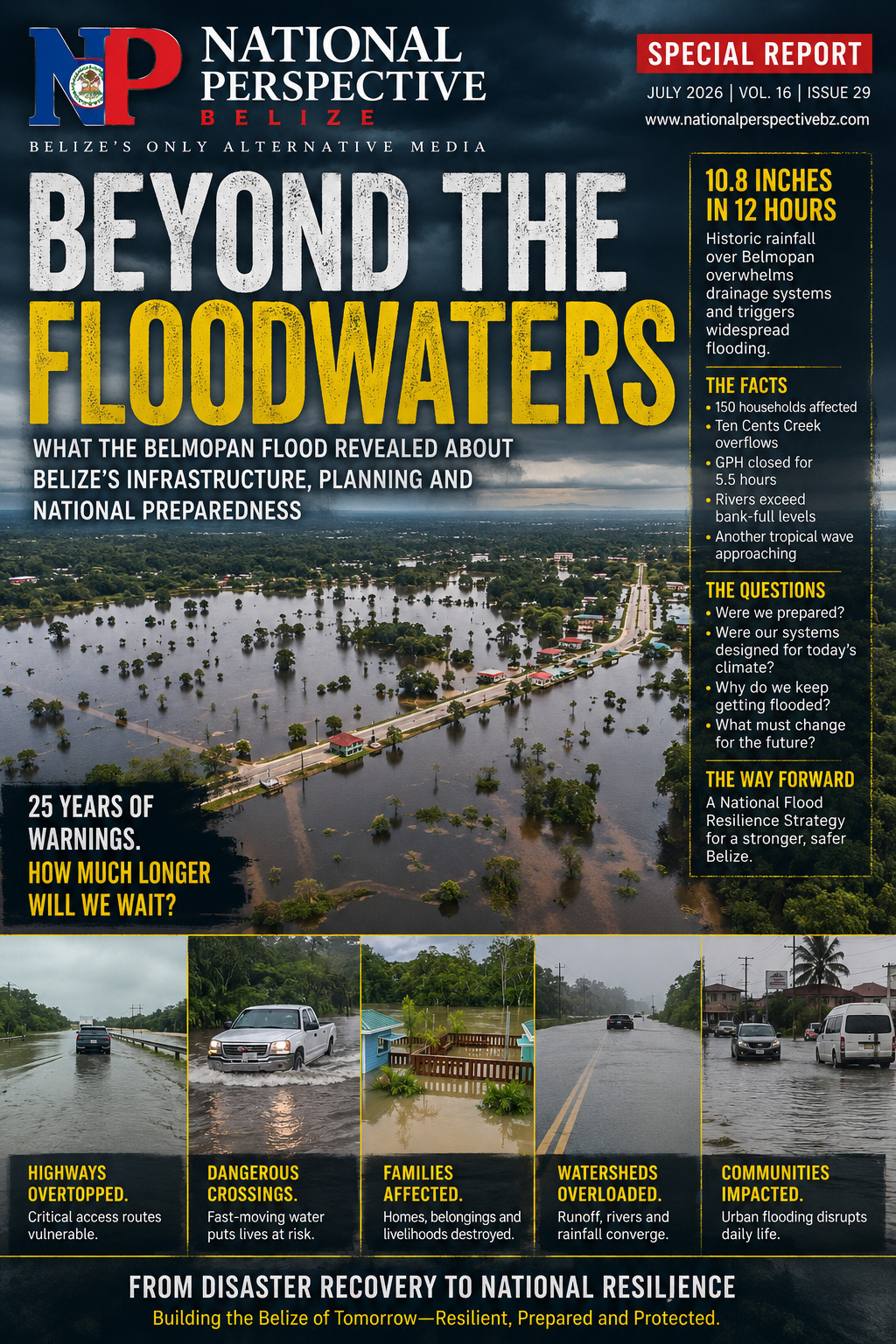
By: Omar Silva – Editor/Publisher
A National Perspective Belize Special Report
INTRODUCTION
When the Water Receded, the Questions Remained
On the morning of July 11–12, 2026, much of Belmopan found itself under water.
Homes were inundated. Families watched furniture, appliances, clothing, and treasured possessions disappear beneath muddy floodwaters. The George Price Highway—the nation's principal transportation corridor linking Belize City to western Belize—was forced to close after fast-moving water overtopped sections of the roadway. Communities such as Salvapan, Las Flores and San Martin experienced flooding that many residents had never witnessed in their lifetimes.
By every meteorological measurement, this was an extraordinary rainfall event.
The National Meteorological Service recorded approximately 273.4 millimetres (10.8 inches) of rainfall in roughly twelve hours—more than Belmopan's average rainfall for the entire month of July. Rivers responded rapidly, drainage channels exceeded capacity, and emergency agencies mobilized to protect lives and property.
No reasonable observer can dismiss the magnitude of the event.
- Yet once the floodwaters began to recede, another question emerged—one that extends far beyond a single storm.
- Was Belize simply overwhelmed by nature, or did this disaster expose vulnerabilities that have been developing for decades?
That distinction matters.
- Natural hazards cannot be prevented.
- National disasters often can be mitigated.
This report does not seek political advantage nor assign blame to individuals. Instead, it examines the flood through a broader institutional lens, separating what was genuinely beyond human control from what may have reflected years of deferred planning, aging infrastructure, changing land use, and inadequate preparation for a climate that is no longer behaving according to yesterday's assumptions.
- The objective is not to criticize for criticism's sake.
- The objective is to learn.
Because every major flood leaves behind two things:
- Water…
- and lessons.
Whether Belize chooses to absorb those lessons may determine how well the nation withstands the next extreme weather event.
CHAPTER ONE
The Day the Capital Was Tested
The events that unfolded over Belmopan were neither the product of a single decision nor a single rainfall event. They were the result of an extraordinary convergence of meteorological, hydrological, and infrastructural conditions.
A tropical wave crossed Belize accompanied by abundant atmospheric moisture, strong low-level winds, and favorable upper-level conditions for the rapid development of heavy rainfall. What forecasters initially expected to produce between two and four inches of rain instead generated more than ten inches over the Belmopan area within approximately twelve hours.
The implications were immediate.
Water that would ordinarily disperse over several days instead entered the watershed within half a day.
- Every drainage channel feeding toward the Belize River began receiving runoff simultaneously.
- The Belize River itself was already rising.
- The consequence was inevitable.
Drainage systems designed to carry water away from the city suddenly found themselves attempting to discharge into a river whose own capacity had already been compromised.
Hydrologists describe this as a backwater effect—a condition in which high river levels slow or even prevent local drainage from emptying efficiently. Water that would normally leave the city instead backs up through creeks, drains, and low-lying areas until those systems exceed capacity.
In other words, the question was not simply whether Belmopan's drains were functioning.
- The more important question was whether they had anywhere left to send the water.
- That distinction is essential.
It explains why even well-maintained drainage infrastructure can become overwhelmed during exceptional watershed events.
Yet this explanation alone does not complete the story.
Because while the rainfall may have been extraordinary, the vulnerabilities it exposed were not.
Officials acknowledged that similar flooding had occurred during Hurricane Mitch in 1998. The National Meteorological Service confirmed that Belmopan experienced even greater rainfall in June 2002. The Ministry of Infrastructure also revealed that Mount Pleasant experienced a comparable highway overtopping event in 2020.
These are not isolated incidents.
They represent recurring warnings spread across more than two decades.
- Every one of those events provided valuable data.
- Every one highlighted weaknesses.
- Every one offered Belize an opportunity to strengthen its resilience before the next major storm arrived.
That observation shifts the conversation.
The issue is no longer simply whether this rainfall was historic.
The issue becomes whether Belize treated previous floods as isolated emergencies—or as planning lessons.
When the floodwaters receded, they left behind more than damaged roads, flooded homes, and interrupted lives. They revealed the choices Belize now faces. One path is to repair what failed and wait for the next storm. The other is to recognize that extreme weather is no longer an occasional interruption but an enduring national challenge.
Every culvert enlarged, every bridge redesigned, every watershed restored, every wetland protected, every drainage system modernized, and every community planned with resilience in mind is an investment in Belize's future. The question is no longer whether another major flood will come. It is whether, when it does, Belize will meet it with the same infrastructure of yesterday or with the foresight of tomorrow.
The true measure of national resilience is not how we rebuild after disaster—it is how wisely we prepare before the next one.
- Log in to post comments