Revisiting Industrial Policy: Why Latin America Is Rebuilding Its Economic Future — And Why Belize Cannot Afford to Stay Behind
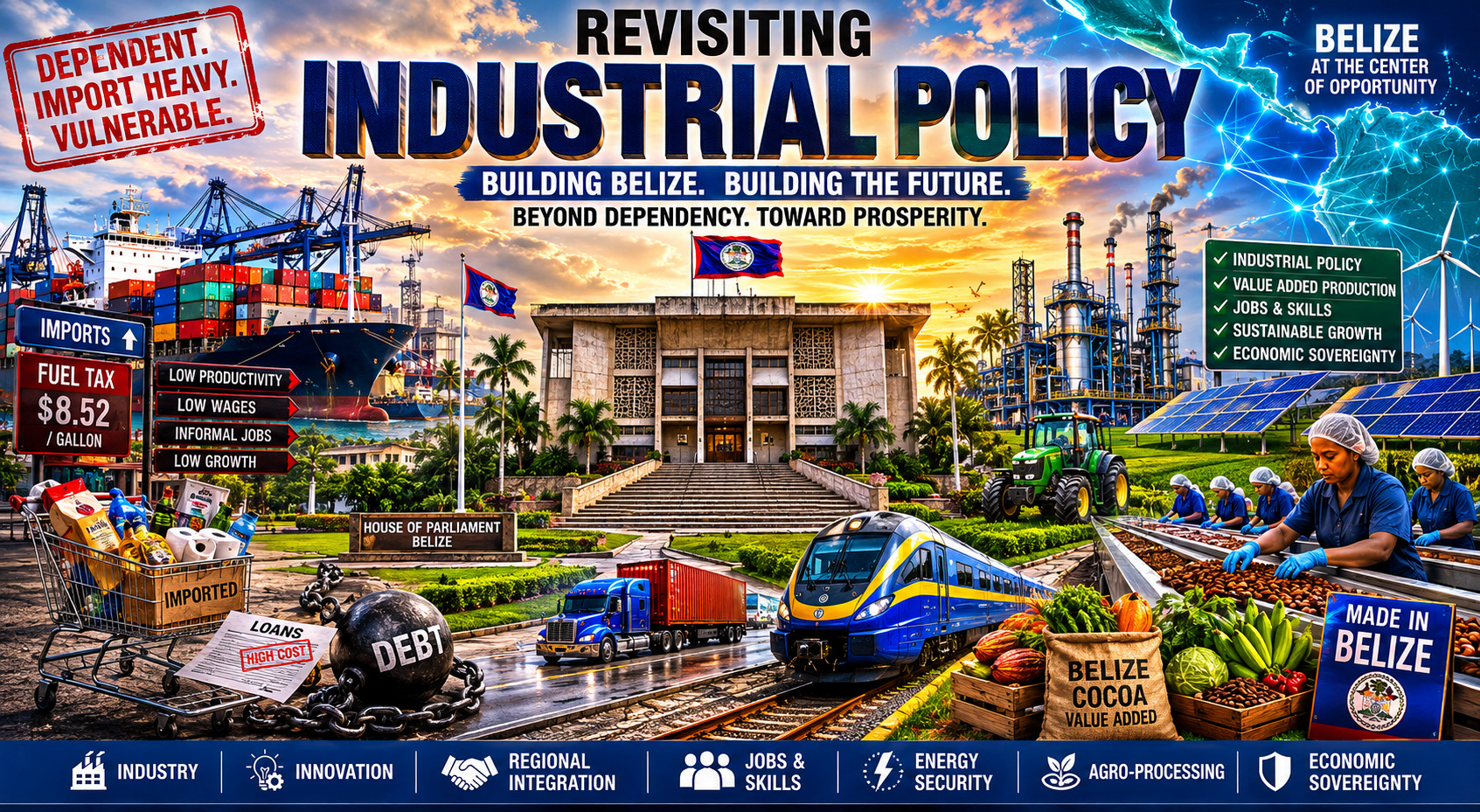
Belize City: Monday 25th May 2026: The latest regional economic outlook coming out of the Inter-American Development Bank and the World Bank is actually sounding a warning siren for Latin America and the Caribbean — including Belize. The central message is blunt: the region cannot continue surviving on low productivity, imports, debt dependence, raw commodity exports, tourism dependency, and weak industrial capacity while expecting meaningful transformation.
Across Latin America and the Caribbean, a profound economic realization is quietly but rapidly taking shape.
The old economic formulas are no longer working.
For decades, governments throughout the region were persuaded — and in many cases pressured — to embrace a model cantered on liberalized imports, privatization, external borrowing, tourism dependency, raw commodity exports, and minimal state participation in productive economic development.
The promise was straightforward:
Open the economy, reduce the role of the state, encourage foreign investment, and prosperity would naturally follow.
But today, even the major international financial institutions themselves are acknowledging that the results have fallen dangerously short.
The latest Economic Update for Latin America and the Caribbean released by the Inter-American Development Bank and supported by analysis from the World Bank sends a message that Belizeans should study carefully:
The region must revisit industrial policy and rebuild productive economies if it hopes to survive the next global economic era.
This is no small adjustment in economic thinking.
This is a strategic shift.
And Belize must pay attention.
The End of Passive Economic Survival
The publication warns that Latin America and the Caribbean remain among the slowest-growing regions in the world, with projected growth hovering around just above two percent — insufficient to significantly reduce poverty, unemployment, public debt, inequality, or economic vulnerability.
That reality is painfully familiar to Belize.
For decades, Belize has survived on an economic structure built heavily around:
- imports,
- tourism,
- fuel taxation,
- external borrowing,
- consumption taxes,
- remittances,
- and limited raw commodity exports.
Meanwhile:
- manufacturing remains weak,
- agro-processing remains underdeveloped,
- productive industries remain limited,
- technical innovation remains minimal,
- and true economic diversification remains more political slogan than national reality.
The result is an economy constantly vulnerable to external shocks.
When fuel prices rise internationally, Belize suffers.
When freight costs increase, Belize suffers.
When tourism slows, Belize suffers.
When global inflation rises, Belize suffers.
When international lenders tighten conditions, Belize suffers.
And yet, successive governments continue operating largely within the same inherited colonial-era economic framework — managing dependency rather than transforming it.
The latest regional economic outlook is effectively warning that such a model is no longer sustainable.
The Return of Industrial Policy
Perhaps the most significant message in the report is the renewed embrace of what economists call “industrial policy.”
For years, many countries were discouraged from directly supporting strategic industries, manufacturing, or state-led economic planning.
Now, the very institutions that once promoted aggressive liberalization are acknowledging that countries cannot industrialize, modernize, or compete globally without strategic national planning.
The report argues that governments must now actively support:
- manufacturing development,
- technological innovation,
- industrial clusters,
- logistics infrastructure,
- technical training,
- renewable energy,
- agro-processing,
- export diversification,
- and productive industries capable of generating value-added growth.
This does not mean returning blindly to outdated state-controlled economic models.
The report specifically warns against corruption, political favoritism, and inefficient bureaucracy.
Instead, the new industrial policy approach calls for:
- transparency,
- measurable outcomes,
- accountability,
- technological competitiveness,
- and regional integration.
In simple language:
Countries must produce more, process more, innovate more, and depend less on imports if they hope to survive future economic turbulence.
Belize’s Dangerous Economic Vulnerability
Belize’s reality fits almost perfectly within the vulnerabilities identified in the regional report.
The country imports the overwhelming majority of:
- manufactured goods,
- machinery,
- processed foods,
- fuel,
- fertilizers,
- pharmaceuticals,
- industrial equipment,
- and consumer products.
At the same time, Belize exports relatively limited value-added products.
Even many of Belize’s agricultural exports leave the country in largely raw form rather than being processed domestically into higher-value products.
This means Belize continues exporting low-value raw production while importing expensive finished goods.
That imbalance drains foreign exchange, weakens national productivity, and traps the economy in dependency.
The publication indirectly raises a critical question Belizeans must now confront:
How can Belize ever achieve meaningful economic independence while remaining overwhelmingly dependent on imported production?
That question becomes even more serious when one considers the global realities now emerging:
- geopolitical tensions,
- trade wars,
- supply chain disruptions,
- energy insecurity,
- artificial intelligence,
- digital transformation,
- climate pressures,
- and growing global competition.
The world economy is changing rapidly.
Belize risks being left behind.
Human Capital: The Foundation Belize Continues to Neglect
One of the strongest warnings in the report concerns education and workforce preparedness.
The future economy will increasingly depend on:
- engineers,
- technicians,
- logistics specialists,
- data analysts,
- manufacturing experts,
- digital technology professionals,
- and highly skilled technical workers.
Yet Belize continues struggling with:
- limited technical institutions,
- weak vocational expansion,
- inadequate industrial training,
- and educational systems still heavily disconnected from modern productive realities.
A country cannot industrialize without skilled human capital.
That is simply economic reality.
Industrial transformation requires a workforce capable of:
- operating modern machinery,
- managing supply chains,
- developing software systems,
- maintaining industrial equipment,
- processing agricultural production,
- and innovating competitively.
Without technical education reform, Belize’s economic future remains constrained.
Informality and Survival Economics
The regional report also highlights another major challenge:
informal economies.
Across Latin America and the Caribbean, millions survive through small unregistered businesses, street commerce, survival entrepreneurship, and unstable self-employment.
Belize reflects this same pattern.
Many Belizeans today are not operating businesses because they see opportunity.
They are doing so because survival leaves them few alternatives.
The report warns that high informality weakens:
- productivity,
- tax collection,
- pensions,
- worker protections,
- access to financing,
- and economic modernization.
The solution, however, is not punishment.
The solution is creating conditions where small enterprises can realistically formalize and grow.
That requires:
- lower bureaucratic barriers,
- access to credit,
- affordable energy,
- fair taxation,
- technical assistance,
- and industrial support mechanisms.
Belize cannot continue suffocating productive sectors through excessive costs while expecting economic growth.
The New Global Opportunity
Despite the warnings, the report also identifies enormous opportunities emerging across Latin America and the Caribbean.
The global transition toward:
- renewable energy,
- artificial intelligence,
- electric transportation,
- digital economies,
- agro-industrial innovation,
- and regional supply chain restructuring
creates strategic openings for countries willing to adapt.
Belize possesses several untapped advantages:
- geographic proximity to Mexico and Central America,
- access to CARICOM markets,
- agricultural potential,
- marine resources,
- fisheries,
- aquaculture,
- renewable energy opportunities,
- tourism integration,
- and a bilingual labor advantage.
But opportunity alone means nothing without national vision.
Belize must stop thinking only in terms of:
- importing,
- taxing,
- borrowing,
- and politically surviving election cycles.
The future belongs to nations capable of producing, processing, innovating, and strategically integrating into regional economies.
Regional Integration Is No Longer Optional
Another major conclusion emerging from the report is that small fragmented economies cannot effectively compete alone.
The future increasingly depends on:
- regional trade integration,
- coordinated logistics,
- transportation connectivity,
- energy cooperation,
- industrial partnerships,
- and integrated production chains.
This is especially important for Belize.
Geographically, Belize sits at the crossroads between:
- Central America,
- Mexico,
- and the Caribbean.
Yet economically, Belize often behaves isolated from the very region surrounding it.
This outdated approach limits:
trade expansion,
industrial partnerships,
investment attraction,
and regional competitiveness.
The report essentially confirms what many economists and regional thinkers have argued for years:
Belize must think regionally if it hopes to grow sustainably.
The National Question Belize Must Now Confront
The deeper issue now confronting Belize is not merely economic.
It is philosophical.
Will Belize continue managing dependency?
Or will Belize finally pursue transformation?
Will governments continue relying on:
fuel taxes,
import duties,
consumption taxes,
external borrowing,
and tourism dependency?
Or will the country finally begin constructing:
productive industries,
manufacturing capacity,
agro-industrial expansion,
technological innovation,
and economic self-sufficiency?
The latest regional economic outlook does not merely present statistics.
By Omar Silva – Editor/Publisher
National Perspective Belize– Digital
- Log in to post comments