The First Five Years That Belize Keeps Ignoring
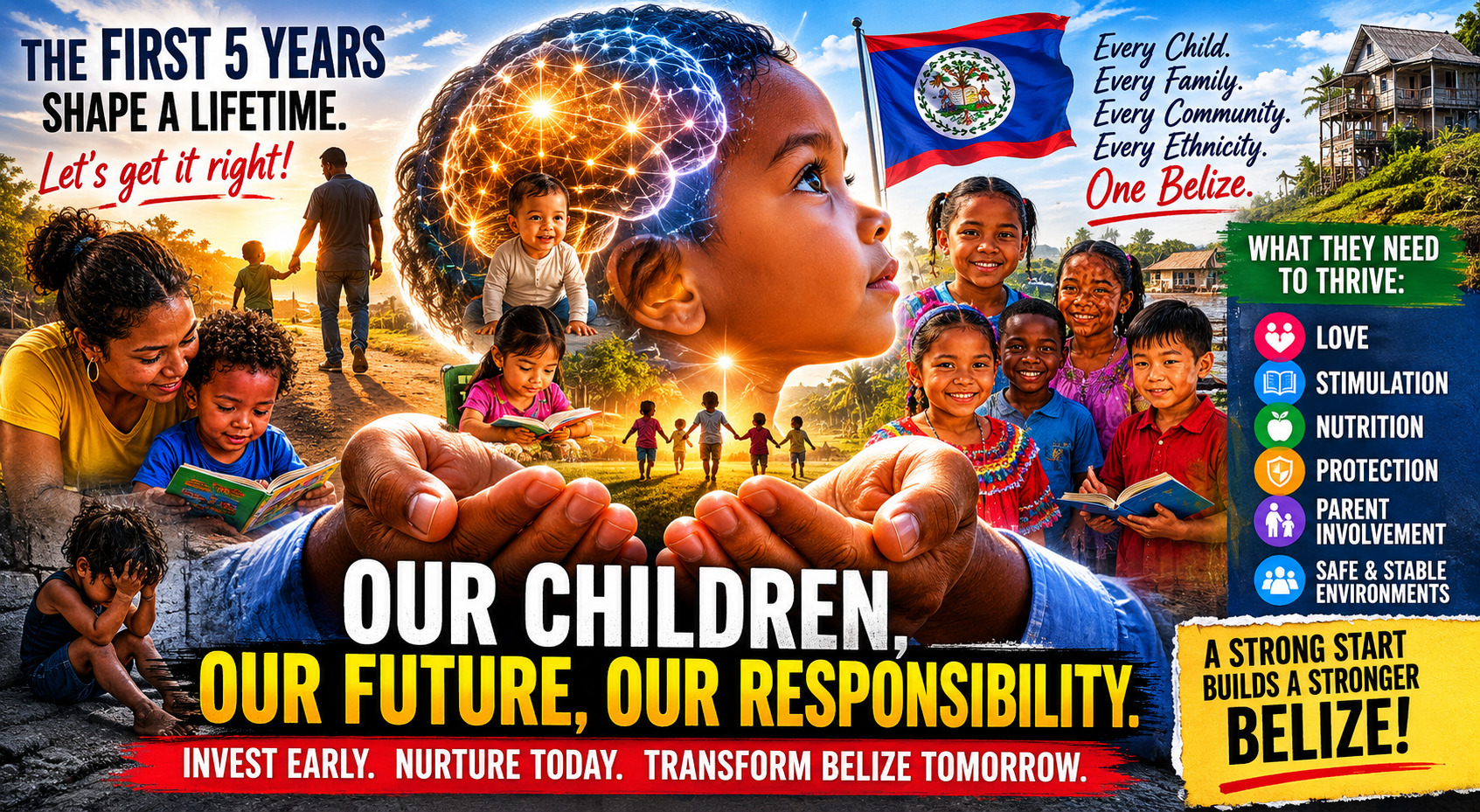
SPECIAL FEATURE DEDICATED TO OUR CHILDREN...
Belize City: Thursday 28th May 2026: Why the IDB’s New Early Childhood Warning Should Concern Every Belizean Family, Every Ethnicity, and the Future of the Nation Itself
For decades, Belize has debated politics, elections, infrastructure, foreign investment, crime, unemployment, migration, and economic survival.
Yet quietly, beneath all the national noise, another crisis has been unfolding inside homes, villages, communities, schools, and struggling households across the country.
It is the silent crisis of Early Childhood Development.
Now, the Inter-American Development Bank (IDB), alongside regional institutions, has released a publication sounding a serious alarm across Latin America and the Caribbean:
the first years of a child’s life will determine the future strength or weakness of entire nations.
That warning should not be ignored in Belize.
The publication highlights more than twenty proven solutions already tested throughout the region which have reportedly benefited over one million children and caregivers. But behind the technical language and international development terminology lies a blunt reality many Belizeans still do not fully understand:
A child’s brain develops faster between birth and age five than at any other time in life.
What happens during those first years determines:
- learning ability,
- emotional stability,
- future productivity,
- behavioural patterns,
- literacy capacity,
- social interaction,
- and even future economic potential.
In other words:
the future of Belize is already being shaped inside homes long before children ever reach primary school.
And that is where Belize faces a serious problem.
A National Problem Hidden in Plain Sight
Across Belize’s many ethnic communities — Mestizo, Creole, Maya, Garifuna, East Indian, Mennonite, Chinese, Lebanese, and mixed populations — child raising has traditionally depended heavily on family structures, grandparents, cultural customs, and survival instincts passed from generation to generation.
Some practices remain strong and nurturing.
Others have weakened under modern economic pressure, migration, poverty, technology dependency, family separation, and social instability.
The reality is that many Belizean parents are struggling silently.
Not because they do not love their children.
But because many themselves were never taught:
- emotional nurturing,
- developmental stimulation,
- communication methods,
- literacy engagement,
- or positive early learning practices.
For generations, many households across the region have operated under the belief that:
“Children will grow naturally on their own.”
The IDB publication challenges that belief directly.
Science now shows that without:
- emotional interaction,
- early stimulation,
- reading exposure,
- play,
- nutrition,
- protection from violence,
- and responsive caregiving,
many children suffer developmental setbacks before they even enter school.
Those setbacks often become permanent.
Belize’s Hidden Childhood Divide
The publication indirectly exposes another uncomfortable reality:
children born into poverty begin life at a severe disadvantage.
That truth is visible throughout Belize.
There are children growing up in:
- overcrowded housing,
- unstable households,
- violent environments,
- food insecurity,
- limited healthcare access,
- and communities where parents are consumed by economic survival.
Meanwhile, wealthier families often have:
- books,
- internet access,
- structured preschool systems,
- stable nutrition,
- emotional support,
- and safer environments.
By the time both children sit in the same Standard One classroom,
they are already worlds apart developmentally.
And Belize’s education system often spends years trying to repair damage that started long before school ever began.
The Forgotten Role of Fathers
One of the strongest findings emerging from regional studies is the absence of fathers in early childhood engagement.
Many men still culturally believe that:
providing financially alone defines fatherhood.
But the IDB and regional child development experts argue otherwise.
Children require:
- emotional interaction,
- language engagement,
- storytelling,
- play,
- reassurance,
- affection,
- and presence.
Not simply financial survival.
Across many Belizean communities, father absence — whether physical or emotional — has become normalized.
The long-term consequences are now becoming visible in:
- behavioural instability,
- youth violence,
- emotional detachment,
- gang recruitment,
- school failure,
- and social fragmentation.
The publication effectively warns that national crime prevention begins inside childhood development long before police intervention ever becomes necessary.
Violence Is Reshaping Childhood
The report places major emphasis on “toxic stress.”
That includes:
- domestic violence,
- shouting,
- instability,
- alcoholism,
- drug abuse,
- neglect,
- chronic fear,
- and emotional trauma inside homes.
These conditions literally affect brain development during infancy.
This becomes especially relevant for Belize, where many children are exposed daily to:
- social violence,
- economic pressure,
- political frustration,
- migration uncertainty,
- and unstable living conditions.
The damage is often invisible.
But it surfaces years later through:
- poor school performance,
- aggression,
- depression,
- anti-social behaviour,
- addiction,
- and cycles of poverty.
Belize Cannot Build a Strong Economy While Neglecting Childhood
Perhaps the most powerful message hidden inside the IDB publication is economic.
Early childhood development is not charity.
It is national investment.
A country cannot realistically expect:
- productivity,
- innovation,
- industrial growth,
- educational excellence,
- or social stability while neglecting the developmental foundation of its children.
Every weak educational outcome.
Every literacy crisis.
Every violent youth.
Every underperforming workforce.
Often traces back to failures during early childhood.
The publication argues that governments spend far more money later repairing social damage than they would investing early in children.
In practical terms:
Belize can either invest early in childhood development now,
or continue paying later through:
- prisons,
- crime fighting,
- remedial education,
- welfare dependency,
- healthcare burdens,
- and social instability.
A National Conversation Belize Has Barely Started
The uncomfortable reality is that Early Childhood Development rarely becomes a major national discussion in Belize.
Political campaigns focus on:
- roads,
- contracts,
- buildings,
- slogans,
- and election theatrics.
Meanwhile, the developmental condition of Belize’s children quietly deteriorates beneath the surface.
The IDB publication should therefore not simply be viewed as another international report.
It should serve as a wake-up call.
Because no country transforms economically while neglecting the mental, emotional, and developmental foundation of its youngest population.
What Belize Must Begin Considering
The publication indirectly points toward several areas Belize may eventually need to strengthen nationally:
Expanded parental education programs
Teaching caregivers practical developmental methods.
Greater nutritional support
Especially during pregnancy and early infancy.
Community early learning centers
Particularly in vulnerable rural and urban communities.
Literacy exposure at home
Encouraging reading, storytelling, and language development.
Mental health and emotional support systems
For both parents and children.
Stronger father involvement campaigns
Reframing cultural understandings of fatherhood.
Better childcare support for working families
Especially single-parent households.
Early detection systems
For developmental delays and disabilities.
The Future of Belize Begins Before Primary School
The most profound truth emerging from the IDB publication is perhaps the simplest one:
A nation’s future workforce,
future leadership,
future productivity,
future stability,
and future prosperity are already being shaped in the earliest years of childhood.
Long before politics.
Long before elections.
Long before adulthood.
And unless Belize begins taking Early Childhood Development seriously at a national level,
the country may continue producing generations forced to struggle against disadvantages they never chose in the first place.
The future of Belize does not begin in Parliament.
It begins in the first years of life inside Belizean homes.
By: Omar Silva – Editor/Publisher
National Perspective Belize – Digital
- Log in to post comments