THE FLEET MOVES BACK Is America Being Pushed Toward a Future Withdrawal from the Persian Gulf?
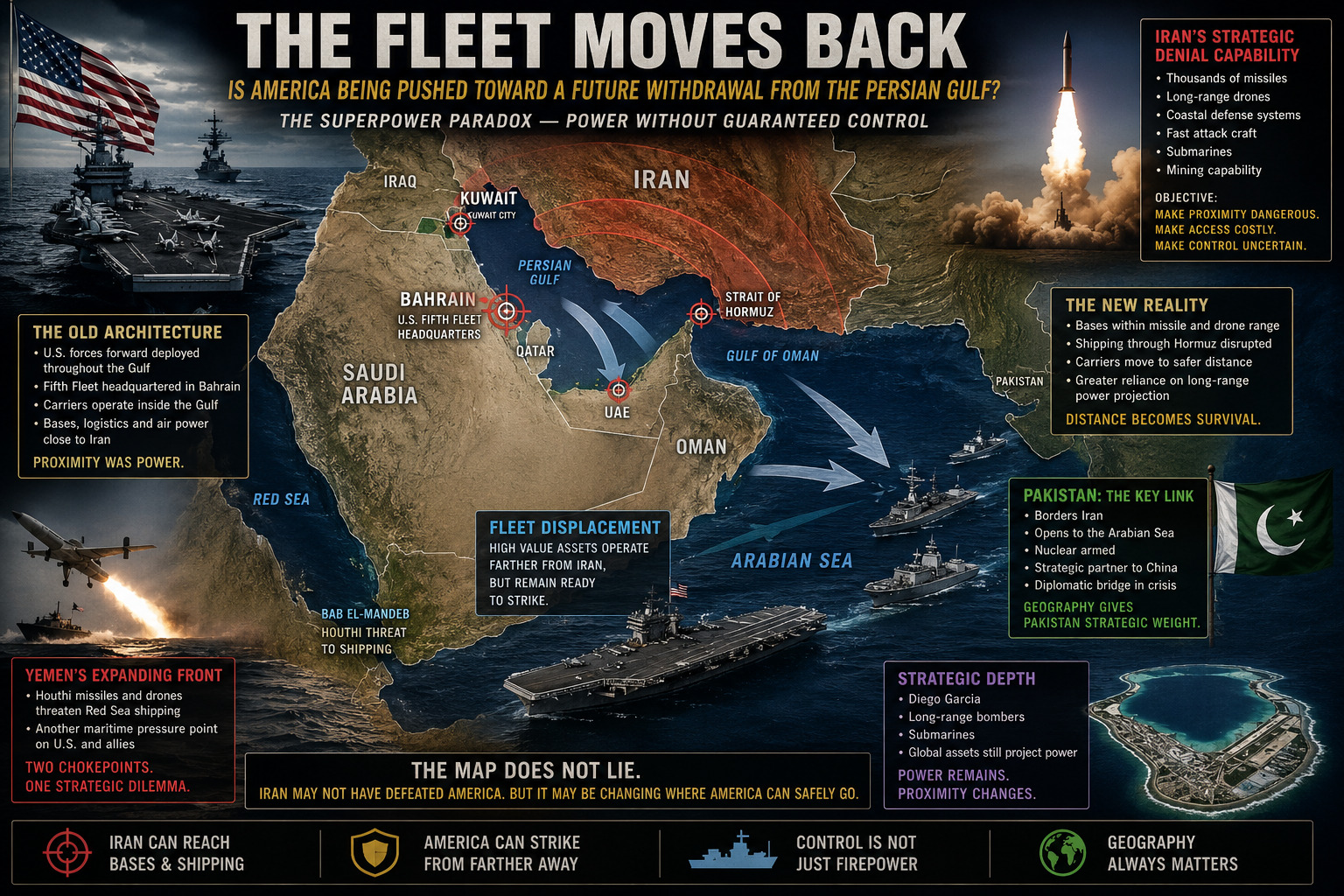

THE SUPERPOWER PARADOX — Power Without Guaranteed Control
A National Perspective Belize Geopolitical Feature
Belize City: Thursday 13th August 2026: There are moments in military history when the most important development is not the battle being fought, the missile being launched or the declaration being made.
It is the movement on the map.
And something important may now be happening on the waters surrounding Iran.
Reports emerging from Iran, Yemen, Pakistan and other parts of the region increasingly suggest that United States naval forces are changing the way they position themselves around the Persian Gulf.
Some reports go considerably further, describing what is happening as an American naval withdrawal.
That conclusion cannot yet responsibly be presented as established fact.
The United States Fifth Fleet has not formally announced that it is abandoning Bahrain. Washington has not declared that it is relinquishing the Persian Gulf. CENTCOM continues conducting extensive military operations throughout its regional area of responsibility.
But concentrating exclusively upon whether Washington has formally announced a withdrawal may cause us to miss the much larger strategic story.
Because military withdrawals rarely begin with a press conference.
Sometimes they begin with distance.
- They begin when expensive military assets are moved farther away from an adversary.
- They begin when bases once regarded as secure become targets.
- They begin when ships that once operated confidently within confined waters increasingly perform their missions from more distant seas.
- They begin when commanders must calculate not merely how much firepower they possess — but how much risk they must accept merely to position that firepower where it was once routinely stationed.
And measured against those criteria, there is now sufficient evidence to ask a serious question:
HAS IRAN BEGUN TO CHANGE THE GEOGRAPHY OF AMERICAN POWER?
For generations, American dominance of the Persian Gulf was built around an extraordinary military architecture.
Naval forces operated throughout the Gulf.
The Fifth Fleet established its headquarters in Bahrain.
American aircraft operated from bases distributed across Gulf monarchies.
Pre-positioned equipment, logistics installations, intelligence facilities and air-defence systems created an interconnected network capable of projecting American military power throughout the Middle East.
The architecture communicated an unmistakable message:
- America was not merely capable of entering the Gulf.
- America lived there militarily.
- Iran could threaten that architecture.
- It could criticize it.
- It could build missiles against it.
- But Washington possessed overwhelming conventional military superiority.
That assumption now requires examination.
WHEN THE BASE BECOMES THE TARGET
The strategic vulnerability of America's Persian Gulf posture is geographical.
- Bahrain is extremely close to Iran.
- So are Qatar, Kuwait and the United Arab Emirates.
The Persian Gulf itself is relatively narrow.
- Its only maritime entrance and exit into the Gulf of Oman passes through the Strait of Hormuz.
- That geography was manageable when American military superiority meant that regional adversaries possessed limited ability to threaten American bases, ships and logistical networks simultaneously.
- Iran spent decades developing a different answer.
- Rather than attempting to construct an American-style military, Tehran invested heavily in missiles, drones, coastal systems, dispersed launchers and asymmetric warfare.
- The objective did not necessarily have to be destroying the United States Navy.
- There was another possibility.
Make operating close to Iran increasingly dangerous.
That possibility is no longer theoretical.
- Iranian attacks during the present confrontation have placed American military interests in Bahrain, Kuwait and elsewhere under direct threat.
- The implications reach far beyond individual missile strikes.
- Because Bahrain is not simply another American overseas military installation.
- It hosts the headquarters of the United States Fifth Fleet.
- Once the headquarters itself enters the adversary's targeting equation, a fundamental military calculation changes.
The question becomes:
- How much strategic value is gained by remaining close compared with how much vulnerability that proximity creates?
THE CARRIER PROBLEM
Nothing illustrates the paradox more clearly than the American aircraft carrier.
- A modern carrier strike group represents an extraordinary concentration of naval power.
- Its aircraft can strike targets hundreds of kilometres away.
- Its escorts provide air defence, missile defence, anti-submarine protection and offensive capabilities.
But the carrier's immense value also creates its greatest strategic weakness.
It is an asset commanders cannot afford to expose unnecessarily.
- The Persian Gulf is confined water.
- The Arabian Sea is not.
- From the Arabian Sea, an American carrier has vastly greater space for manoeuvre.
- Its location becomes more difficult to predict.
- Iranian coastal missile systems must operate across considerably greater distances.
- And American aircraft can still conduct missions toward Iran with aerial refuelling and supporting assets.
Consequently, the important question is not whether an American carrier can enter the Persian Gulf.
Of course it can.
The question is increasingly:
Why would it need to?
That apparently simple question could eventually transform America's entire Gulf naval doctrine.
THE DIFFERENCE BETWEEN DEFEAT AND DENIAL
Iran does not have to sink an American aircraft carrier to achieve an important strategic objective.
This point is essential.
- Military power is frequently measured by what weapons destroy.
- But deterrence also operates through what weapons prevent an adversary from doing.
If Iranian missiles, drones, submarines, coastal defences or fast-attack systems create sufficient risk that American commanders prefer positioning major assets farther from Iranian territory, then those weapons are producing strategic effects even when they never strike an American vessel.
This concept is known broadly within military strategy as anti-access and area denial.
Its purpose is straightforward:
- Make entry expensive.
- Make proximity dangerous.
- Make sustained operations difficult.
- And eventually force the adversary to operate from farther away.
That does not amount to defeating the United States Navy.
- It changes the geography within which that Navy can exercise its advantages.
And geography matters enormously.
HORMUZ — WHERE THE CLAIM OF CONTROL MEETS REALITY
Nowhere is this contradiction clearer than the Strait of Hormuz.
Washington has repeatedly projected confidence regarding its ability to maintain maritime access through this crucial waterway.
Yet commercial behaviour tells its own story.
- Shipping through Hormuz has remained dramatically disrupted.
- Insurance companies calculate risk.
- Tanker operators calculate risk.
- Shipowners calculate risk.
- Naval commanders calculate risk.
- Markets calculate risk.
- None of them operate according to political declarations.
They operate according to what they believe can actually happen.
That distinction is extremely important.
A state can announce that it controls a waterway.
But genuine maritime control exists when vessels can reliably transit that waterway without unacceptable danger.
If commercial shipping remains severely restricted despite enormous American military power in the region, then the Persian Gulf confrontation has revealed something considerably larger than a temporary shipping disruption.
- It has revealed the difference between military superiority and guaranteed control.
That is precisely the Superpower Paradox.
YEMEN CHANGES THE EQUATION FURTHER
There is another dimension Washington must confront.
The strategic problem no longer exists exclusively around Iran.
Yemen's Houthi forces have demonstrated the ability to threaten maritime traffic around the Bab el-Mandeb and Red Sea.
Recent attacks have again made those waters dangerous, while the Houthis have announced broader maritime pressure against Saudi Arabia.
That means American planners are confronting pressure around two critical maritime corridors.
To the east:
Strait of Hormuz.
To the west:
Bab el-Mandeb and the Red Sea.
Between them lie Saudi Arabia and the broader American Gulf security architecture.
This creates something approaching a strategic compression of American maritime power.
- Moving ships away from the Persian Gulf does not necessarily remove them from danger.
- Moving west introduces the Red Sea problem.
- Moving east places them farther into the Arabian Sea.
- America therefore possesses overwhelming military strength while simultaneously confronting increasingly complicated geography.
Again:
Power without guaranteed control.
PAKISTAN — THE QUIETLY IMPORTANT PLAYER
Pakistan should not be treated as a peripheral observer.
Its geographical position makes it enormously important.
Pakistan sits immediately east of Iran.
- Its coastline opens onto the Arabian Sea.
- It maintains deep relations with Gulf states.
- It possesses nuclear weapons.
- It maintains military relations with both China and the United States.
- And Islamabad has increasingly become involved diplomatically in attempts to prevent further escalation between Washington and Tehran.
That gives Pakistani reporting and diplomatic messaging particular importance.
- It should not automatically be accepted as confirmation of battlefield developments.
But neither should it be dismissed.
- Pakistan is positioned geographically and diplomatically close enough to the crisis that developments appearing through Pakistani channels deserve examination alongside Western, Iranian, Arab and independent sources.
The National Perspective therefore should not construct its understanding exclusively through Washington.
Nor exclusively through Tehran.
The responsible approach is triangulation.
- What does America say?
- What does Iran say?
- What are Gulf governments observing?
- What is Pakistan reporting?
- What are Yemeni actors claiming?
And finally:
What are the ships actually doing?
That last question may eventually become the most important one.
DO NOT WAIT FOR WASHINGTON TO CALL IT A WITHDRAWAL
Governments rarely describe strategic setbacks using the vocabulary of their adversaries.
- A retreat may become a "force realignment."
- A withdrawal may become a "redeployment."
- An evacuation may become a "precautionary repositioning."
- A vulnerable base may become a "distributed operating environment."
These expressions are not necessarily dishonest.
Military forces genuinely reposition for tactical reasons.
- But language can obscure strategic transformation.
Therefore, we should not become trapped by terminology.
The National Perspective does not need to prove that Washington has secretly ordered the abandonment of the Persian Gulf.
There is currently insufficient evidence for such a claim.
Our inquiry is more consequential:
- ARE THE CONDITIONS EMERGING THAT COULD EVENTUALLY MAKE AMERICA'S PRESENT PERSIAN GULF MILITARY ARCHITECTURE UNSUSTAINABLE?
That is now a legitimate question.
And if the answer eventually becomes yes, the geopolitical consequences would be profound.
WITHDRAWAL DOES NOT MEAN DISAPPEARANCE
There is another misconception we must avoid.
An eventual American withdrawal of high-value naval assets from inside the Persian Gulf would not mean America disappeared from the Middle East.
Quite the contrary.
The United States could maintain enormous military power from:
- the Arabian Sea,
- Diego Garcia,
- regional airfields,
- carrier groups,
- submarines,
- long-range bombers,
- missile platforms,
- satellite networks,
- and allied installations.
America's military reach would remain formidable.
- But the architecture would change.
- Instead of permanent proximity, Washington could increasingly rely upon offshore projection.
- Instead of placing major assets inside Iran's immediate weapons envelope, those assets could remain farther away while striking from greater distances.
That would represent neither American military collapse nor Iranian conquest of the Gulf.
- It would represent something more subtle.
Iran would have altered the price America must pay to remain physically close to it.
- Historically, that would be an extraordinary strategic achievement.
THE FORESEEABLE WITHDRAWAL
This brings us to the proposition at the centre of this feature.
A formal American withdrawal from the Persian Gulf has not occurred.
- But a foreseeable pathway toward partial naval displacement now exists.
It could develop in stages.
- First comes dispersal.
- Then greater reliance upon the Arabian Sea.
- Then reduced routine presence of high-value platforms within confined Gulf waters.
- Then hardened or distributed bases.
- Then greater dependence upon unmanned systems, submarines, long-range aircraft and partner navies.
- And eventually political leaders may discover that the Navy has already changed its operational geography before anyone formally announces that strategic doctrine has changed.
That is how military eras sometimes end.
- Not with surrender.
- Not with flags being lowered.
- Not even necessarily with defeat.
- But with commanders quietly deciding that yesterday's operating environment has become tomorrow's unacceptable risk.
THE SUPERPOWER PARADOX
The war surrounding Iran is therefore testing something much larger than Iranian military capability.
It is testing the meaning of superpower itself.
- The United States can possess more aircraft.
- More advanced warships.
- More satellites.
- More sophisticated intelligence.
- More global bases.
- More long-range bombers.
- More financial resources.
- And more total conventional military capability than Iran.
Yet none of those advantages automatically guarantees uncontested control of a narrow sea located beside the territory of an adversary possessing thousands of missiles, drones and distributed weapons systems.
That is the paradox.
- Power can destroy.
- Power can punish.
- Power can dominate battles.
But power does not automatically eliminate geography.
And geography has returned to the Persian Gulf.
THE QUESTION HISTORY MAY EVENTUALLY ASK
- Perhaps historians will look back upon this confrontation and conclude that America successfully preserved its Gulf military architecture.
- Perhaps diplomatic settlement will reduce the threat.
- Perhaps Washington will reinforce Bahrain and other installations and restore something resembling the old equilibrium.
Those possibilities must remain inside any serious analysis.
But another possibility can no longer be dismissed.
Historians may eventually discover that the American departure from the Persian Gulf did not begin on the day Washington announced a withdrawal.
- It began much earlier.
- It began when Iranian missiles made the bases vulnerable.
- It began when commercial ships hesitated to enter Hormuz.
- It began when carriers found greater security farther into the Arabian Sea.
- It began when defending the architecture became increasingly expensive.
- And it began when America's enormous military machine confronted an uncomfortable reality:
THE MOST POWERFUL NAVY ON EARTH MAY STILL HAVE TO RESPECT THE GEOGRAPHY OF A MUCH WEAKER ADVERSARY.
That would not constitute the disappearance of American power.
It would constitute something geopolitically more important.
The end of guaranteed proximity.
- And perhaps that is the real story now developing beneath the missiles, speeches and propaganda of the Persian Gulf war.
The fleet may not yet be leaving.
But for the first time in generations, there are serious reasons to ask whether the strategic conditions are being created that could eventually compel it to move back.
By: Omar Silva - Editor/Publisher @ www.nationalperspectivebz.com
- Log in to post comments