WHEN WHATSAPP BECOMES EVIDENCE: The CCJ Reset That Shook Belize’s Extradition System
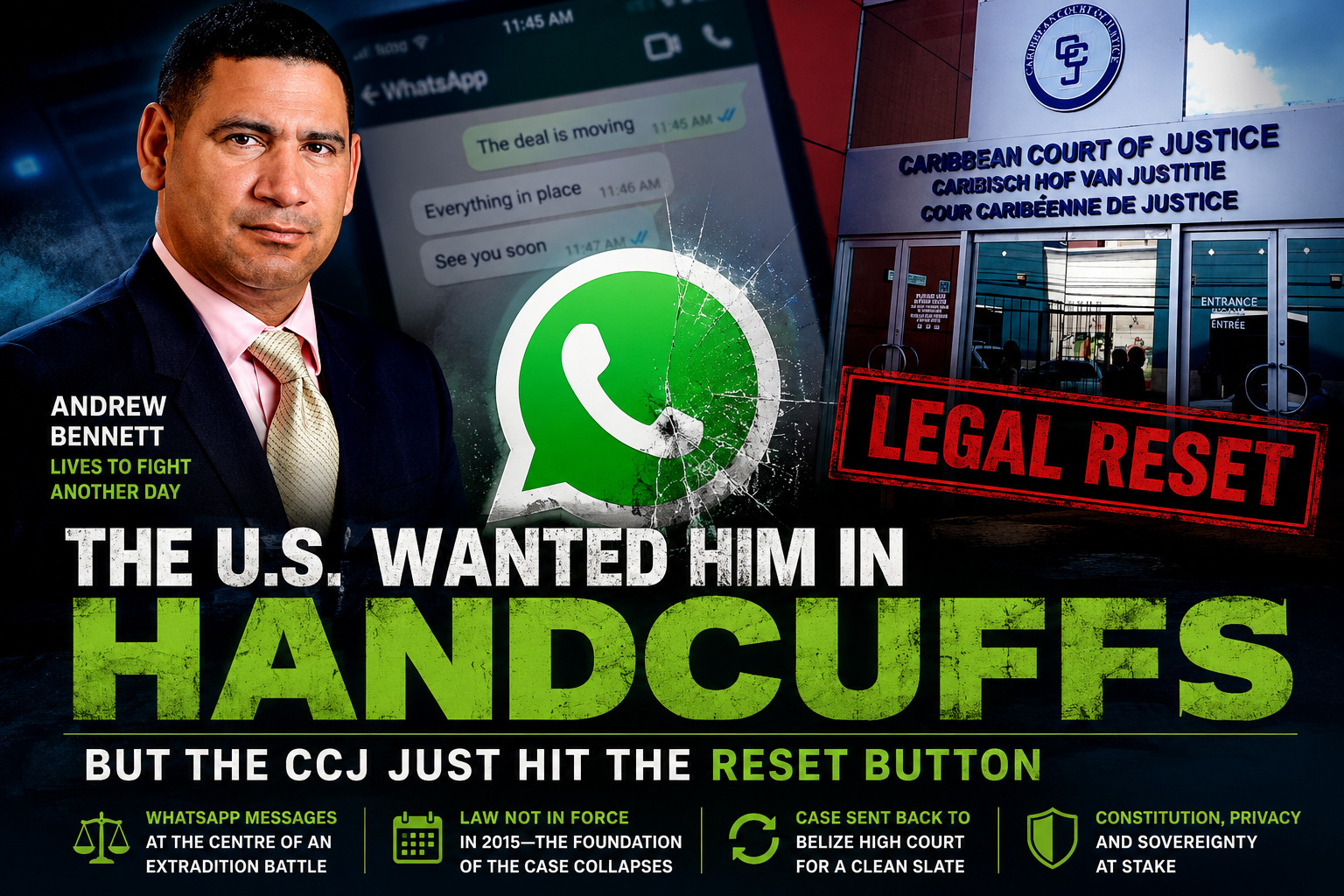
The CCJ Reset That Shook Belize’s Extradition System
By: Omar Silva – Editor/Publisher
National Perspective Belize – Digital
Belize City Saturday 16th May 2026
For years, the extradition battle involving Belizean attorney Andrew Bennett appeared to be steadily moving toward one inevitable destination: extradition to the United States over allegations tied to drug money laundering and communications with undercover operatives connected to the U.S. Drug Enforcement Administration (DEA).
But in a dramatic judicial twist now reverberating through Belize’s legal and constitutional landscape, the Caribbean Court of Justice (CCJ) has effectively blown apart the legal foundation upon which the previous rulings against Bennett had been built.
The result?
The extradition process has been reset.
The United States may still want Andrew Bennett in handcuffs, but for now, Bennett remains on Belizean soil — and perhaps more importantly, the case has reopened serious constitutional, legal, and sovereignty questions that Belizeans should not ignore.
Because beneath the headlines lies a much bigger issue:
What happens when WhatsApp messages, foreign undercover operations, and digital surveillance collide with Belize’s constitutional protections?
And more critically:
How did Belize’s courts spend years relying on a law that was not even legally in force at the time the alleged communications took place?
That question alone now stands as one of the most uncomfortable legal revelations in recent Belizean judicial history.
THE CASE THAT WOULD NOT END
The allegations against Bennett stem from a U.S.-led undercover operation dating back to 2015. According to reports emerging from the extradition proceedings, WhatsApp communications allegedly exchanged between Bennett and undercover operatives formed a major pillar of the American case.
Those digital communications became central evidence.
However, Bennett’s legal team fought aggressively against their use, arguing that the interception and use of the communications violated Belize’s constitutional protections and the provisions of Belize’s Interception of Communications Act.
For years, Belize’s High Court and Court of Appeal accepted those arguments.
The courts proceeded on the understanding that the law governing intercepted communications applied to the 2015 exchanges.
But at the CCJ level, a stunning discovery emerged:
The Interception of Communications Act had not yet been legally brought into force in 2015.
The legislation reportedly only became operational in late 2023.
That revelation changed everything.
A MASSIVE JUDICIAL OVERSIGHT
The CCJ identified what lawyers refer to as a per incuriam error — meaning the lower courts reached decisions while operating under a mistaken legal assumption.
This was not a minor procedural glitch.
It means that years of constitutional reasoning, evidentiary rulings, and legal arguments rested on a statutory framework that technically did not exist in enforceable form at the time of the alleged events.
In simple language:
Belize’s courts spent years debating protections under a law that was not legally active.
That revelation alone should send shockwaves through Belize’s legal fraternity.
Because if courts can proceed for years under an incorrect assumption regarding whether a law is actually in force, serious questions naturally arise:
- Where was the prosecutorial verification?
- Where was judicial scrutiny?
- How did both defence and prosecution overlook such a critical statutory reality?
- And how many other cases may contain similar procedural assumptions?
The CCJ did not exonerate Bennett.
But it did something equally significant:
It dismantled the legal track that had been carrying the extradition process forward.
WHY THIS IS A FUNCTIONAL WIN FOR BENNETT
In extradition law, outright acquittals are rare.
Most battles revolve around procedure, timing, admissibility, constitutional safeguards, and delay.
From a strategic legal standpoint, Bennett achieved what many extradition defendants seek:
time, reset, and procedural survival.
By sending the matter back to the Belize High Court for reconsideration, the CCJ effectively restarted the process.
That means:
- fresh constitutional arguments,
- renewed evidentiary challenges,
- new hearings,
- additional appeals,
- and potentially years more litigation.
For a defendant fighting extradition, that is no small victory.
The handcuffs remain suspended.
THE WHATSAPP QUESTION BELIZE MUST NOW FACE
Months ago, concerns were already being raised publicly about the dangerous precedent of using WhatsApp communications as the backbone of extradition proceedings.
Today, those concerns appear more justified than ever.
Digital messaging platforms now occupy one of the murkiest legal territories in modern criminal law.
The Bennett matter forces Belize to confront difficult constitutional realities:
- Are WhatsApp conversations private communications?
- Under what circumstances can they be intercepted?
- Can screenshots alone satisfy evidentiary standards?
- Who authenticates digital messages?
- What constitutes lawful consent?
- Can foreign agencies conduct covert digital operations that later become evidence in Belizean courts?
- Which country’s privacy laws apply?
- And what protections do Belizeans actually possess in the digital age?
These are not merely technical legal questions anymore.
They strike directly at constitutional privacy rights, due process protections, and national sovereignty.
THE DEA DIMENSION AND NATIONAL SOVEREIGNTY
Another issue that cannot be ignored is the role of the DEA.
Reports indicate the communications were tied to undercover operations connected to U.S. federal agents.
That opens an even deeper debate:
How much influence should foreign law enforcement operations exert inside Belize’s justice system?
Belize, like many smaller nations, maintains close cooperation with the United States on security and narcotics enforcement.
But cooperation and constitutional surrender are not the same thing.
The Bennett case now forces Belizeans to ask:
If foreign agencies gather digital evidence abroad or through covert operations, what constitutional safeguards protect Belizean citizens and residents from overreach?
This issue transcends Bennett himself.
It concerns the future balance between international cooperation and Belizean constitutional independence.
THE DIGITAL ERA HAS OUTPACED BELIZE’S LEGAL SYSTEM
Perhaps the most alarming lesson from this case is how rapidly technology has outpaced traditional legal systems.
WhatsApp, Signal, Telegram, encrypted communications, cloud storage, metadata tracking, digital surveillance, screenshots, and covert online identities now dominate modern investigations.
Yet many legal frameworks throughout the Caribbean remain outdated, fragmented, or poorly understood even within judicial circles.
The Bennett matter exposes the danger of this gap.
When courts, prosecutors, and defence attorneys all struggle to navigate rapidly evolving digital evidence laws, constitutional mistakes become increasingly likely.
And when liberty depends on those rulings, the consequences become enormous.
THE BIGGER WARNING FOR BELIZE
This case is no longer simply about Andrew Bennett.
It has evolved into something far larger:
a warning about Belize’s preparedness for the digital legal age.
The CCJ’s intervention exposed vulnerabilities involving:
- statutory verification,
- judicial diligence,
- digital evidence,
- constitutional protections,
- and foreign investigative influence.
The uncomfortable truth is that Belize now finds itself confronting a legal future where WhatsApp messages may carry the same evidentiary weight once reserved for signed confessions, recorded conversations, or physical documents.
But unlike traditional evidence, digital communications can be:
- manipulated,
- selectively presented,
- contextually distorted,
- anonymously generated,
- or obtained through questionable surveillance methods.
That reality demands extreme judicial caution.
A CASE THAT MAY RESHAPE FUTURE EXTRADITIONS
The Bennett saga is far from over.
The United States still seeks extradition.
The allegations remain unresolved.
But the CCJ’s ruling may ultimately become one of the most consequential legal moments in Belize’s modern extradition history.
Not because it declared innocence.
But because it exposed how fragile the legal architecture surrounding digital evidence and constitutional rights may actually be.
In the end, the greatest lesson emerging from this judicial reset may not concern one attorney fighting extradition.
It may concern whether Belize’s justice system is truly prepared for the dangerous intersection between technology, foreign enforcement power, and constitutional liberty in the digital age.
- Log in to post comments