BELIZE AT THE EDGE OF THE GLOBAL STORM: Why the 2026 Latin America & Caribbean Economic Outlook Should Terrify — and awaken — Belize
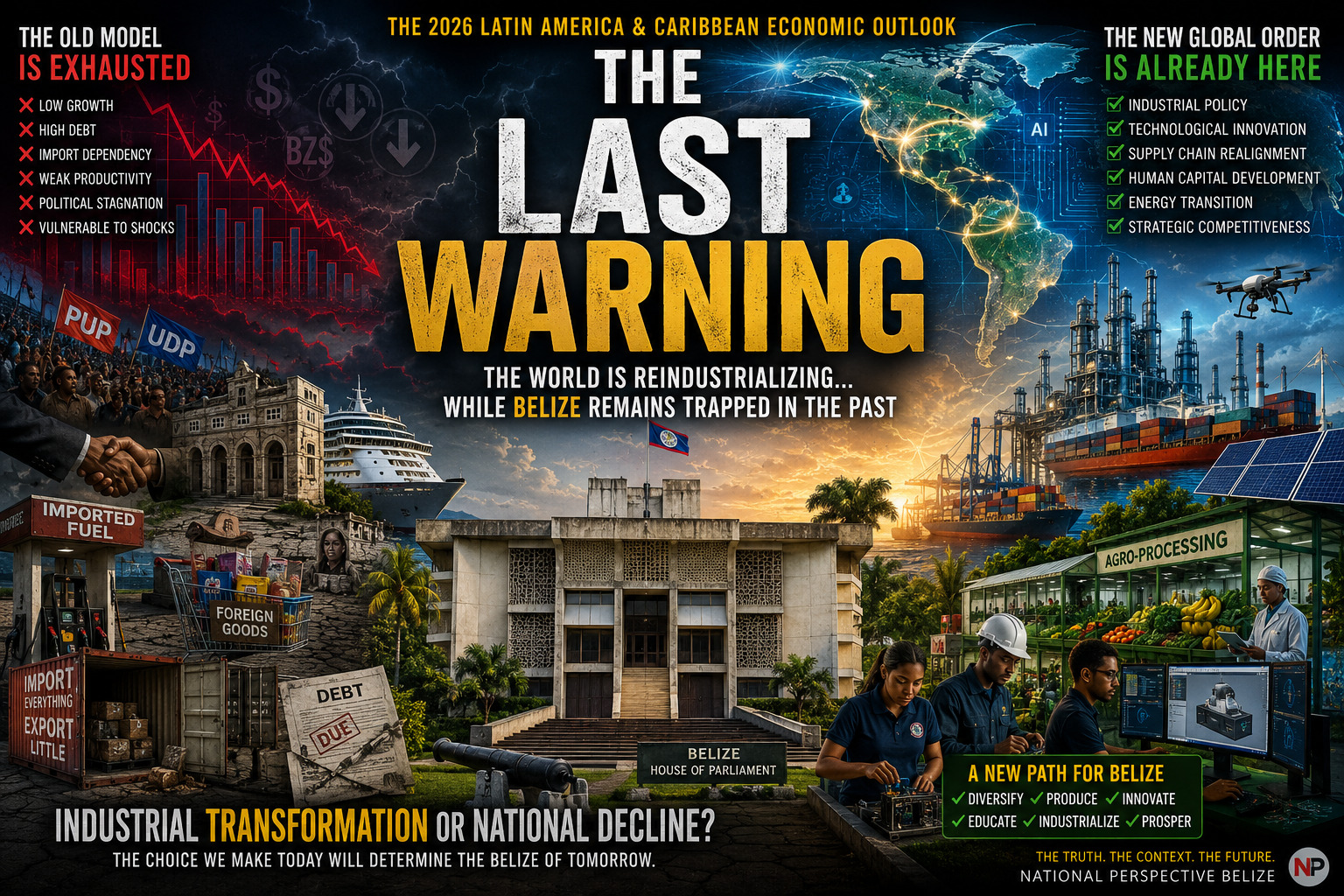
Why the 2026 Latin America & Caribbean Economic Outlook Should Terrify — and awaken — Belize
By: Omar Silva – Editor/Publisher
National Perspective Belize – Digital
Belize City: Thursday 14th May 2026
The latest April 2026 economic outlook from the World Bank titled “Revisiting Industrial Policy: Strategic Options for Today” is not merely another technical economic document buried in international bureaucracy.
It is a warning.
A warning to every small, import-dependent, politically stagnant nation in Latin America and the Caribbean.
And for Belize, it should sound like a national alarm bell.
The report lays bare a painful reality:
- Latin America and the Caribbean remain among the slowest-growing regions on Earth.
- Productivity remains weak.
- Quality jobs are disappearing.
- Public debt continues rising.
- Investment is collapsing under uncertainty.
- Global instability is reshaping trade, energy, manufacturing, and geopolitical alliances faster than most governments can react.
For Belize — a nation still trapped inside an obsolete colonial-style economic framework dependent on imports, tourism, debt, consumption, foreign financing, and political patronage — the implications are profound.
Because the global economic order is changing.
And Belize is dangerously unprepared.
THE WORLD IS ENTERING A NEW INDUSTRIAL ERA
One of the most explosive revelations in the report is the global return of Industrial Policy.
For decades, institutions like the World Bank promoted open-market liberalization and minimal state intervention.
Now, the same institutions openly acknowledge that nations which strategically protected, developed, trained, financed, and modernized their productive sectors achieved transformational growth — particularly the Asian economies once dismissed as “exceptions.”
The report openly revisits:
- South Korea
- Taiwan
- Singapore
- Industrial modernization models
- Export-driven manufacturing
- Strategic state coordination
- Human capital development
- Technological upgrading
- Value-chain integration
And indirectly asks Latin America and the Caribbean:
“Why did your region fail to transform?”
For Belize, that question cuts deep.
Because Belize never truly industrialized.
Belize never created a national manufacturing vision.
Belize never built a modern productive state.
Instead:
- Governments competed over political colors.
- Consumption replaced production.
- Imports replaced national productivity.
- Political theatrics replaced long-term planning.
- Foreign dependency became normalized.
The result?
A country permanently vulnerable to:
- oil shocks,
- shipping disruptions,
- inflation,
- tourism collapse,
- global wars,
- foreign lending pressure,
- and external economic dictates.
THE GLOBAL SYSTEM IS FRACTURING
The World Bank report warns of rising instability tied to:
- geopolitical conflicts,
- energy volatility,
- shifting trade regimes,
- inflation uncertainty,
- and weakening global investment confidence.
The ongoing Middle East conflict has already triggered:
- energy price instability,
- transportation cost increases,
- inflationary pressure,
- and renewed fears across import-dependent economies.
Belize imports almost everything:
- fuel,
- machinery,
- processed foods,
- industrial inputs,
- pharmaceuticals,
- construction materials,
- technology,
- fertilizers,
- and manufactured goods.
That means Belize imports inflation.
Belize imports vulnerability.
Belize imports dependency.
And when global conflict erupts, Belize absorbs the pain without having productive buffers of its own.
TOURISM ALONE CANNOT SAVE BELIZE
Perhaps the greatest illusion sold to Belizeans over the past 40 years is that tourism alone could carry the nation indefinitely.
Tourism is important.
But tourism is fragile.
One pandemic.
One war.
One recession.
One oil shock.
One climate disaster.
One geopolitical conflict.
And the entire economic engine begins to tremble.
The World Bank and IMF are both warning that tourism-dependent Caribbean economies are especially vulnerable in the current global environment.
Belize stands directly in that danger zone.
Without:
- diversified industry,
- manufacturing capacity,
- technological development,
- agro-processing,
- energy sovereignty,
- skilled labor expansion,
- and regional industrial integration,
Belize remains exposed.
THE REAL CRISIS IS NOT ECONOMIC — IT IS STRUCTURAL
The most important lesson hidden inside the April 2026 report is this:
Economic stagnation is not accidental.
It is structural.
The report repeatedly references:
- weak institutions,
- low productivity,
- weak competition,
- lack of innovation,
- poor educational alignment,
- and insufficient human capital development.
Belize suffers from every single one of those weaknesses simultaneously.
For decades:
- politics became transactional,
- education became disconnected from industrial reality,
- governance became reactive,
- and national planning became election-cycle propaganda.
Meanwhile:
- the productive base shrank,
- the youth migrated,
- skilled labor stagnated,
- and economic sovereignty weakened.
THE REPORT QUIETLY VALIDATES WHAT MANY HAVE WARNED FOR YEARS
The World Bank now openly recognizes that nations require:
- strategic industrial direction,
- coordinated investment,
- skilled workforce development,
- innovation systems,
- deeper trade integration,
- and stronger public institutions.
In other words:
A nation cannot consume its way into prosperity.
A nation cannot borrow its way into transformation.
A nation cannot slogan its way into development.
Real transformation requires:
- production,
- discipline,
- modernization,
- institutional seriousness,
- and national purpose.
BELIZE NOW STANDS AT A HISTORIC CROSSROADS
The world economy is reorganizing itself.
Artificial intelligence.
Automation.
Green energy.
Critical minerals.
Regional manufacturing.
Nearshoring.
Supply-chain restructuring.
Technological nationalism.
Strategic trade blocs.
All are reshaping the future in real time.
And Belize must now decide:
Will it remain:
- a dependent consumer economy,
- governed by obsolete political practices,
- permanently vulnerable to external shocks?
Or will it finally pursue:
- economic sovereignty,
- industrial transformation,
- human capital development,
- modern national planning,
- and productive independence?
Because the old model is visibly reaching exhaustion.
The April 2026 outlook is not merely an economic report.
It is a mirror.
And Belize must decide whether it has the courage to finally look into it.
A QUESTION THE BELIZEAN PEOPLE MUST NOW ASK
If the entire world is rethinking development…
If major institutions now admit that productivity, industrial policy, strategic planning, and national capability matter…
Then why is Belize still trapped inside a political culture designed more for electoral survival than national transformation?
That may be the defining question of this generation.
And the answer may determine whether Belize survives the next global era merely as a vulnerable spectator…
—or rises as a modern nation prepared for the future.
- Log in to post comments