One Case, Three Claimants: The Sapodilla Stakes Just Got Higher
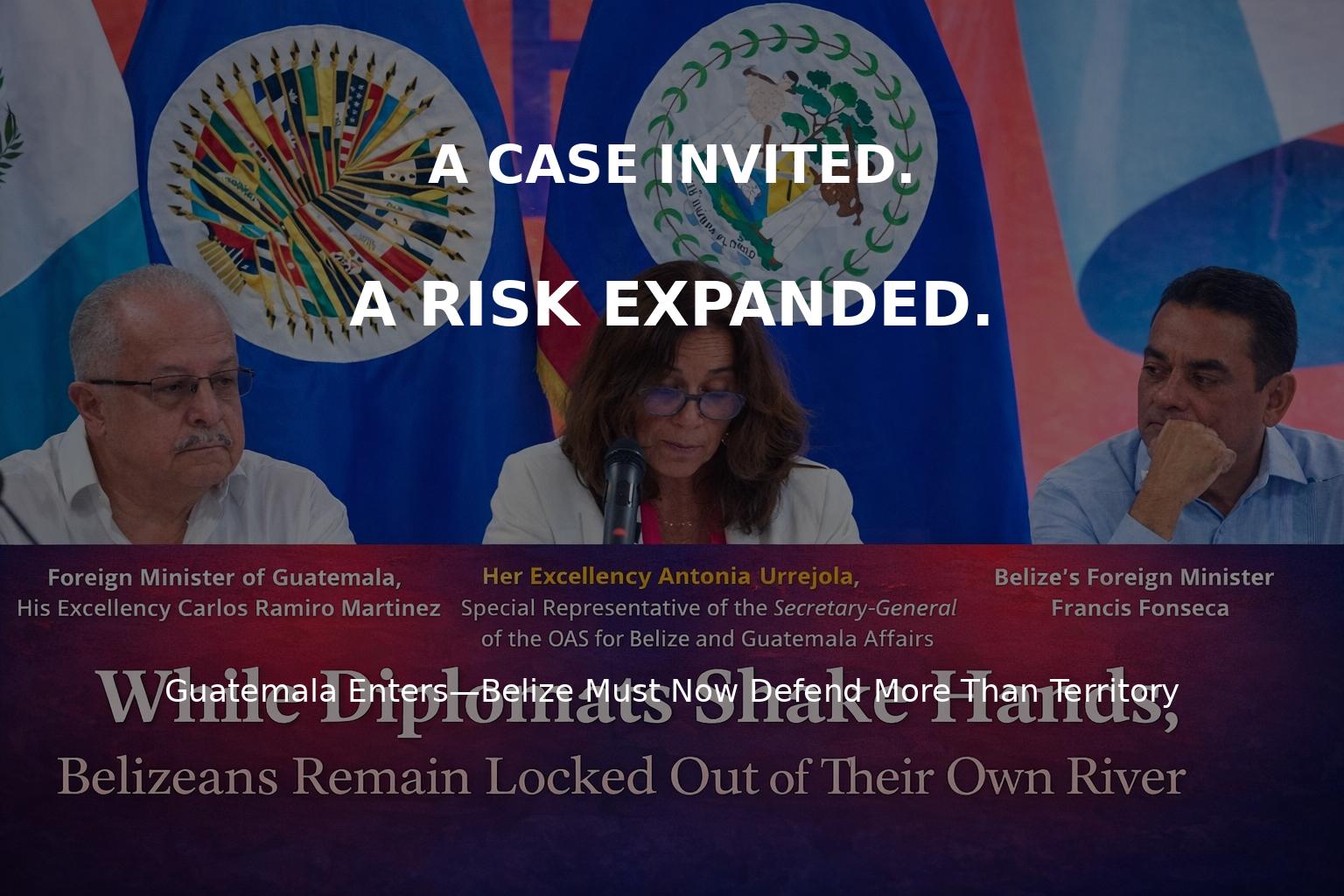
Belize welcomes Guatemala into the ICJ case—but the real question is whether this bold legal strategy will deliver clarity or complexity.
By: Omar Silva I Editor/ Publisher
National Perspective Belize – Digital 2026
Belize City: Saturday 21st March 2026
Investigative Feature
In a development now being framed as “progress” by officialdom, the International Court of Justice has granted Guatemala permission to intervene in Belize’s ongoing sovereignty case against Honduras over the Sapodilla Cayes.
Belize did not object.
In fact, Belize welcomed it.
The government’s position is clear:
Bring all claims before the Court—settle everything once and for all.
But beneath that confidence lies a more complex reality Belizeans must now understand:
This case is no longer Belize vs Honduras.
It is now Belize vs Honduras—with Guatemala shaping the battlefield.
From two claimants to three voices
The Sapodilla Cayes dispute began in 2022 when Belize sought a definitive ruling affirming its sovereignty over the islands—known in Honduras as Cayos Zapotillos.
For Belize, the case appeared straightforward:
- Over 200 years of continuous administration
- Established British colonial governance
- Inherited sovereignty post-independence
Honduras’ constitutional claim was the primary legal obstacle.
But in 2023, Guatemala made a decisive move:
It applied to intervene.
And now, the ICJ has allowed it.
Not as a party.
But as something equally strategic:
A legal influencer inside the case.
What “intervention” really means
Guatemala’s status as a non-party intervenor under Article 62 does not allow it to seek a ruling in its favor directly.
But it allows something more subtle—and potentially more impactful:
- To present legal arguments
- To challenge Belize’s historical narrative
- To outline its own claim to the same territory
- To influence how the Court interprets sovereignty
This is not participation for appearance.
This is participation for positioning.
Belize’s gamble: clarity vs complexity
Belize’s decision not to oppose Guatemala’s intervention is being framed as confidence.
Minister Henry Charles Usher put it plainly:
“Make we do it one time.”
The strategy is clear:
- Avoid fragmented rulings
- Prevent future legal ambiguity
- Force the Court to address all claims together
It is a bold approach.
But it is also a gamble.
Because inviting Guatemala into this case means:
Belize has voluntarily expanded the legal battlefield.
The three possible outcomes Belizeans must understand
Scenario 1: Total Victory (Best Case)
The ICJ rules:
- The Sapodilla Cayes belong to Belize
- Honduras’ claim is rejected
- Guatemala’s interest is dismissed
Impact:
- Strengthens Belize’s broader territorial case against Guatemala
- Reinforces sovereignty legally and diplomatically
- Creates a powerful precedent
This is the outcome Belize is aiming for.
Scenario 2: Victory with Shadows (Moderate Risk)
The ICJ rules:
- Honduras has no valid claim
- Belize has the strongest claim
BUT acknowledges Guatemala’s “legal interest”
Impact:
- Belize wins technically
- Guatemala gains language it can use in the broader territorial case
- The dispute is not fully extinguished
This is the outcome Belizeans must not underestimate.
Because:
A partial victory can become a future vulnerability.
Scenario 3: Legal Ambiguity (High Risk)
The ICJ:
- Rejects Honduras’ claim
BUT avoids a definitive position on Guatemala
Or introduces shared or unclear language.
Impact:
- Creates uncertainty
- Opens doors for prolonged disputes
- Weakens Belize’s leverage in the larger ICJ territorial case
This is the danger of complexity:
The more voices in a case, the more cautious the judgment may become.
Guatemala’s strategy: never be absent
Guatemala’s intervention is not symbolic—it is strategic.
By entering this case, Guatemala:
- Prevents Belize from securing an uncontested ruling
- Ensures its claim is part of the Court’s reasoning
- Gains access to legal arguments and evidence
- Positions itself for advantage in the larger territorial case
In simple terms:
Guatemala refused to let Belize win anything uncontested—even indirectly.
The overlooked battle: fishing rights
While sovereignty over the islands dominates headlines, the ICJ has explicitly included:
Fishing rights in surrounding waters
This is not secondary.
This is critical.
Because it affects:
- Fisherfolk livelihoods
- Marine resource access
- Economic activity
- Enforcement authority
Even if Belize wins sovereignty:
The waters could still become contested terrain.
The wider pattern Belizeans must recognize
This development does not exist in isolation.
It mirrors what Belizeans are already experiencing:
- At the Sarstoon River → Guatemala asserts physical control
- At the ICJ → Guatemala asserts legal presence
Two fronts. One strategy.
Influence the ground. Influence the law.
The narrative Belizeans are being sold
The official line is simple:
“This is progress.”
“This is confidence.”
“This is clarity.”
But the full truth is more nuanced:
- Belize is confident
- Belize is legally prepared
- BUT Belize has entered a more complex and unpredictable legal arena
The question Belizeans must now ask
Not: “Will Belize win?”
But: “What kind of victory will Belize secure—and will it close the door or leave it open?”
Conclusion: A decisive moment disguised as routine process
This ICJ decision may appear procedural.
It is not.
It is a turning point.
Because for the first time in this case:
- All three claimants now have a voice
- The Court must navigate overlapping sovereignty claims
- The outcome will ripple beyond the Sapodilla Cayes
Belize has chosen to face this complexity head-on.
Now the nation must prepare for every possible outcome.
Because in international law—as on the Sarstoon—
Sovereignty is not only what you claim.
It is what you can defend, define, and secure—without ambiguity.
- Log in to post comments