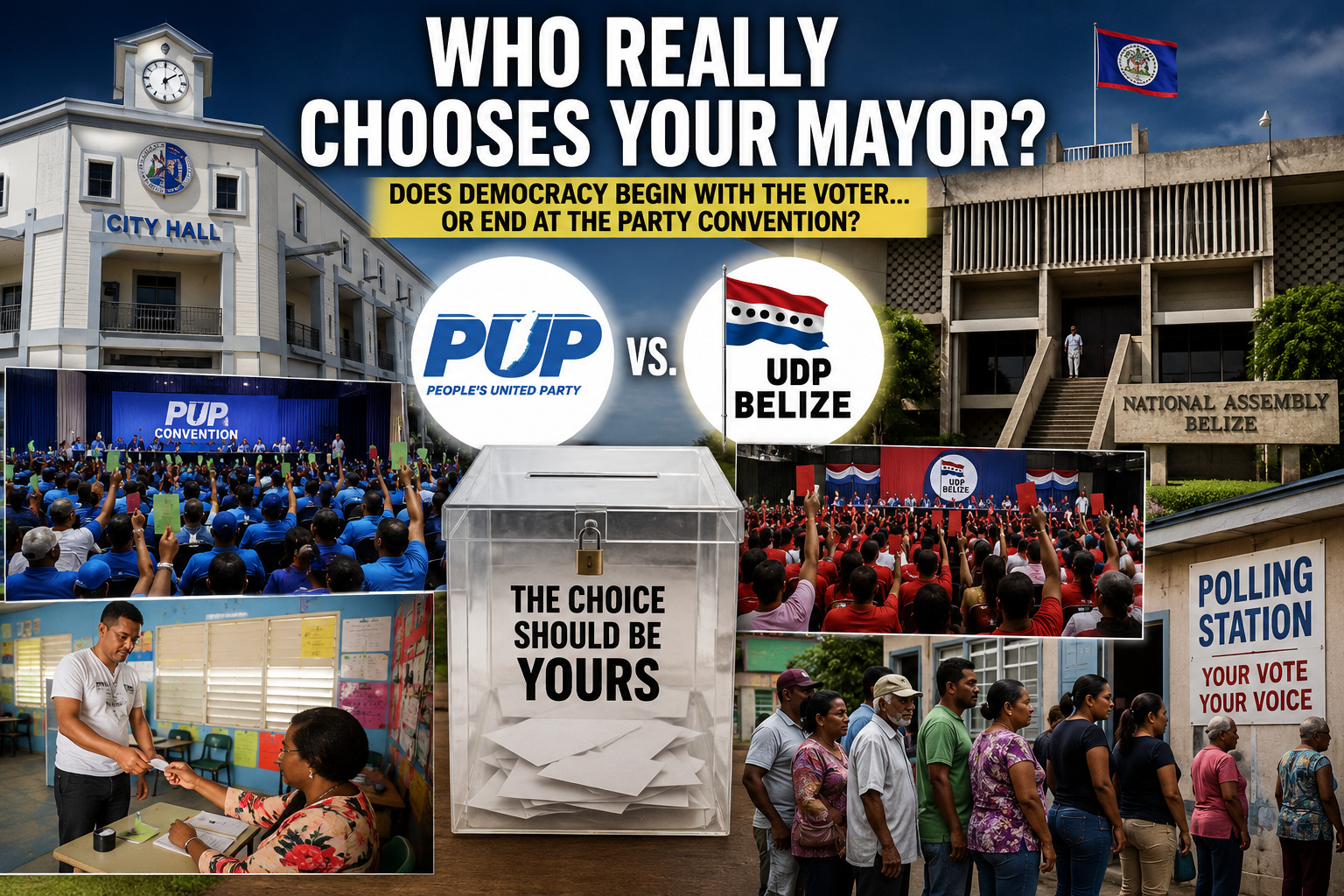
WHO REALLY CHOOSES YOUR MAYOR? When Democracy Stops at the Party’s Gate
NATIONAL PERSPECTIVE SPECIAL FEATURE
Belize City: Friday 26th June 2026: Every election season, Belizeans are reminded that democracy belongs to the people.
Yet before a single voter casts a ballot for mayor or area representative, another election has already taken place—one that most Belizeans never participate in.
It is the election that determines who they will be allowed to vote for.
That is where the real contest often occurs.
The recent public discussion surrounding the People's United Party's Belize City mayoral selection has once again raised a question that extends far beyond one municipality, one party, or one election.
It raises a constitutional and democratic question that has followed Belize since Independence.
Who really chooses our leaders?
Is it the people?
Or is it the party hierarchy?
Democracy Before Election Day
Much public attention focuses on Election Day.
- Campaigns.
- Manifestos.
- Rallies.
- Television debates.
But democracy does not begin when voters receive their ballots.
Democracy begins when candidates are chosen.
If that process lacks openness, transparency, and genuine competition, then the choices presented to the electorate have already been narrowed long before citizens enter the polling station.
The first election is often the most important election.
Unfortunately, it is usually the least democratic.
The Delegate System
Both major political parties rely upon conventions and delegates to select candidates.
On paper, this appears democratic.
In practice, however, delegates often become the focus of internal political influence.
- Party executives.
- Cabinet ministers.
- Political patrons.
- Senior strategists.
Long before ordinary Belizeans have an opportunity to vote, these internal structures may shape who ultimately appears on the ballot.
Whether or not this occurs in every instance, the perception itself weakens public confidence.
The Colonial Political Inheritance
Belize inherited the Westminster parliamentary model.
It successfully transferred political authority from Britain to Belize.
It did not necessarily transfer political power from party elites to ordinary citizens.
Instead, Belize inherited a political structure where party leadership frequently exercises considerable influence over nominations, appointments, and advancement.
The result is that loyalty to party structures can become more politically valuable than accountability to citizens.
This is not unique to one party.
It is a structural characteristic that has affected both major political organizations for decades.
The Mayor's First Responsibility
When Belizeans elect a mayor, they expect that individual to serve the municipality.
- Not the party.
- Not Cabinet.
- Not a political executive.
- Not internal strategists.
A mayor is entrusted with roads, sanitation, planning, markets, parks, drainage, public safety partnerships, and municipal urban development.
The office belongs to the city—not to the political machinery that helped secure the nomination.
Yet if advancement depends primarily upon maintaining favour with party leadership, competing loyalties inevitably arise.
The question becomes:
Who does the mayor truly answer to?
- The citizens?
- Or the political organization that controls future opportunities?
The Cost of Manufactured Consensus
Political leaders often argue that avoiding conventions preserves unity.
Unity is important.
But unity imposed from above differs fundamentally from unity earned through open competition.
Healthy democracies are strengthened—not weakened—when capable individuals compete fairly.
Competition tests ideas.
Competition develops leadership.
Competition allows citizens to compare visions.
Democracy is not disorder.
Democracy is choice.
The Belizean Voter Deserves Better
- The ordinary voter contributes taxes.
- The ordinary voter obeys the laws.
- The ordinary voter finances public institutions.
Surely the ordinary voter deserves more influence over who seeks to represent them.
Instead, too many Belizeans feel that by the time Election Day arrives, the most important decision has already been made.
The ballot simply confirms it.
That perception alone should concern every democrat.
Municipal Government Should Not Be Political Apprenticeship
Municipal government is not intended to be a waiting room for national political careers.
It is a constitutional institution responsible for managing the daily lives of citizens.
Candidates should therefore be evaluated primarily upon:
- Their vision for urban development.
- Financial management.
- Public accountability.
- Infrastructure planning.
- Environmental resilience.
- Economic development.
- Transparency.
Not merely upon seniority within a political organization.
What Genuine Internal Democracy Could Look Like
Belize can strengthen democracy without changing its Constitution overnight.
Political parties themselves can voluntarily embrace reforms such as:
• Open conventions where every qualified aspirant competes.
• Public debates between aspirants before delegates.
• Transparent delegate selection procedures.
• Independent oversight of internal party elections.
• Publication of convention rules well in advance.
• Equal access for candidates to present their programmes.
These reforms would not weaken parties.
They would strengthen public confidence in them.
Beyond Red and Blue
This discussion is not about one political party.
Nor is it about one mayoral contest.
The same criticisms have been levelled over the years against both the People's United Party and the United Democratic Party.
That reality suggests the problem is institutional rather than partisan.
Belize's democracy should not depend upon which colour occupies Belmopan.
It should depend upon principles that apply equally to every political organization.
A Second Republic Begins with Democratic Parties
If Belize truly seeks political renewal, reform cannot stop at Parliament.
Political parties themselves must become more democratic.
Leadership should be earned through open competition.
Candidates should emerge because citizens choose them—not because hierarchy approves them.
The legitimacy of government begins long before Election Day.
It begins the moment political parties decide whether they trust the people enough to let them choose.
Until that happens, Belizeans may continue asking one uncomfortable question:
When I vote for my mayor, am I choosing my representative—or simply endorsing someone who was already chosen for me?
By: Omar Silva – Editor/Publisher
National Perspective Belize
- Log in to post comments