Jungle for Rent or Nation to Defend? Why Belize Must Rethink Its Entire Defence Doctrine Before the World Changes Around Us
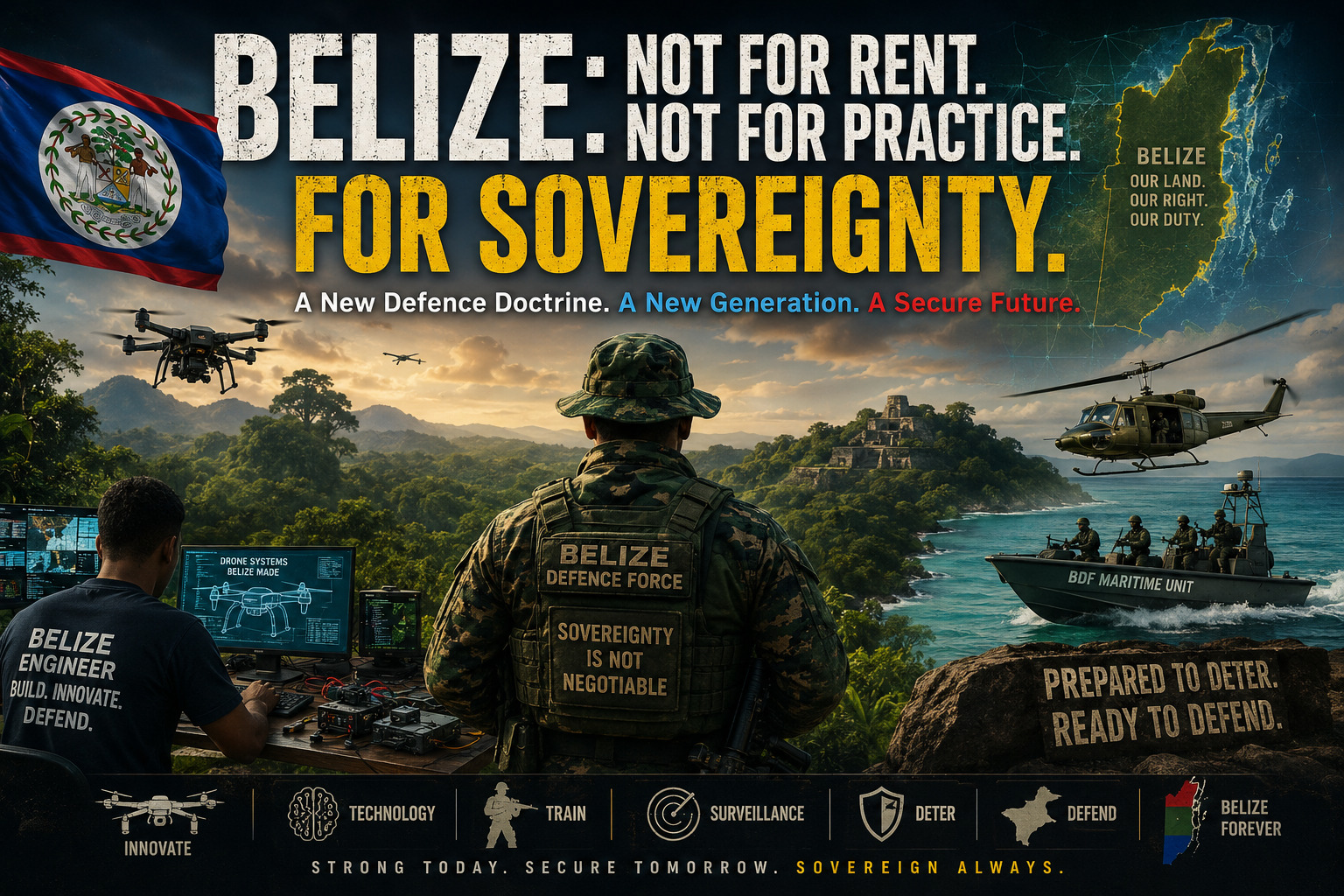
Why Belize Must Rethink Its Entire Defence Doctrine Before the World Changes Around Us
Belize City: Sunday, 24th May 2026: There was a time when Belize’s jungle terrain was viewed merely as a tropical training ground for foreign militaries. Dense rainforest, humidity, rugged rivers, swamp lands, and isolated terrain were marketed as ideal conditions for jungle warfare exercises. In 2016, the vision was sold as “military tourism” — an economic and diplomatic opportunity where Belize could host international soldiers from the United States, Britain, Germany, and other allied countries seeking specialized jungle combat training.
At the time, the concept sounded attractive. Belize would supposedly gain exposure, diplomatic ties, military cooperation, and economic activity from foreign personnel rotating through the country. Helicopter operations, jungle warfare schools, and multinational exercises were portrayed as the beginning of a modern military strategy.
But 2026 is not 2016.
The world that existed a decade ago no longer exists today.
The geopolitical atmosphere has become colder, harder, more aggressive, and increasingly unpredictable. The illusion of a stable unipolar world dominated by one unquestioned superpower has fractured. The emerging reality is multipolar competition — where major powers are openly challenging one another economically, militarily, technologically, and territorially.
And in such a world, small nations without strategic vision become vulnerable nations.
Belize must now ask itself a difficult but unavoidable question:
Are we developing a defence doctrine to protect Belize, or are we merely offering Belize as a convenient training laboratory for larger powers?
The Region Around Belize Is Quietly Becoming More Dangerous
Belize cannot afford to think in outdated diplomatic language while the strategic environment around us evolves rapidly.
The warning signs already exist:
• Guatemala’s territorial claim against Belize remains active before the International Court of Justice.
• Venezuela continues pressing its claim against Guyana’s Essequibo region.
• Colombia and Nicaragua remain locked in maritime tensions over San Andrés and surrounding waters.
• Historical friction between Honduras and El Salvador never truly disappeared beneath the surface.
• Drug trafficking routes continue militarizing sections of Central America.
• Organized transnational criminal structures now possess weapons, technology, drones, communications systems, and financing once reserved only for states.
Meanwhile, the global powers themselves are demonstrating increasingly hostile behaviour:
• NATO expansion tensions,
• U.S.–China confrontation,
• Russia–West strategic escalation,
• disputes over Taiwan,
• militarization of trade routes,
• cyber warfare,
• economic sanctions used as weapons,
• and growing normalization of proxy conflicts.
The lesson is simple:
Power respects preparedness. Weakness invites pressure.
Small states that fail to adapt strategically often become zones of influence rather than sovereign actors.
Belize’s Defence Structure Was Built for Another Era
The uncomfortable truth is that Belize’s defence architecture was largely designed for a colonial and post-colonial environment centered around:
• border patrol,
• internal security,
• anti-narcotics support,
• ceremonial sovereignty,
• and limited defensive reaction.
But modern conflict is no longer conventional alone.
Future warfare increasingly revolves around:
• drones,
• cyber operations,
• surveillance technology,
• asymmetric deterrence,
• precision strikes,
• information warfare,
• electronic disruption,
• intelligence dominance,
• and rapid mobility.
Belize presently lacks:
• a modern mechanized unit,
• armoured defensive capabilities,
• substantial artillery deterrence,
• anti-drone systems,
• domestic military manufacturing,
• serious aerospace capability,
• or an indigenous defence technology programme.
And that reality cannot be hidden behind ceremonial uniforms or occasional multinational exercises.
The harsh truth is this:
Belize cannot rely forever on diplomatic goodwill while possessing minimal deterrence capability.
The Era of Passive Defence Must End
For decades, Belize’s defence mentality has largely remained reactive.
Wait.
Observe.
Call allies.
Depend on diplomacy.
Hope for international intervention.
But history repeatedly demonstrates that nations incapable of defending themselves become dependent on the political calculations of stronger nations.
And stronger nations always act primarily in their own strategic interests.
Belize therefore faces a critical crossroads:
continue thinking like a vulnerable post-colonial territory,
or begin thinking like a sovereign state serious about long-term survival.
The Future May Lie in Asymmetric Defence
Belize does not possess the economic size to compete conventionally against larger militaries.
But modern history has proven that smaller nations can still develop credible deterrence through asymmetric strategy.
That means:
• mobility instead of mass,
• innovation instead of expensive scale,
• terrain familiarity instead of heavy deployment,
• technological adaptation instead of dependence,
• decentralized capability instead of rigid doctrine.
Belize’s jungles should not merely become rental space for foreign military exercises.
They should become laboratories for Belizean strategic innovation.
A New Generation of Belizean Military Thinking
Imagine a Belize Defence Force that:
• recruits’ engineers, programmers, drone specialists, mechanics, and innovators,
• develops local drone research programmes,
• studies defensive surveillance systems,
• builds domestic technical expertise,
• trains specialized rapid-response jungle units,
• integrates cyber intelligence into national defence,
• develops maritime surveillance capabilities,
• and establishes partnerships with universities for technological innovation.
Not to become an aggressive nation.
But to become a nation capable of meaningful deterrence.
Modern defence no longer belongs exclusively to nations with billion-dollar budgets.
Technology has changed the equation.
Small states can now develop intelligent defensive capabilities at lower cost through innovation, adaptation, and strategic thinking.
The future battlefield increasingly rewards creativity as much as firepower.
Belize Must Stop Thinking Small About Sovereignty
Sovereignty is not simply a flag.
It is not speeches.
It is not ceremonial independence celebrations.
Real sovereignty means possessing:
• strategic awareness,
• economic resilience,
• technological capability,
• institutional discipline,
• and credible national defence capacity.
Belize’s geography alone makes national security essential:
• Caribbean access,
• Central American proximity,
• maritime territory,
• natural resources,
• energy potential,
• trade routes,
• and unresolved territorial pressures.
A weak Belize invites calculation.
A prepared Belize encourages caution.
Military Tourism Cannot Be the End Goal
There is nothing inherently wrong with international military cooperation.
Training partnerships can bring:
• experience,
• logistics exposure,
• interoperability,
• diplomatic ties,
• and operational learning.
But Belize must never confuse hosting foreign soldiers with building national capability.
Those are two completely different things.
The larger strategic question is not whether foreign troops train here.
The real question is:
What lasting capability is Belize itself developing from these relationships?
If the answer remains minimal after ten years, then the country must reassess the doctrine itself.
The Time for Strategic Naivety Is Over
The world entering the 2030s will likely become more unstable, not less.
Food security tensions.
Water disputes.
Migration pressure.
Energy competition.
Territorial claims.
Cyber warfare.
Regional instability.
Economic nationalism.
Belize cannot approach this century using frameworks inherited from the last one.
The nation requires:
• a modern defence review,
• a long-term strategic doctrine,
• technological adaptation,
• stronger territorial surveillance,
• and a new philosophy centered on deterrence rather than symbolic presence.
________________________________________
Final Reflection
The Belizean jungle is not merely scenery.
It is territory.
It is strategic space.
It is sovereignty.
And sovereignty must never become complacent.
The future will not wait for Belize to prepare at its convenience.
The future is already arriving.
The only question left is whether Belize will continue reacting to events after they happen —
or whether this generation will finally develop the courage, vision, and national seriousness to prepare before they do.
By: Omar Silva – Editor/Publisher
National Perspective Belize – Digital
www.nationalperspectivebz.com
- Log in to post comments