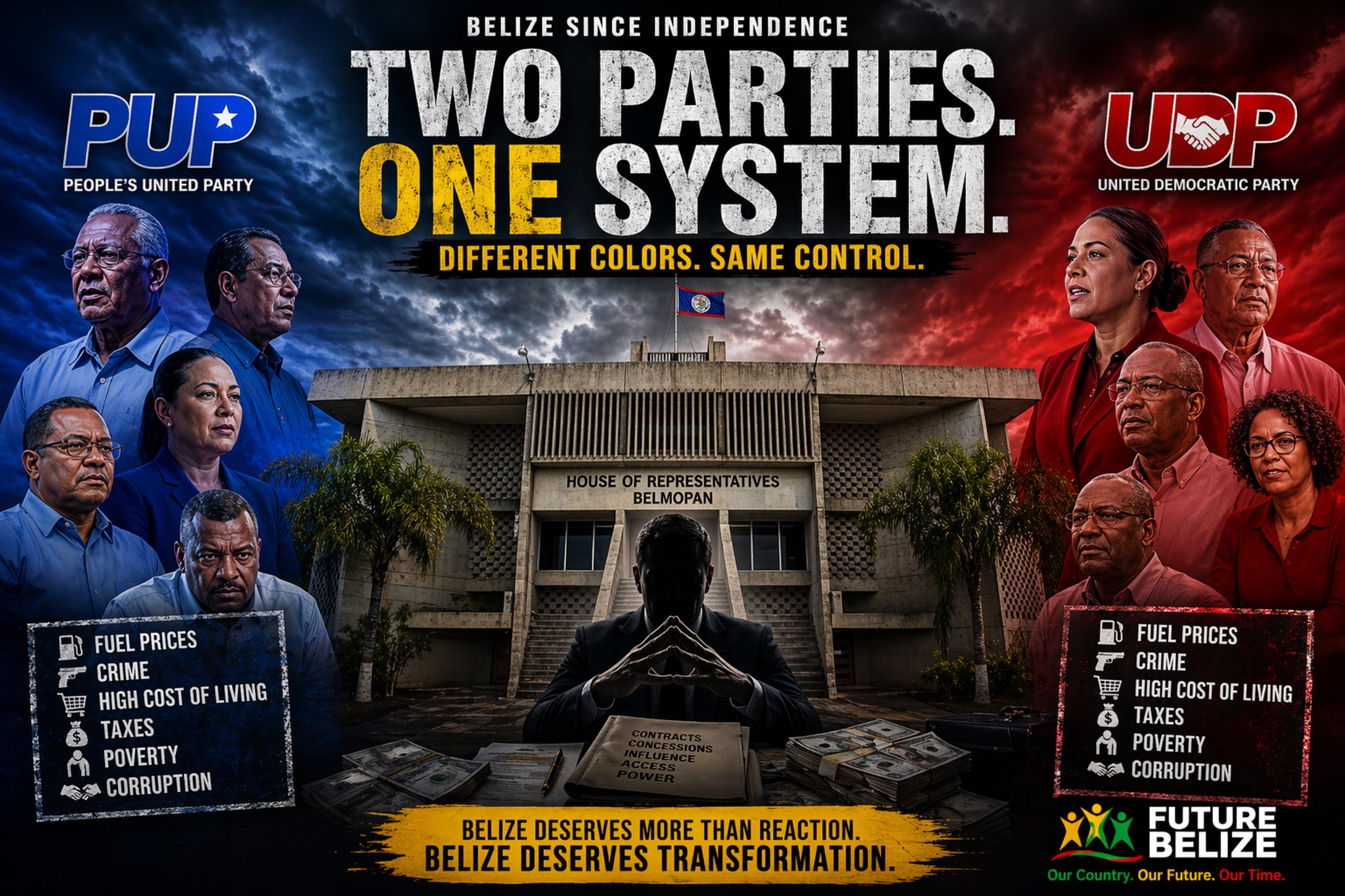
“Two Parties, One System: Inside Belize’s Engine of Dependency—and Why Nothing Ever Changes”
By Omar Silva - Editor/Publisher
National Perspective Belize -Digital 2026
Belize City: Thursday 23ed April 2026
📰 HEADLINE FEATURE
🔍 INTRODUCTION: THE PERFORMANCE BELIZEANS KEEP WATCHING
On April 23rd, the United Democratic Party (UDP) stood before the nation and did what every opposition in Belize has done for decades:
They spoke of crisis.
Crime.
Fuel prices.
Rising cost of living.
Healthcare failures.
Government excess.
Every word rang true.
And yet—nothing changed.
Because what Belize witnessed was not a solution.
It was a performance inside a system designed to never solve itself.
⚙️ PART I: THE SYSTEM NO ONE WANTS TO NAME
Belize does not suffer from a lack of awareness.
Belize suffers from a lack of structural change.
At the center of the nation’s stagnation is a political framework inherited at Independence in 1981:
- A Westminster-style governance model
- An import-dependent economy
- A revenue system driven by taxation, not production
- A state reliant on foreign loans and grants
- A political class financed outside the reach of the electorate
This is not accidental.
It is design.
And for over four decades, both the People’s United Party (PUP) and the United Democratic Party (UDP) have operated within it—without ever attempting to dismantle it.
🔁 PART II: THE ROTATION OF POWER—NOT THE TRANSFORMATION OF A NATION
Belize’s political cycle is not ideological.
It is rotational.
- The PUP governs → public dissatisfaction rises
- The UDP campaigns → wins power
- The UDP governs → public dissatisfaction rises
- The PUP campaigns → wins power
And the country remains locked in the same condition:
👉 High cost of living
👉 Low wage growth
👉 Weak productive sectors
👉 Rising public frustration
The parties change.
The outcome does not.
💰 PART III: THE FINANCING QUESTION NO ONE ADDRESSES
Behind every campaign, every rally, every resurgence of political momentum—
There is money.
Significant money.
And Belizeans must ask the question both parties avoid:
👉 Who finances political power in Belize?
👉 What influence comes with that financing?
👉 What policies are shaped before elections even begin?
When a political organization publicly struggles for resources one month—
And appears revitalized the next—
That is not grassroots transformation.
That is financial intervention.
This is not speculation.
It is a pattern observed across electoral cycles.
And it reinforces a deeper reality:
Political competition exists.
Financial dependency is shared.
🧱 PART IV: POLICY WITHOUT PHILOSOPHY
The April 23rd UDP press conference revealed something more important than its criticisms:
It revealed what was missing.
There was:
❌ No governing doctrine
❌ No economic model
❌ No production strategy
❌ No institutional reform plan
❌ No long-term transformation framework
Only reaction.
And this is not unique to the UDP.
The PUP, after nearly five years in government, has likewise failed to present:
- A national development ideology
- A structural shift away from import dependency
- A roadmap toward economic independence
Instead, Belize receives:
👉 Projects without systems
👉 Spending without transformation
👉 Policies without direction
📉 PART V: THE ECONOMY OF SURVIVAL
At its core, Belize’s economy is not built to expand.
It is built to survive.
- Fuel prices rise → government collects more tax
- Imports increase → revenue increases through duties
- Citizens spend more → GST collections rise
This creates a dangerous paradox:
👉 The more Belizeans struggle, the more the system sustains itself.
There is no incentive to reduce dependency—
Because dependency is the revenue engine.
🚧 PART VI: THE FAILURE OF INFRASTRUCTURE THINKING
From public transportation to healthcare to energy—
Belize suffers from implementation without systems.
Projects are launched:
- Without maintenance frameworks
- Without long-term financing structures
- Without institutional capacity
The result:
👉 Short-term visibility
👉 Long-term inefficiency
And ultimately:
Public distrust.
⚠️ PART VII: SOCIAL PRESSURE WITHOUT STATE RESPONSE
The UDP is correct on one critical point:
Belizeans are under pressure.
But what remains absent is state capacity to respond structurally.
Crime rises → reactive policing
Costs rise → reactive subsidies
Healthcare strains → reactive funding
What is missing is preventive design.
And that absence is not a failure of individuals—
It is a failure of the system they operate within.
🧠 PART VIII: WHY BOTH PARTIES CANNOT FIX IT
This is the most uncomfortable truth:
Neither the PUP nor the UDP can fundamentally transform Belize—
Because both depend on:
- The same economic structure
- The same financing channels
- The same governance model
- The same political incentives
To change the system would require:
👉 Reducing dependency on external financing
👉 Rebuilding the economy around production
👉 Restructuring governance institutions
👉 Limiting political-financial influence
And that would mean:
Dismantling the very system that sustains their power.
🌱 PART IX: THE BREAK FROM REACTIONARY POLITICS
What Belize witnessed on April 23rd was not leadership.
It was reactionary politics:
- Identify the problem
- Amplify public frustration
- Assign blame
- Offer no structural alternative
And repeat.
Breaking this cycle requires something Belize has not yet seen at the national level:
👉 A defined political doctrine
👉 A clear economic ideology
👉 A transformation roadmap
👉 A restructuring of governance
Not promises.
Design.
🔥 PART X: THE FIRST TRANSFORMATION—WHAT IT MUST ADDRESS
If Belize is to move forward, the next political evolution must confront:
1. Economic Dependency
Shift from import reliance → domestic production
2. Revenue Model
Shift from taxation → productivity-driven growth
3. Governance Structure
Modernize beyond colonial-era administrative frameworks
4. Political Financing
Introduce transparency and limits on influence
5. Institutional Strength
Build systems, not projects
🧨 FINAL WORD: THE TRUTH BELIZE MUST FACE
The April 23rd UDP press conference did not fail.
It did exactly what it was designed to do:
👉 Capture frustration
👉 Reflect national pain
👉 Position for political gain
But it did not—and could not—offer transformation.
Because transformation does not come from reaction.
It comes from reconstruction.
And until Belize confronts the reality that:
Two parties can compete endlessly
Inside the same broken system—
Nothing will change.
⚡ CLOSING LINE
Belize does not need louder opposition.
Belize needs a different system.
- Log in to post comments