When Justice Performs for Power, the People Are Already Defeated

By: Omar Silva I Editor-Publisher
A National Perspective Belize
Belize City: Tuesday 20th January 2026
Editorial
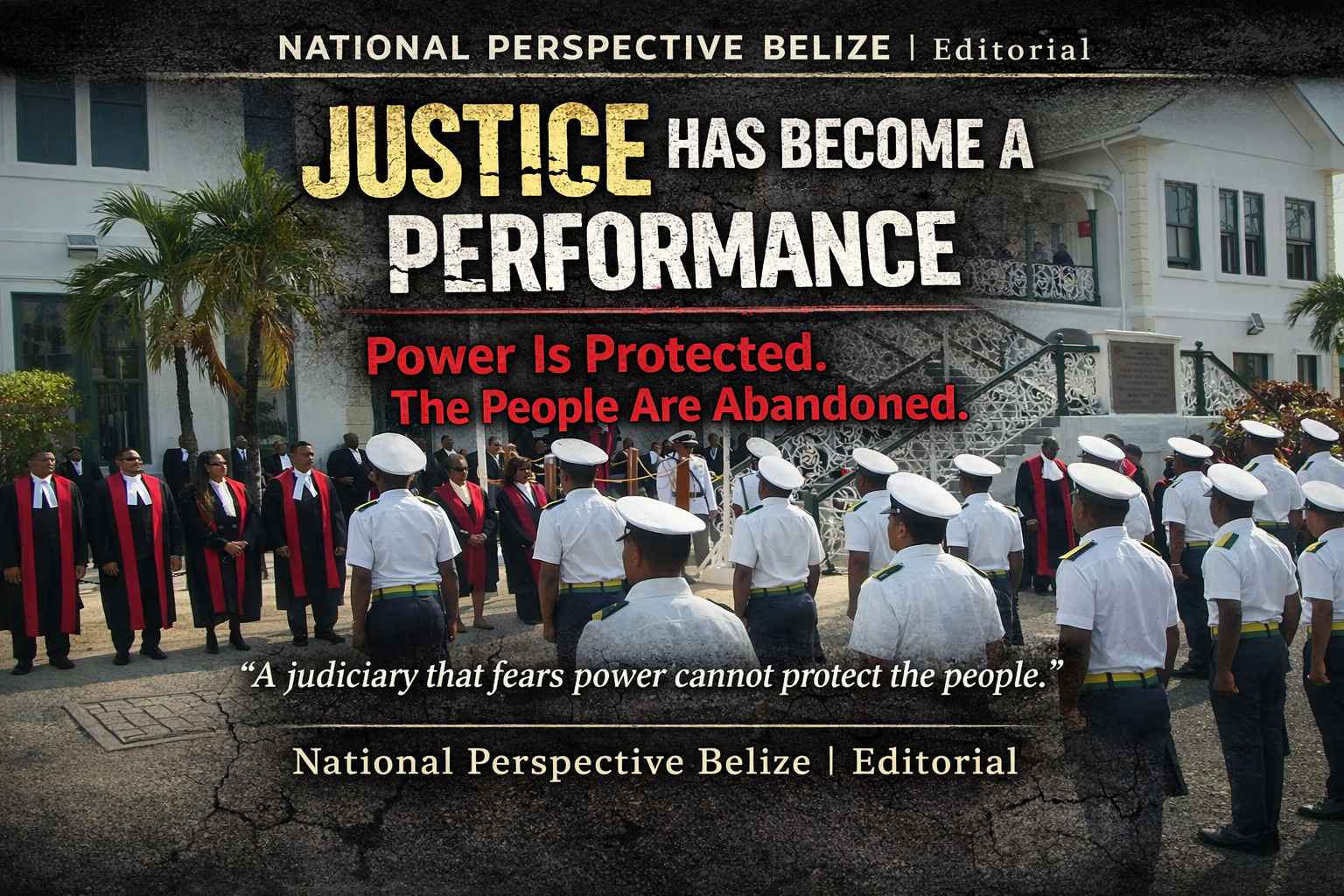
Belize did not witness the opening of a new legal year.
Belize witnessed the opening of another theatrical season.
Robes were pressed. Processions were staged. Speeches were rehearsed. Platitudes were delivered. And once again, the Belizean people were asked to believe that justice is progressing, that reform is real, that confidence should be renewed.
But for those who live inside the system’s failures, such claims are not inspiring.
They are insulting.
Because no amount of ceremony can hide the truth:
Justice in Belize has become performative for the powerful and punitive for the powerless.
A Judiciary That Fears Power Cannot Protect the People
A true judiciary exists to restrain the executive, to defend constitutional boundaries, and to protect citizens against abuse of authority.
Yet recent history tells a different story.
When the government’s political timetable was threatened by a constitutional redistricting challenge, the court did not rise to defend democratic equity. Instead, the case was slowly suffocated by delay, caution, and procedural paralysis.
The result?
- The election proceeded untouched.
- The political class remained comfortable.
- The Constitution remained violated.
That is not judicial independence.
That is judicial accommodation.
Remand Is Now a Sentence Without Conviction
In Belize today, you do not need to be found guilty to lose your freedom.
You simply need to be poor, unconnected, and unlucky.
Young men languish on remand for five and six years. Mothers lose sons to prolonged detention without trial. Families disintegrate under the weight of a system that cannot — or will not — move with urgency when ordinary lives are at stake.
And when those cases finally reach court?
- Files are missing.
- Witnesses are gone.
- Evidence is compromised.
Justice collapses, but the damage is permanent.
This is not inefficiency.
This is state-inflicted harm.
The Colonial Mindset Still Governs Our Courts
A nation that does not trust its own people to administer justice is not truly sovereign.
The increasing preference for foreign judges over qualified Belizeans does not strengthen the judiciary — it weakens it. It signals to every Belizean magistrate, every aspiring jurist, every law student: you are not good enough to steward your own country’s justice.
That is not reform.
That is psychological dependency dressed as professionalism.
No justice system can be respected when it quietly communicates that Belizeans themselves are second-class in their own institutions.
When Political Proximity Replaces Judicial Distance
There is an uncomfortable truth Belizeans increasingly whisper:
The justice system appears closer to political power than it is to the people.
Lawyers who are senators.
Political insiders who dominate key legal spaces.
High-profile cases that move swiftly for the connected but stagnate for the ordinary.
Even when no illegality can be proven, the perception alone is devastating.
Justice must not merely be impartial.
It must be unmistakably independent.
Right now, too many Belizeans believe the courts protect influence before they protect innocence.
The Cost of Silence
Perhaps the most troubling sign is not what is said publicly, but what is said privately.
Lawyers speak in corridors but fall silent in public.
Court staff express concern but avoid attribution.
Magistrates feel neglected but remain cautious.
Fear has entered the justice ecosystem.
And when fear enters the judiciary, freedom exits democracy.
The People Are Not Blind
Belizeans see the contradictions clearly:
- They hear speeches about efficiency while experiencing endless delays.
- They hear praise for reform while watching remand numbers grow.
- They hear commitments to independence while observing political convenience.
- They hear talk of modernization while magistrate courts crumble under pressure.
The people are not fooled by processions.
They are measuring outcomes.
And the outcome they see is simple:
Justice is not serving them.
A System That Protects Power Will Eventually Collapse Under Public Distrust
History teaches this truth repeatedly:
- Institutions do not fail when they are attacked.
- They fail when they lose legitimacy.
- When citizens stop believing in the courts, they stop believing in the state.
- When justice feels inaccessible, society begins to fracture.
- When fairness feels selective, stability becomes fragile.
Belize is not there yet.
But the direction is unmistakable.
This Is Not an Attack on the Judiciary. This Is a Call to Conscience.
This editorial does not call for the destruction of institutions.
It calls for their awakening.
It calls on:
- Judges to remember their constitutional duty over political comfort
- Lawyers to find their courage over their caution
- Judicial leadership to prioritize Belizean development over external dependency
- Government to respect judicial independence instead of benefiting from its timidity
- The people to demand accountability rather than accept ceremony
Because a Nation Without Justice Has No Future
- A country can survive poverty.
- A country can survive political division.
- A country can even survive corruption for a time.
- But a country cannot survive the collapse of trust in justice.
Belize stands at that crossroads.
- We can continue applauding pageantry while ignoring suffering.
- Or we can demand that justice stop performing and start protecting.
National Perspective Belize chooses the second.
And the people must too.
- Log in to post comments