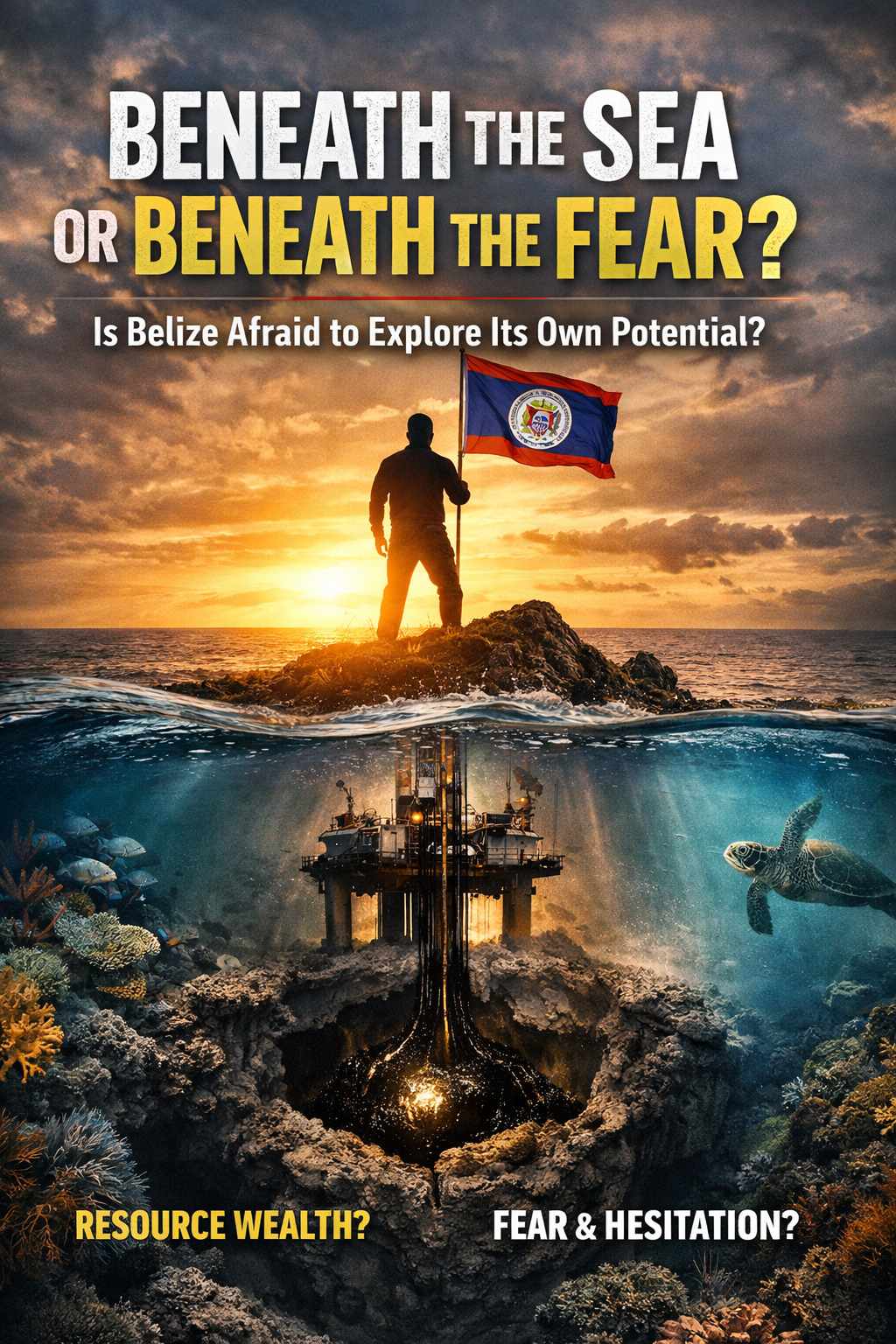
**Beneath the Sea or Beneath the Fear? The Oil Question Belize Never Properly Debated**
By: Omar Silva – Editor/Publisher
National Perspective Belize – Digital 2026
Belize City: Monday 16th February 2026
Energy is the new language of power.
In the twenty-first century, nations are no longer measured only by territory or population, but by control over energy, logistics, food, and strategic resources. Countries that understand this reality shape their future. Those that do not often find their destiny shaped by others.
Belize now stands at one of those crossroads—one that was never fully debated, never transparently examined, and never decided through a truly national conversation.
The question remains unresolved:
Did Belize protect its environment wisely, or did it close the door on a strategic opportunity without first understanding what lay beneath the sea?
The Discovery That Raised a Larger Question
In the mid-1990s, oil was discovered in the Spanish Lookout basin of western Belize. It was not a massive discovery by global standards, but it proved something important:
Belize sits within a petroleum-bearing geological region that extends across southern Mexico, Guatemala, and offshore basins in the Gulf of Honduras.
Geologists understand a basic principle:
Where oil is found on land, there is often potential offshore.
That reality raised a legitimate national question:
If oil existed onshore, could Belize also possess offshore reserves?
That question was never scientifically answered.
Instead, the debate was shut down before exploration itself could occur.
How the Debate Was Framed
When offshore exploration emerged as a possibility, public discourse quickly shifted—not toward scientific study, but toward prohibition.
Environmental campaigns intensified. Public pressure mounted. Offshore drilling was eventually banned.
Many Belizeans supported the decision, believing it was necessary to protect the Barrier Reef, fisheries, and tourism.
Those concerns were real and deserved consideration.
But another reality is also true:
Belize never conducted a national strategic debate that balanced:
- Environmental risk
- Economic sovereignty
- Scientific exploration
- Long-term national planning
The country moved directly from uncertainty to prohibition.
Exploration itself—not just drilling—was effectively closed.
The Global Context Belize Ignored
While Belize shut the door, the world moved forward.
Guyana, once considered one of the poorest countries in the hemisphere, began offshore exploration with modern seismic technology and strict contractual frameworks.
Today:
- Guyana has become one of the fastest-growing economies in the world.
- Oil revenues are financing infrastructure and public programs.
- The country has entered the global energy map.
Guyana also faces governance challenges and environmental concerns—but it did not refuse to explore.
It chose to understand what resources existed before deciding how to use them.
Belize never reached that stage.
The Environmental Argument—And Its Limits
Environmental groups argued that offshore drilling could damage:
- The Barrier Reef
- Fisheries
- Tourism
These concerns are not imaginary. Oil spills have caused devastation in other regions.
But modern offshore exploration is not the same as the uncontrolled drilling practices of decades past.
Today:
- Seismic surveys use satellite and sonar mapping.
- Exploration wells are limited and heavily monitored.
- Many countries conduct exploration without immediately proceeding to production.
Exploration is not exploitation.
It is information.
And information is the foundation of sovereign decision-making.
The Question That Was Never Asked
The debate Belize needed was not:
“Drill or do not drill.”
The real question should have been:
“Should Belize study its offshore potential under strict scientific and environmental safeguards before deciding its future?”
That question was never seriously discussed at a national level.
The Deeper Issue: Governance
Even more important than the question of oil is another, more uncomfortable question:
Does Belize have the governance, vision, and institutional strength to manage strategic resources responsibly?
This is where the real national dilemma lies.
Oil does not transform nations automatically.
Without strong institutions, oil can:
- Enrich a few
- Corrupt systems
- Deepen inequality
- Damage the environment
Examples exist across the world where oil wealth became a curse rather than a blessing.
Belize must confront this reality honestly.
The issue is not only whether oil exists.
It is whether Belize is prepared to manage it.
The Pattern Belize Must Confront
This is not only about oil.
It is about a national pattern:
- Belize exports raw products instead of building factories.
- Belize imports energy instead of producing it.
- Belize signs agreements instead of building logistics systems.
- Belize debates politics instead of planning strategy.
Again and again, the country closes doors before building capacity.
The oil debate fits this pattern.
A Responsible Path Forward
A serious national policy—if Belize ever chooses to revisit this question—would not begin with drilling rigs.
It would begin with knowledge.
A responsible approach could include:
- Independent seismic mapping of offshore basins
- Public disclosure of all findings
- Strict environmental oversight
- Transparent legislative frameworks
- A national referendum before any production phase
Such a process would place the decision in the hands of the Belizean people—not political actors, not foreign interests, and not pressure groups of any kind.
That is what sovereignty looks like.
Energy and the Future of Small Nations
The world is changing rapidly.
Energy security, food security, and industrial capacity are now the pillars of national survival.
Small nations that fail to plan strategically risk permanent dependency.
Belize must decide whether it will remain:
- A consumer nation
- A service economy
- A transit point for other countries’ goods
Or whether it will become:
- A producer
- A strategist
- A nation that plans fifty years ahead, not five
That decision cannot be postponed forever.
The Question That Remains
The real issue is not oil.
The real issue is national maturity.
Are we afraid of what lies beneath the sea…
or afraid of confronting what lies within our own institutions?
Until Belize answers that question honestly, the future will continue to be shaped not by vision—but by hesitation.
And hesitation, in a world driven by energy and power, is the most expensive decision of all.
- Log in to post comments