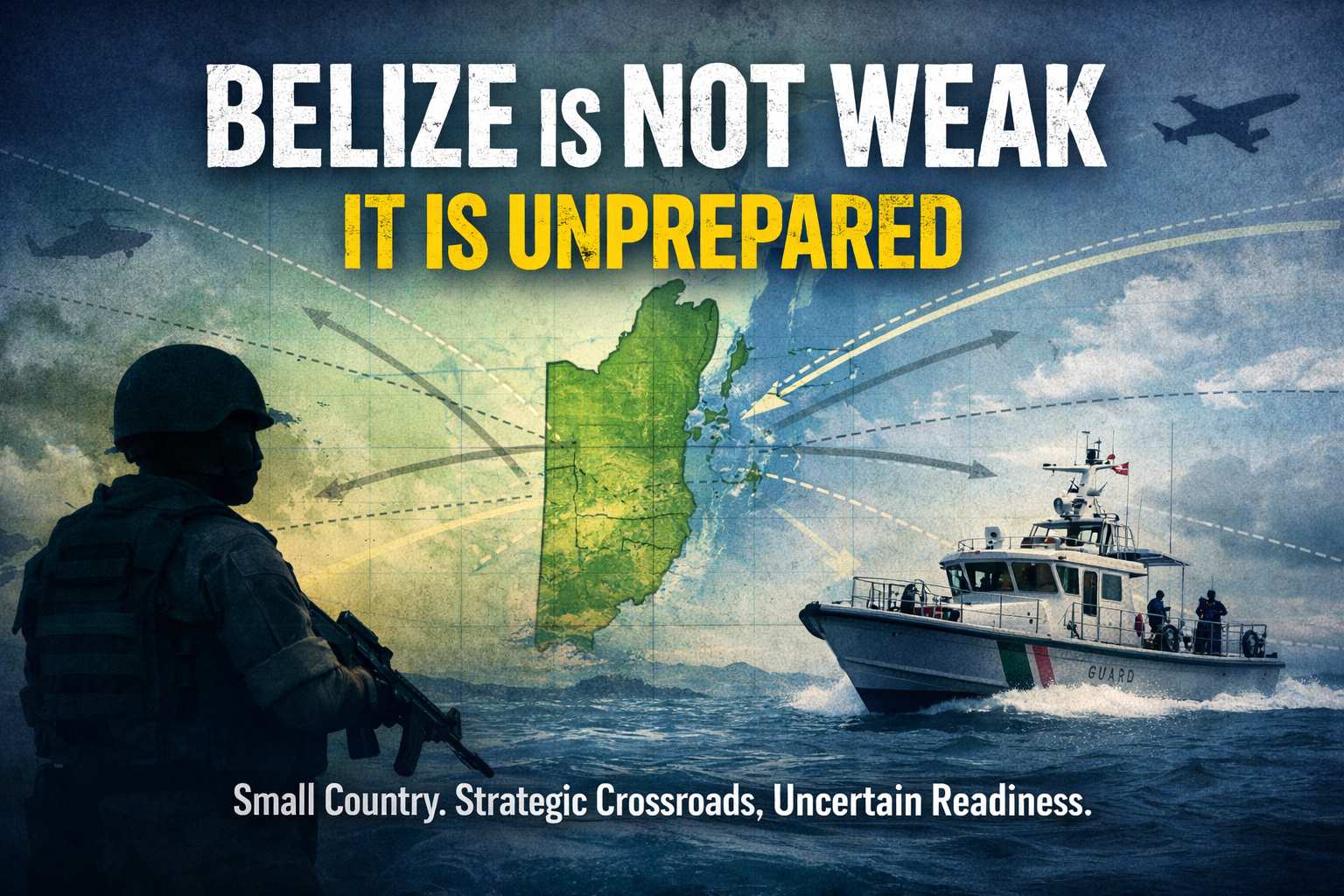
Small Country, Strategic Crossroads: Why Belize Matters More Than It Is Treated
By: Omar Silva - Editor/Publisher
A National Perspective Belize - Special Feature
Belize City: Sunday 8th February 2026
Belize is often described in international reports as a small state—small population, small economy, small military.
But geography does not shrink with population.
And geography, not size, determines strategic relevance.
Belize sits at a crossroads that few countries its size occupy: a maritime and territorial bridge between Central America, the Caribbean basin, and the Gulf of Mexico. Yet despite this reality, national planning, defense doctrine, and even public perception continue to treat Belize as if its position carries little consequence.
That assumption may be one of the most dangerous illusions in Belize’s modern history.
A Strategic Position Few Belizeans Fully Appreciate
Belize occupies a location that intersects multiple strategic realities:
- A land border with Guatemala, where a territorial claim remains unresolved pending international adjudication.
- Proximity to Mexico’s Yucatán Peninsula, a major economic and security zone.
- A coastline along Caribbean maritime corridors used by commercial shipping and illicit trafficking alike.
- Air and sea routes linking South America to North America.
In geopolitical terms, Belize is not a peripheral territory.
It is a corridor.
And corridors are always important—whether nations acknowledge it or not.
The Security Reality Behind the Geography
The same routes that carry trade also carry narcotics, contraband, and organized crime networks.
This is why Belize has long been included—though often quietly—in regional security frameworks involving:
- Maritime interdiction
- Intelligence sharing
- Anti-trafficking operations
- Regional surveillance networks
Yet Belize’s participation has often been modest, receiving limited assistance compared to larger neighbors.
The paradox is clear: Belize is strategically located, but not strategically treated.
Leadership Changes in the BDF and Coast Guard: A Moment for Reflection
The recent structural changes in the command of the Belize Defence Force and the Belize Coast Guard come at a moment when Belize must confront a deeper question:
What is the mission of Belize’s defense institutions in the 21st century?
Historically, the BDF was designed with a limited doctrine:
- Territorial observation
- Border patrol
- Internal support roles
It was never designed as a modern deterrence force.
And the Coast Guard, though improving in professionalism and capability, still operates under constraints of equipment, doctrine, and long-term strategic planning.
Leadership transitions are therefore more than administrative changes.
They are opportunities to redefine purpose.
The Doctrine That Never Evolved
Since its formation in 1978, Belize’s defense posture has largely remained reactive rather than strategic.
The structure, training orientation, and procurement philosophy of the BDF have not fundamentally evolved to reflect:
- Maritime threats
- Hybrid security risks
- Intelligence-driven operations
- Technological surveillance requirements
In effect, Belize continues to operate under a doctrine designed for a different era.
And the world has moved on.
Strategic Value Without Strategic Planning
Belize’s geography gives it potential leverage in areas such as:
- Maritime logistics
- Regional security coordination
- Disaster response hubs
- Trade and port development
- Environmental monitoring of the Mesoamerican Barrier Reef
But leverage only exists when a country recognizes and plans around it.
Otherwise, geography becomes something others use, not something a nation benefit from.
The Regional Reality Belize Must Face
Across Central America and the Caribbean, security dynamics are changing rapidly:
- Organized crime networks are becoming more sophisticated.
- Maritime trafficking routes are shifting constantly.
- Cyber and financial crime are expanding into smaller jurisdictions.
- Climate disasters are increasing pressure on fragile infrastructure.
Small states that fail to modernize their security and strategic planning risk becoming weak links in regional systems.
And weak links attract pressure—from criminals and from larger powers alike.
A Modern Defense Vision Belize Needs
If Belize is to align its defense posture with its geography, several realities must be addressed:
- A doctrine based on deterrence, not observation.
- Investment in surveillance and maritime domain awareness.
- Professional training aligned with modern threats.
- Integration of intelligence capabilities across agencies.
- A long-term national security strategy that looks beyond electoral cycles.
These are not luxuries.
They are necessities for a country located where Belize is located.
Strategic Importance Must Translate Into National Policy
One of the greatest risks for small states is not invasion or external pressure.
It is complacency.
When a country underestimates its own strategic importance, it fails to prepare for the responsibilities that come with it.
Belize’s geography ensures that events beyond its borders will always affect it—economically, politically, and in matters of security.
Ignoring this reality does not change it.
A Nation at a Turning Point
The recent leadership changes in the BDF and Coast Guard should not be seen merely as personnel rotations.
They should be seen as a moment to ask:
- What kind of defense posture does Belize truly need?
- What role should Belize play in regional security?
- How can Belize convert geography into national advantage?
These are questions that must be debated openly, not quietly confined to closed rooms.
Conclusion: Small Country, Large Consequences
Belize may be small in size.
But it occupies a position larger than its borders suggest.
And history teaches a simple truth:
Small countries located at strategic crossroads are never irrelevant.
They are either prepared—or they are vulnerable.
The choice, ultimately, is Belize’s to make.
“Belize Is Not Weak—It Is Unprepared.”
- Log in to post comments