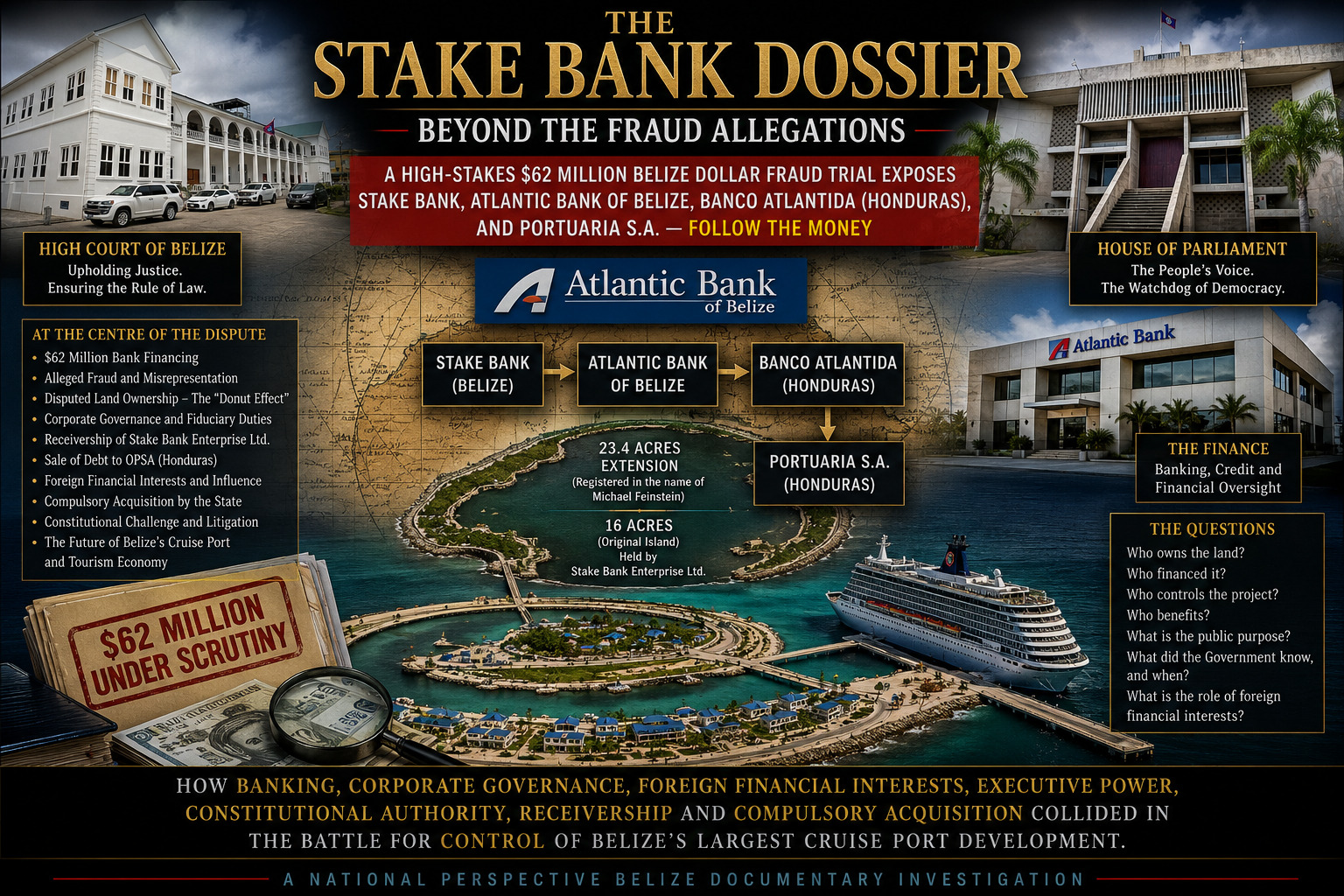
THE STAKE BANK DOSSIER Beyond the Fraud Allegations
By: Omar Silva
National Perspective Belize
Documentary Investigation
Belize City Friday 10th July: How Banking, Corporate Governance, Foreign Financial Interests, Executive Power, Constitutional Authority, Receivership and Compulsory Acquisition Collided in the Battle for Control of Belize's Largest Cruise Port Development
Across the Caribbean, governments compete to attract foreign investment, modernize ports, expand tourism infrastructure and stimulate economic growth. These projects are often presented as symbols of national progress, promising employment, increased visitor arrivals and new opportunities for local businesses. Yet behind many of the region's largest developments lies a more complex reality, where commercial ambition, public authority, private finance and constitutional safeguards do not always move in harmony.
The Stake Bank cruise port dispute in Belize has evolved into one of the most significant legal and institutional controversies in the country's modern history. What began as the financing of an ambitious tourism project has grown into a multi-layered conflict involving allegations of fraud, disputed land ownership, corporate governance, banking oversight, receivership, foreign financial interests, compulsory acquisition by the State and continuing constitutional litigation.
- At the centre of the dispute stands businessman Michael Feinstein, Atlantic Bank Limited, the receivership of Stake Bank Enterprise Limited, the involvement of the Honduran company Operaciones Portuarias S.A. (OPSA), and a series of executive decisions by the Government of Belize that have attracted national attention and legal challenge. Together, these developments raise questions that extend well beyond the fate of a single cruise port.
They invite a broader examination of how strategic national infrastructure should be financed, how banks should protect the public and their depositors when advancing substantial commercial loans, how company directors should discharge their fiduciary obligations, how governments should exercise compulsory acquisition powers, and how constitutional safeguards are expected to function when public and private interests intersect.
This documentary investigation does not presume the guilt or innocence of any individual or institution. Allegations remain before the courts, and the judicial process must be respected. Instead, this publication examines the documented facts, the competing legal positions, the institutional decisions already taken, and the wider implications for governance, investor confidence and the rule of law.
The purpose is neither to defend nor to condemn. It is to distinguish evidence from narrative, law from politics, and public interest from private interest. By tracing the chronology of events and examining each participant's role through the lens of documentary evidence, this investigation seeks to provide readers in Belize and across the Caribbean with a clearer understanding of a dispute whose consequences may extend far beyond one island development.
Stake Bank is no longer merely a commercial disagreement between a borrower and a lender. It has become a case study in the intersection of corporate governance, banking regulation, constitutional authority, foreign investment and executive decision-making. However the litigation is ultimately resolved, its lessons will resonate wherever Caribbean nations seek to balance economic development with transparency, accountability and the rule of law.
This is the Stake Bank Dossier.
- Log in to post comments