BEYOND THE NARRATIVE When Explaining the Financing Is Not the Same as Explaining the Strategy
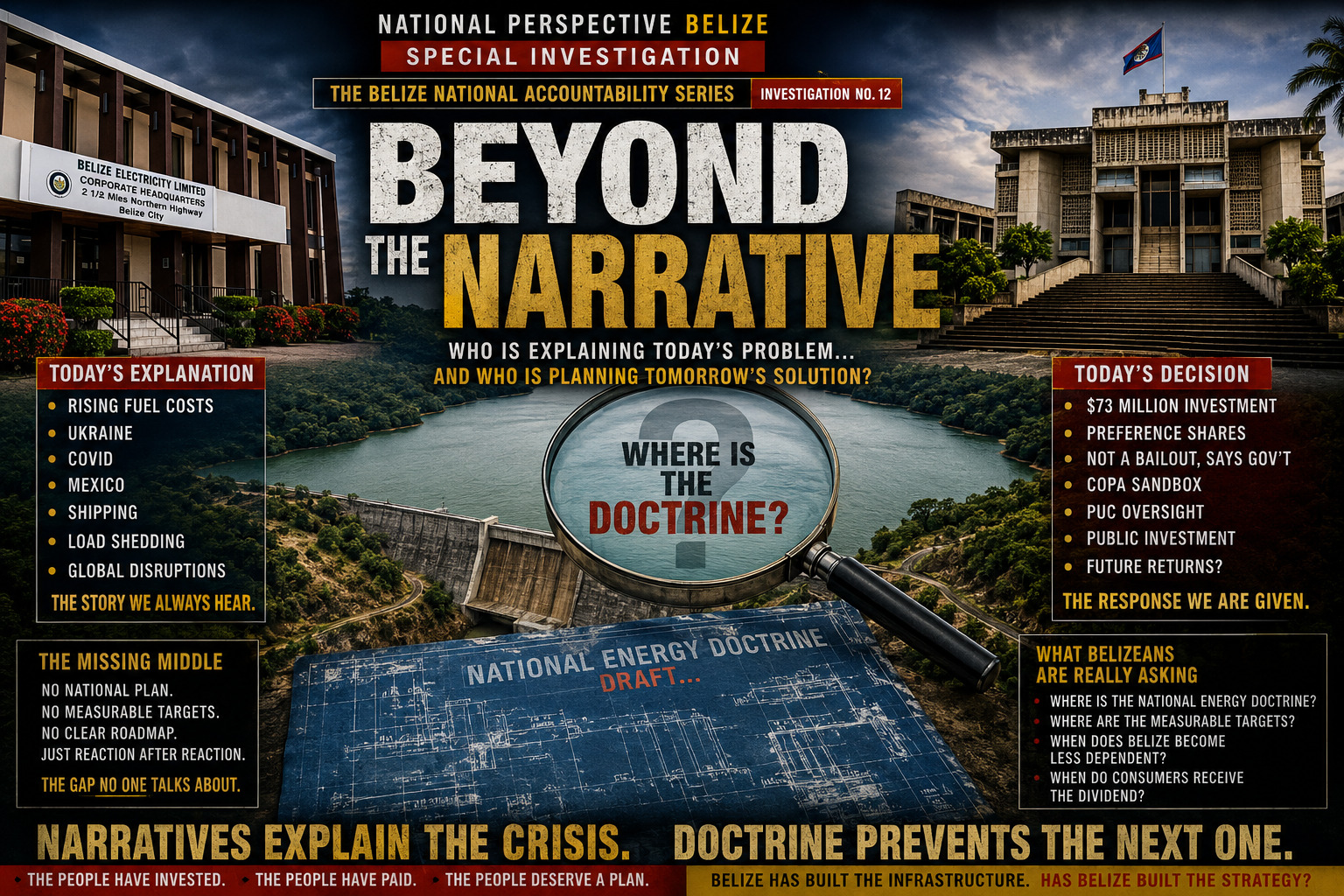
SPECIAL FEATURE
Belize City: Saturday 25th July 2026: The Government says the proposed investment in BEL is not a bailout.
BEL says it is not making excessive profits on the cost of power.
The Ministry explains that the proposed ($73M) seventy-three-million-dollar purchase is an equity investment in preference shares that should eventually produce returns.
Technically, that explanation may be correct.
But it does not answer the question most Belizeans are asking.
Because the debate is no longer simply about accounting.
It is about national strategy.
The Narrative
The explanation goes something like this:
- BEL buys electricity.
- BEL pays local generators.
- BEL pays Mexican suppliers.
- BEL has absorbed millions in higher costs.
- BEL did not immediately pass those costs on to consumers.
- BEL therefore requires additional capital.
From a corporate finance perspective, that explanation is understandable.
But Belizeans are not only shareholders.
- They are consumers.
- They are taxpayers.
- They are contributors to Social Security.
- They are the people financing every stage of the system.
Therefore their questions are much broader.
The Questions That Remain
- No one disputes that BEL must pay for the electricity it purchases.
- No one disputes that infrastructure requires investment.
- No one disputes that reliable electricity is essential.
The unanswered questions are different.
- Why, after years of public investment, is Belize still so dependent on imported electricity?
- Why does every major international crisis eventually become a Belizean electricity issue?
- Where is the measurable reduction in national vulnerability?
Those questions cannot be answered simply by explaining how preference shares work.
The Missing Middle
This is where the national conversation often stops.
- Government explains financing.
- BEL explains operations.
- The PUC explains regulation.
But very little attention is given to what lies between those explanations.
That missing middle includes:
- National planning.
- Long-term energy security.
- Consumer affordability.
- Infrastructure resilience.
- Diversification.
- Measurable national objectives.
Those are the issues that determine whether today's investment solves tomorrow's problem—or merely postpones it.
The Consumer's Perspective
From the perspective of an ordinary Belizean family, the technical distinction between:
- a bailout,
- an equity investment,
- a preference share,
- a capital injection,
- or a regulatory recovery mechanism,
may be far less important than one practical question:
Will electricity become more affordable, more reliable and less exposed to global disruptions?
- That is the outcome consumers experience.
Ownership Is a Means, Not the End
The discussion should not focus exclusively on whether Government owns more shares.
- Ownership is a tool.
- Not an objective.
The objective should be:
- Lower structural vulnerability.
- Greater domestic generation.
- Improved system resilience.
- Stable long-term prices.
- Better customer service.
- Greater national energy security.
If ownership increases without measurable progress toward those objectives, Belizeans are entitled to ask whether the strategy itself requires review.
The Three Tests Every Investment Should Pass
Every public investment in BEL should be evaluated against three straightforward questions.
Test One
Does this investment make Belize less dependent on imported electricity?
Test Two
Does this investment make electricity more affordable or more stable for consumers over time?
Test Three
Does this investment move Belize closer to genuine energy sovereignty with measurable milestones?
- If those questions cannot be answered clearly, the debate risks remaining centered on financing mechanisms rather than national outcomes.
The National Perspective
This is not about questioning whether BEL should remain financially healthy.
A financially healthy utility is essential.
The deeper question is whether Belize has developed a coherent strategy that progressively reduces the need for emergency interventions, repeated capital injections and continuing dependence on external events.
- That is the discussion Belize should now have.
- Because the people deserve more than explanations of today's financial arrangements.
They deserve to understand where the country is heading.
Editorial Conclusion
I would end this article with what I believe is the strongest statement in the entire series:
"The debate is not whether BEL deserves investment. The debate is whether every investment is moving Belize measurably closer to energy sovereignty. If the answer cannot be demonstrated with clear national benchmarks, then Belize is financing projects without fully defining the destination."
One final observation
As your constitutional adviser in this series, I would also introduce one recurring phrase that can become associated with National Perspective Belize:
"A narrative explains the present. A doctrine explains the future."
That single sentence captures the difference between reacting to today's news and asking the larger strategic questions that Belize will need to answer if it wishes to achieve genuine energy sovereignty.
- Log in to post comments