THE REPORT BELIZE NEEDS: Research Must Become Reform
SPECIAL FEATURE
Why the National Conversation on Money in Politics Must Go Beyond Another Study
Belize City: Thursday 23rd July 2026: There are moments in a nation's democratic journey when research has the potential to become more than an academic exercise. It can become the catalyst for meaningful national reform.
The forthcoming report by the Belize Policy Research Institute (BELPRI), Money in Belizean Politics: Breaking the Regulation Deadlock, presents one such opportunity.
Belizeans should welcome serious research into political financing. Universities play an indispensable role in strengthening democracy through independent scholarship, evidence-based analysis, and informed public debate. The willingness to examine one of the country's most sensitive governance issues deserves recognition.
But history also teaches an important lesson.
Belize has never lacked discussions about governance reform. Over the years, governments, universities, civil society organizations, professional associations, international partners, election observers, and constitutional experts have all produced recommendations on transparency, accountability, institutional strengthening, and democratic modernization.
Yet one question continues to echo across successive administrations:
How much of that work has ultimately been transformed into binding law and effective public policy?
That is the real challenge before Belize.
The success of BELPRI's report should not be measured merely by its launch, its media coverage, or the number of copies distributed. Its true significance will depend on whether it contributes to informed legislation, stronger institutions, and greater public confidence in the country's democratic process.
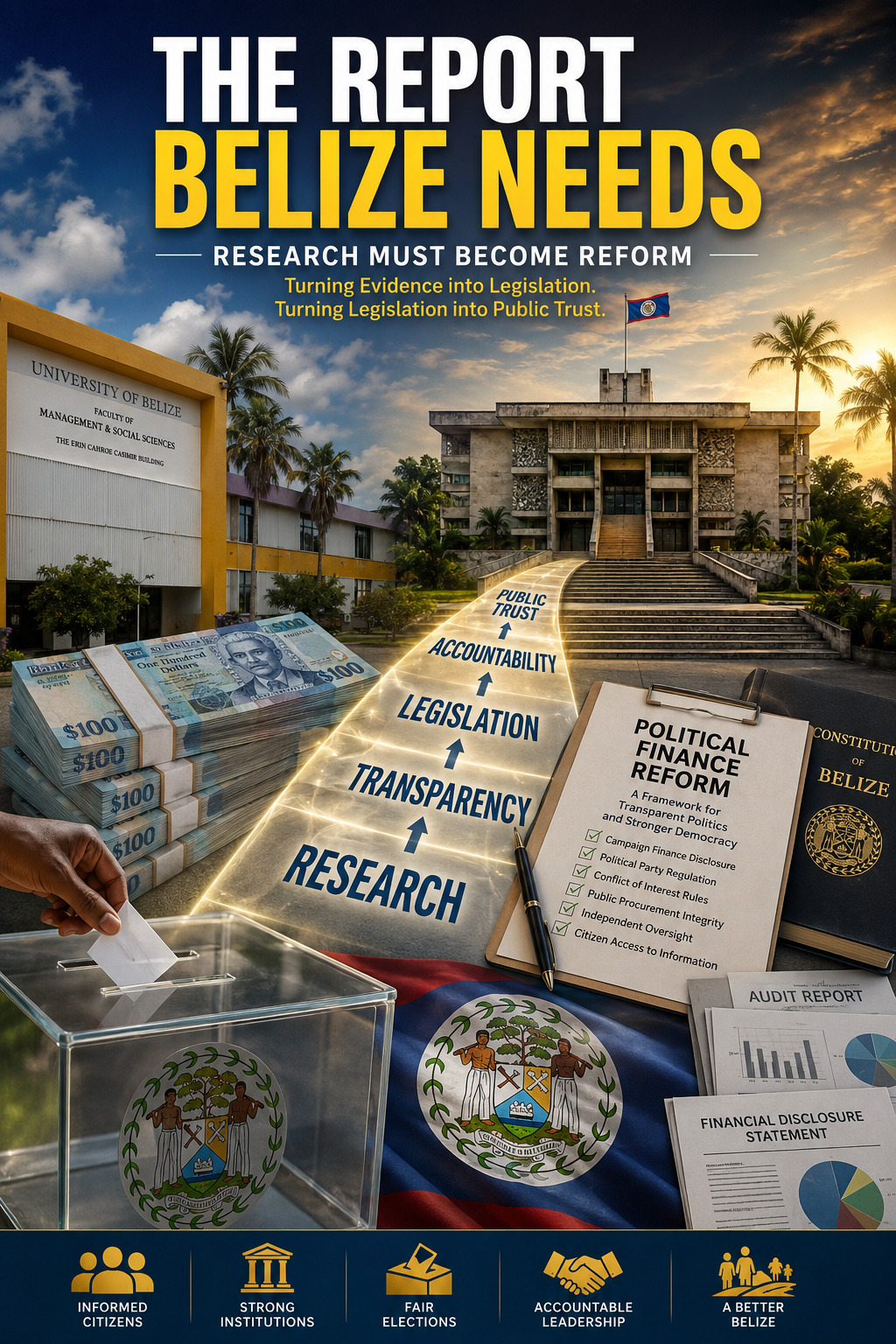
Research Is Only the Beginning
Every meaningful reform follows a journey.
Research identifies problems.
Public debate broadens understanding.
National consensus builds momentum.
Legislation establishes the legal framework.
Institutions implement the law.
Independent oversight ensures compliance.
Public confidence is earned through consistent enforcement.
Too often, Belize begins this journey but does not complete it.
The nation has become familiar with consultations, recommendations, policy papers, and public commitments that generate headlines but fail to produce lasting institutional reform. This observation is not directed at any single government, political party, or institution. Rather, it reflects a broader governance challenge that has persisted across political administrations.
The question therefore is not simply whether Belize needs another report.
The question is whether Belize is prepared to act upon it.
Looking Beyond Political Campaign Financing
Political financing is frequently reduced to discussions about campaign donations. In reality, it is part of a much larger governance ecosystem.
A comprehensive national study should encourage Belizeans to examine several interconnected questions.
Who finances political parties?
How transparent are those financial relationships?
What safeguards exist to prevent conflicts of interest?
How are government contracts awarded following elections?
What mechanisms ensure that procurement decisions are made in the public interest?
How effectively are existing integrity institutions performing?
Are political parties themselves subject to modern standards of financial accountability?
How accessible is information to ordinary citizens?
These are not partisan questions.
They are democratic questions.
Every political party that governs today will one day sit in opposition. Every opposition party aspires to become government. A transparent political-finance framework therefore protects every participant in Belize's democracy and strengthens public confidence regardless of who occupies the government benches.
The Human Dimension
BELPRI's discussion of Maslow's Hierarchy of Needs introduces an important perspective.
Economic hardship affects democratic participation.
Citizens struggling to secure employment, food, housing, healthcare, or education often face immediate realities that influence political decision-making. In many democracies, political scientists describe this phenomenon as clientelism—the exchange of political support for short-term material benefits.
Understanding these socio-economic realities is essential.
However, understanding them is only the first step.
A mature democracy must also create institutions that reduce dependence upon patronage by strengthening opportunity, transparency, fairness, and equal treatment under the law.
Democracy should empower citizens to make political choices based upon conviction rather than necessity.
From Regulation to Integrity
A modern political-finance framework cannot exist in isolation.
It should be supported by complementary reforms that reinforce one another, including:
comprehensive legislation governing political parties;
transparent campaign-finance disclosure requirements;
independent auditing of party finances;
clear conflict-of-interest standards;
strengthened public procurement safeguards;
effective beneficial ownership disclosure;
meaningful whistleblower protections;
stronger oversight institutions;
accessible public reporting systems;
regular legislative review; and
sustained civic education that enables citizens to understand and participate in democratic accountability.
Transparency is not created by a single law.
It is created by an integrated system in which institutions support one another and public confidence grows through consistent application of the rules.
The Responsibility of Parliament
Ultimately, universities conduct research.
Civil society advocates.
Journalists investigate.
Citizens participate.
But only Parliament can transform recommendations into law.
That responsibility belongs equally to the Government and the Opposition.
Political-finance reform should never be viewed as legislation designed to benefit one political party or disadvantage another. It should be regarded as a national democratic safeguard that strengthens every future government and every future opposition.
The institutions Belize builds today will serve generations yet to come.
A National Opportunity
BELPRI's report therefore represents more than an academic publication.
It represents an opportunity.
An opportunity for Parliament to revisit comprehensive political-finance legislation.
An opportunity for political parties to demonstrate their commitment to transparency.
An opportunity for civil society to contribute constructively to public debate.
An opportunity for citizens to demand institutions worthy of their confidence.
And an opportunity for Belize to move from discussion to implementation.
Conclusion: The Measure of Success
Belize does not need another report that is remembered only for its launch ceremony.
It needs a report that becomes the foundation for legislative debate.
It needs research that informs policy.
It needs recommendations that become institutions.
It needs transparency that becomes public trust.
The true measure of BELPRI's work will not be found on the day of its presentation.
It will be found in the months and years that follow.
If this report helps inspire comprehensive political-finance legislation, strengthens democratic institutions, and advances accountability across Belize's political system, it will have achieved something far greater than academic recognition.
It will have contributed to the strengthening of Belizean democracy itself.
For a nation seeking greater transparency, stronger institutions, and renewed public confidence, that is not merely an academic ambition.
It is a democratic necessity.
- Log in to post comments