From Power, Prosperity and Mega-Projects to Corruption, Conviction and Diplomatic Exile The Rise and Fall of Ricardo Martinelli and the Crisis Now Brewing Between Panama and Nicaragua
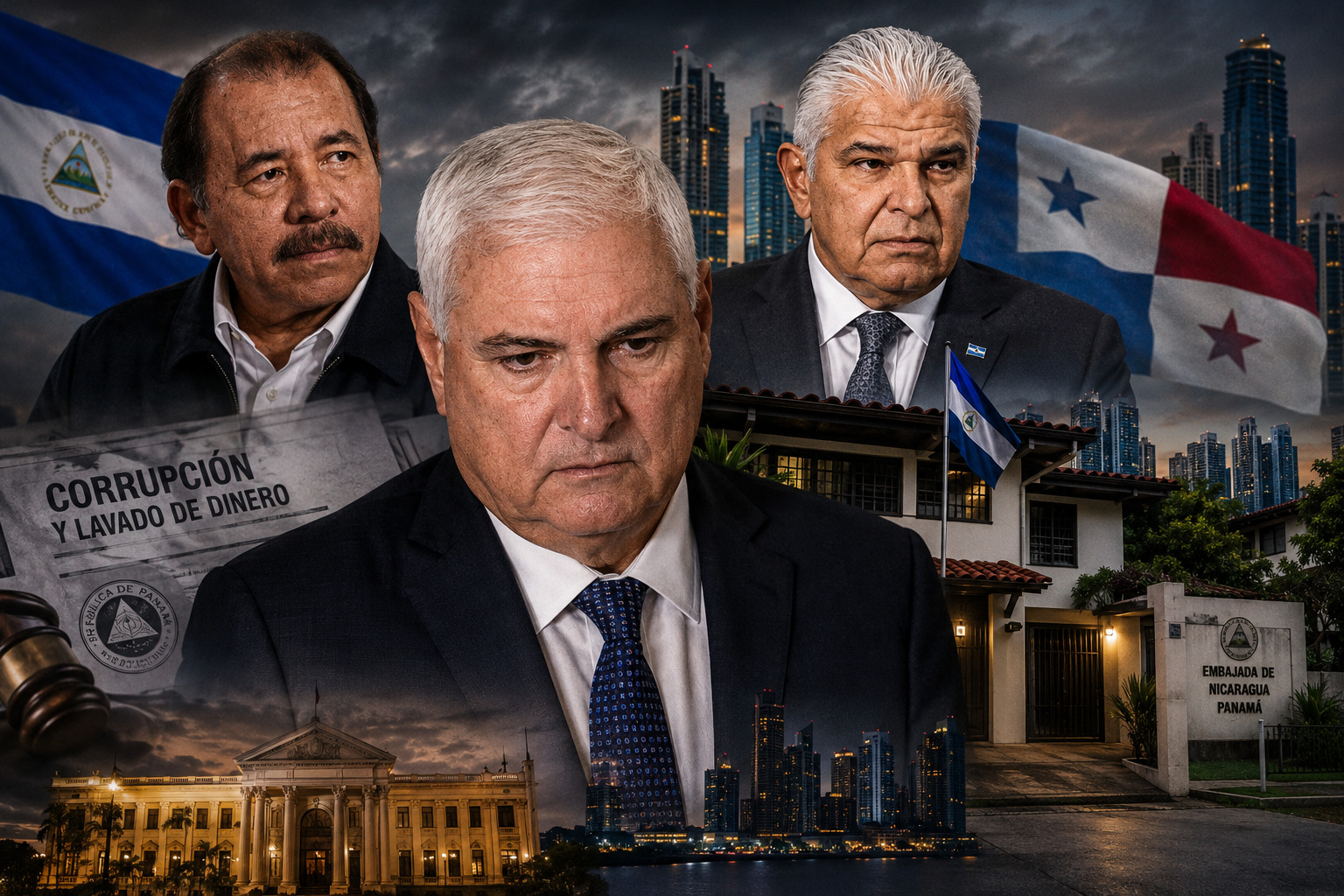
The Rise and Fall of Ricardo Martinelli and the Crisis Now Brewing Between Panama and Nicaragua
Belize City: Wednesday, 27th May 2026. There are few political figures in modern Central America as controversial, influential, admired, feared, and politically resilient as Ricardo Martinelli.
To his supporters, Martinelli was a bold businessman-turned-president who modernized Panama, accelerated infrastructure development, expanded economic growth, and transformed Panama City into one of Latin America’s most visible financial and commercial hubs.
To his critics, he embodied the dangerous fusion of political power, business influence, state contracts, surveillance, corruption, and elite impunity.
Today, the same man who once governed Panama from the presidential palace found himself seeking refuge inside the Nicaraguan Embassy in Panama City, convicted of money laundering, barred from office, and at the center of a diplomatic dispute involving Panama, Nicaragua, Colombia, Interpol, and regional political tensions.
This is the broader story behind the political storm.
The Rise of Ricardo Martinelli
Born in 1952, Ricardo Martinelli emerged from Panama’s powerful business class, building influence through the Super 99 supermarket empire before entering politics. His public image was carefully crafted around efficiency, business discipline, modernization, and economic growth.
Martinelli won the Panamanian presidency in 2009 under the banner of the Democratic Change Party (Cambio Democrático), presenting himself as an outsider capable of transforming Panama into a modern economic powerhouse.
And in many ways, economically, Panama did grow rapidly during his administration.
Under Martinelli’s presidency:
- massive infrastructure projects expanded,
- the Panama Metro project began,
- highways and urban modernization accelerated,
- foreign investment increased,
- banking and logistics sectors expanded,
- and Panama experienced one of the fastest economic growth rates in Latin America.
For many ordinary Panamanians, Martinelli projected the image of a practical leader who “got things done.”
But beneath the aggressive development narrative, allegations of corruption, abuse of power, and political manipulation slowly accumulated.
The Mega-Project Era and the Beginning of Allegations
Martinelli’s administration coincided with one of the largest public spending eras in Panama’s history.
Billions of dollars flowed into:
- transportation projects,
- infrastructure contracts,
- urban expansion,
- state procurement,
- social assistance programs,
- and media influence.
It was during this period that suspicions emerged involving:
- inflated contracts,
- favouritism,
- illegal commissions,
- abuse of public funds,
- and alleged kickback schemes linked to contractors and political insiders.
After Martinelli left office in 2014, the government of his successor, Juan Carlos Varela, opened multiple investigations into alleged corruption tied to the Martinelli era.
Among the earliest scandals were accusations involving:
- irregular food procurement programs,
- misuse of state resources,
- illegal surveillance operations,
- and later, connections to the regional Odebrecht corruption scandal.
The Odebrecht Shadow
The Odebrecht scandal became one of Latin America’s largest corruption investigations, exposing how the Brazilian construction giant allegedly paid bribes to politicians and officials across the region in exchange for government contracts.
Panama became one of the countries heavily touched by the scandal.
Investigators alleged that millions of dollars in bribes circulated through networks connected to political elites during Martinelli’s administration.
The scandal became even more politically explosive when Martinelli’s sons pleaded guilty in the United States in relation to international money laundering linked to Odebrecht payments.
Although Martinelli repeatedly denied wrongdoing and portrayed himself as the victim of political persecution, the legal pressure around him continued growing both domestically and internationally.
The “New Business” Case
The case that finally brought Martinelli down politically became known as the “New Business” case.
Panamanian prosecutors alleged that public funds were diverted through contractors and intermediaries to secretly finance the purchase of Editora Panamá América S.A. (EPASA), a major media conglomerate controlling newspapers such as:
- Panamá América,
- Critica
- and Día a Día.
According to prosecutors, the operation used state money and contractor kickbacks routed through shell structures connected to Martinelli and associates.
In July 2023, a Panamanian criminal court convicted Martinelli of money laundering.
He was sentenced to:
- more than 10 years in prison,
- and fined millions of dollars.
The conviction represented one of the most dramatic political collapses in Panama’s modern democratic history.
Martinelli’s Political Counterattack
Despite the conviction, Martinelli refused to disappear politically.
Instead, he attempted a political comeback by launching another presidential bid ahead of the 2024 elections.
His strategy was clear:
- maintain political relevance,
- use public popularity,
- attack the judiciary,
- and portray himself as a victim of “lawfare” and political persecution.
Martinelli insisted the judicial system was weaponized against him by political enemies.
However, Panama’s Supreme Court upheld the conviction in February 2024, effectively disqualifying him from running for president.
That ruling changed everything.
Flight Into the Nicaraguan Embassy
Facing imprisonment, Martinelli entered the Nicaraguan Embassy in Panama City and formally requested political asylum from the government of Daniel Ortega.
Nicaragua quickly granted asylum, arguing that Martinelli faced political persecution and threats to his life.
Panama strongly rejected that argument.
The Panamanian government maintained that:
- Martinelli had been convicted through ordinary judicial procedures,
- the charges involved common crimes,
- and diplomatic asylum was never intended to shield convicted politicians from prison sentences related to corruption.
This disagreement triggered the diplomatic dispute now straining relations between Panama and Nicaragua.
Why the Diplomatic Crisis Escalated
The situation worsened because Martinelli allegedly continued engaging in Panamanian politics from inside the embassy.
Panama accused Nicaragua of allowing its diplomatic mission to become:
- a political command center,
- a platform for partisan activity,
- and a mechanism for interfering in Panama’s internal affairs.
Panamanian President José Raúl Mulino — ironically elected with strong support from Martinelli’s political machinery — found himself caught between:
- respecting diplomatic asylum conventions,
- maintaining institutional credibility,
- and managing the continuing political influence of his former ally.
The situation became even more chaotic when:
- Panama approved temporary safe passage for Martinelli to travel to Nicaragua,
- judicial authorities sought Interpol involvement,
- Nicaragua objected,
- and Martinelli himself claimed the arrangement was a “trap.”
At one point, his departure to Nicaragua collapsed at the last moment amid disputes involving possible Interpol alerts and international legal complications.
The diplomatic atmosphere deteriorated sharply.
The Colombian Exit
After more than a year inside the Nicaraguan Embassy, Martinelli eventually departed Panama in May 2025 after receiving asylum from Colombia under President Gustavo Petro.
His departure temporarily reduced tensions between Panama and Nicaragua, but the political scars remain.
The broader regional implications continue reverberating across Latin America.
The Larger Regional Question
The Martinelli affair became more than a corruption case.
It evolved into a regional debate about:
- judicial independence,
- political persecution,
- corruption,
- asylum abuse,
- elite impunity,
- and the use of diplomatic protection for controversial political figures.
For critics of Martinelli:
this was a convicted former president attempting to escape accountability.
For his supporters:
this was political persecution disguised as anti-corruption justice.
And for Nicaragua under Ortega:
granting asylum reinforced its posture as a government willing to confront what it describes as politically manipulated judicial systems in Latin America.
A Political Mirror for Latin America
The Ricardo Martinelli saga reflects one of the deepest contradictions in Latin American politics.
Many former leaders who once governed through mega-projects, aggressive economic expansion, and charismatic populism later found themselves facing accusations of:
- corruption,
- abuse of state resources,
- and manipulation of institutions.
Yet many also retained powerful public support.
That contradiction continues dividing Latin America today.
The Martinelli case therefore is not merely about one man.
It is about:
- the fragile line between development and corruption,
- the dangerous fusion of business and political power,
- and the unresolved struggle between accountability and political survival in the modern Latin American state.
By Omar Silva -Editor/Publisher
National Perspective Belize – Digital
Holding Power to Account !!!
- Log in to post comments