BELIZE IS REFORMING — BUT IS THE SYSTEM REALLY CHANGING?
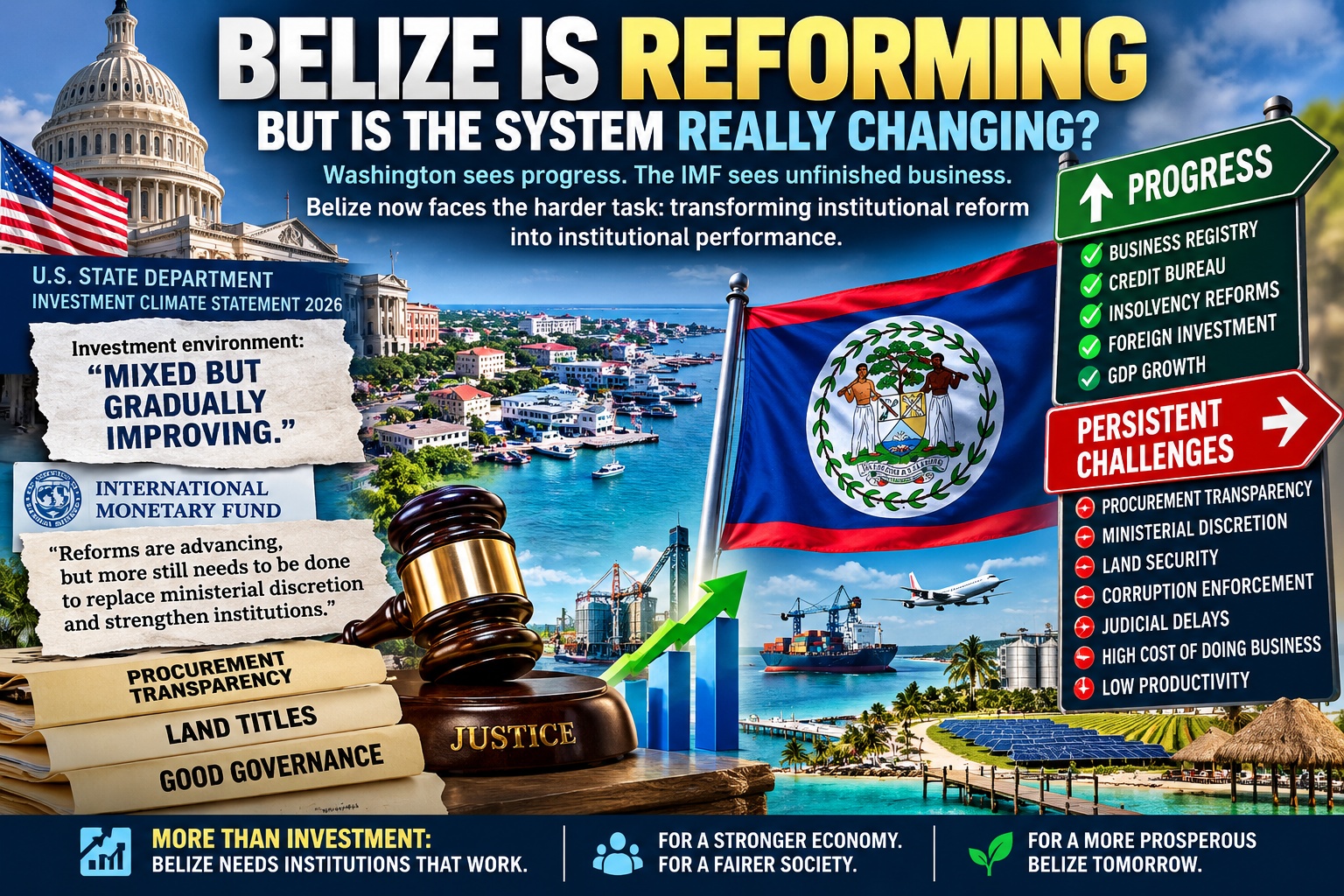
Washington sees progress. The IMF sees unfinished business. Belize now faces the harder task: transforming institutional reform into institutional performance.
NATIONAL PERSPECTIVE BELIZE | SPECIAL ANALYSIS
BELIZE CITY — Monday 5th 2026: There is good news in the United States State Department's newly released 2026 Investment Climate Statement on Belize.
- Belize is reforming.
But buried beneath that encouraging assessment is a much more consequential message for those entrusted with governing the country:
- Reform has begun. Transformation has not yet been completed.
The State Department describes Belize's investment environment as “mixed but gradually improving.” Government remains supportive of foreign direct investment, and several measures introduced over recent years appear to be making portions of the business environment more functional.
That deserves recognition.
But Washington's assessment also identifies persistent concerns involving bureaucratic delays, inconsistent application of rules, land security, corruption, procurement transparency and dispute resolution.
- And therein lies the real story.
This should not become another political argument about whether Belize is doing well or badly.
The question that matters are: Can Belize move from passing reforms to building institutions that work predictably, transparently and independently—regardless of who governs?
THE PROGRESS SHOULD NOT BE DISMISSED
- The State Department identifies genuine movement.
- Belize's Online Business Registry System has streamlined company registration. Amendments to the Fiscal Incentives framework have expanded eligibility into additional economic activities. Foreign exchange procedures have been liberalized for many transactions. Belize has established its first credit bureau, while insolvency reforms provide mechanisms through which distressed businesses can restructure rather than simply collapse.
The IMF independently records other progress.
The Moveable Property Security Rights Act was enacted, a collateral registry was launched, and the Central Bank licensed a credit bureau in June 2025—all potentially important for expanding access to credit, particularly for MSMEs.
These aren't cosmetic changes.
For a small developing economy attempting to attract investment and create domestic enterprises, easier registration, better credit information, modern insolvency arrangements and improved access to collateral financing matter enormously.
- The State Department also reports that foreign investment continued increasing during 2025, driven particularly by tourism-related construction. Real GDP expanded 2.7 percent in 2025, marking a fifth consecutive year of post-pandemic growth.
Government therefore has evidence upon which it can legitimately argue that progress has occurred.
- But there is another side of the ledger.
THE WARNING LIGHTS HAVE NOT DISAPPEARED
The uncomfortable part of Washington's assessment is not necessarily what is new.
It is what keeps appearing year after year.
- The State Department's 2024 assessment already recorded complaints from American and other foreign investors about lack of transparency, land insecurity, bureaucracy, delays, undue influence by politically powerful interests and corruption.
- It also recorded difficulties involving bidding, government procurement and dispute settlement. 2021-2025.state.gov
- Two years later, several of those structural concerns remain recognizable in the 2026 assessment.
That changes the significance of the report.
- A problem identified once may be an emerging weakness.
- A problem identified repeatedly becomes structural.
1. PROCUREMENT: GOVERNMENT MUST FINISH THE JOB
This is perhaps where Belize's reform agenda deserves particularly serious attention.
The IMF has recommended that Belize publish procurement contracts and beneficial-ownership information for recipients of public contracts. It also says further improvements are required in public financial management, including internal audit, fiscal-risk assessment, public-investment management and fiscal reporting. elibrary.imf.org
Consider what that would mean.
- Not merely publishing who received a contract.
- But allowing Belizeans to determine who ultimately owns or controls the company receiving taxpayers' money.
That single reform could strengthen confidence in procurement enormously.
- It would help expose conflicts of interest, discourage politically connected shell arrangements and allow journalists, civil society, competing businesses and Parliament to scrutinize public expenditure.
Government has indicated that it intends to further centralize procurement. elibrary.imf.org
Good.
But centralization without transparency merely concentrates authority.
- Centralization accompanied by open contracting, beneficial-ownership disclosure, competitive tendering and independent oversight creates accountability.
That distinction is fundamental.
2. MINISTERIAL DISCRETION: PERHAPS THE BIGGEST WARNING
Buried within the IMF's assessment is one recommendation that deserves far more public discussion than it has received.
The IMF recommended that Belize: replace ministerial discretion in business-related processes with a more predictable, rules-based system.
And in assessing progress, the Fund concluded: “More still needs to be done to replace ministerial discretion.” elibrary.imf.org
That is an extraordinarily important observation.
- Belize's problem has never simply been whether individual ministers are good or bad.
The larger problem is institutional architecture.
- When licenses, permits, concessions, government land, incentives, contracts or regulatory decisions depend excessively upon political discretion, the system itself creates opportunities for favoritism, inconsistency and influence.
A modern investment economy cannot operate principally on: Who do you know?
It must operate on: What are the rules? Do you qualify? And are those same rules being applied to everyone?
That protects investors.
- But equally importantly, it protects Belizeans.
3. LAND: AN ECONOMIC PROBLEM, NOT MERELY A LANDS DEPARTMENT PROBLEM
- The State Department's concerns regarding land deserve urgent attention.
- Its 2026 assessment reports investor concerns involving land fraud, corruption, unreliable titles, overlapping systems and inadequate surveys, while noting the absence of regulation of real-estate agents. Breaking Belize News
This is bigger than administrative inconvenience.
- Land is capital.
- A reliable land title can become collateral for a loan. It can support agricultural investment, housing, tourism development, manufacturing or generational wealth.
- An unreliable title becomes economic uncertainty.
- Government has announced plans to digitize the land registry and land-tax systems, something also recognized by the IMF. elibrary.imf.org
Digitization should be accelerated.
But Belize must remember: Digitizing an unreliable system simply produces unreliable information faster.
- The underlying records, surveys, ownership histories, safeguards against fraudulent transfers and mechanisms for resolving competing claims must also be strengthened.
4. CORRUPTION: LAWS WITHOUT ENFORCEMENT ARE NOT DETERRENTS
- Belize does not suffer from an absence of anti-corruption legislation.
That distinction is critical.
- The earlier State Department assessment noted the existence of the Prevention of Corruption in Public Life Act, Integrity Commission, public-service conflict-of-interest provisions, Civil Asset Recovery and Unexplained Wealth legislation and Belize's international anti-corruption commitments.
- Yet it simultaneously reported inadequate enforcement and negligible adherence to some disclosure requirements. 2021-2025.state.gov
That exposes perhaps Belize's most persistent governance contradiction:
- We repeatedly build legal mechanisms without ensuring that the institutions responsible for enforcing them possess the independence, resources and determination to do so.
- An anti-corruption law that is rarely enforced cannot substantially deter corruption.
- An asset-declaration regime without meaningful compliance becomes paperwork.
- An unexplained-wealth mechanism that is never meaningfully tested cannot establish whether it works.
- An audit delivered years after expenditure occurred may document history rather than prevent abuse.
Government therefore has an opportunity to move Belize into another phase:
from anti-corruption legislation to anti-corruption enforcement.
5. JUSTICE IS ALSO ECONOMIC INFRASTRUCTURE
- Roads are infrastructure.
- Ports are infrastructure.
- Electricity is infrastructure.
But so is a functioning court system.
- The State Department's 2024 assessment described Belize's judiciary as generally independent, but also underfunded and under-resourced, contributing to adjournments, delays, poor case-flow management and backlogs. 2021-2025.state.gov
- The IMF subsequently called for enhanced technical capacity within the judiciary to strengthen business confidence, while recognizing efforts to modernize access to judicial information. elibrary.imf.org
Why does this matter economically?
- Because contracts ultimately depend upon enforcement.
- An investor calculating whether to put $20 million into Belize isn't merely asking about tax concessions.
The investor is also asking: If somebody breaches my contract, how long will justice take?
- A Belizean entrepreneur deserves exactly the same certainty.
Judicial modernization therefore shouldn't be regarded merely as legal-sector reform.
- It is economic reform.
6. THE NEXT INVESTMENT QUESTION IS QUALITY, NOT SIMPLY QUANTITY
There is another important issue Government should consider.
- Prime Minister John Briceño told Parliament in his 2026 budget presentation that Belize attracted approximately $736 million in capital inflows during 2024 and 2025, with net investment flows of approximately $505 million after specified outflows. He presented those flows as evidence of international confidence in Belize. Belize.com
That is a legitimate argument.
But the next question should be harder: What kind of investment is Belize attracting?
Investment concentrated in tourism construction and real estate can create employment and capital inflows.
- But Belize also needs investment capable of increasing productivity, exports, technological capacity, value-added agriculture, energy resilience and industrial production.
- That becomes especially important because the IMF expects Belize's medium-term potential growth to settle at only around 2 percent without stronger reforms, reflecting capacity constraints. IMF
Its current country data projects approximately 2.2 percent real GDP growth for 2026. IMF
- So, attracting money alone isn't enough.
- Belize must attract productive capital.
THE OPPORTUNITY SITTING INSIDE THE WARNING
- None of this requires Government to reject the State Department assessment.
Quite the opposite.
- Government could use it as a roadmap.
Imagine Belize establishing a measurable National Investment and Institutional Reform Dashboard where the public could see progress in areas such as procurement transparency, beneficial ownership, land digitization, business approvals, court disposition times, investment approvals and anti-corruption enforcement.
Then establish deadlines.
- Assign institutional responsibility.
- Publish results.
- And allow Belizeans to judge progress themselves.
That would transform reform from political messaging into measurable national performance.
THE GOVERNMENT SHOULD READ THIS REPORT AS AN OPPORTUNITY
There is a temptation whenever an international institution identifies weaknesses for governments to defend themselves.
That would miss the value of this report.
Washington isn't saying Belize has failed.
- In fact, its description of an environment that is gradually improving recognizes movement in the right direction. state.gov
The challenge now is considerably harder.
- Belize must institutionalize that progress so thoroughly that the system doesn't depend upon the goodwill of a particular minister, administration, public officer or political party.
- A business shouldn't require political access to obtain a license.
- A contractor shouldn't require political connections to compete for public business.
- A landowner shouldn't need influence to secure certainty over property.
- A citizen shouldn't need connections for an institution to perform its statutory responsibility.
And an investor shouldn't have to calculate political relationships as part of the cost of doing business.
That is what institutional reform ultimately means.
NP BELIZE PERSPECTIVE
- Belize has spent decades asking how to attract more investors.
Perhaps the better question in 2026 is:
- What kind of country must Belize become so that serious investors—and its own entrepreneurs—want to build here?
- Tax concessions cannot compensate indefinitely for weak institutions.
- Promotional summits cannot substitute for predictable regulation.
Digitization cannot substitute for accountability.
- Economic growth cannot permanently conceal poor productivity.
- And legislation cannot substitute for enforcement.
The State Department report therefore shouldn't be interpreted as an indictment of Belize.
- It should be treated as a diagnostic.
- Government has already started several of the reforms required.
Now comes the difficult part: procurement that can withstand scrutiny; land administration people can trust; courts capable of delivering timely justice; regulators governed by rules rather than discretion; meaningful anti-corruption enforcement; and investment policies designed not merely to bring capital into Belize, but to transform that capital into productivity, exports, technology and better-paying Belizean jobs.
- Because ultimately the international investment climate is only one side of the equation.
- The same institutions foreign investors need are the institutions Belizeans deserve.
And perhaps that is the most important message contained between the lines of Washington's report: **Belize does not need another promise of reform.
It needs to finish the reforms it has already begun.**
By: Omar Silva – Editorial Director @ www.nationalperspectivebz.com
National Perspective Belize — Perspective beyond the headline.
- Log in to post comments