BEYOND THE OSHA BILL Protecting Workers, Respecting Rights, and Modernizing Belize's Social Contract
CHAPTER I
A THIRTEEN-YEAR JOURNEY FROM LEGISLATION TO INSTITUTION BUILDING
Belize City: Wednesday 5th August 2026” The Occupational Safety and Health Bill has returned to the Senate after one of the longest legislative journeys in recent Belizean history. Its origins stretch back to 2011. Since then, it has passed through successive governments, multiple rounds of public consultation, parliamentary committees, private sector review, trade union advocacy, technical assistance from the International Labour Organization (ILO), and repeated amendments.
This history alone tells us something important.
Unlike many pieces of legislation that move quickly through Parliament, this Bill has been tested by disagreement. It has been delayed, questioned, rewritten, and returned more than once. Whether one supports every provision or not, the process itself demonstrates that democratic institutions can improve legislation when consultation is genuine and concerns are taken seriously.
That is perhaps the first lesson from the OSHA Bill.
Good legislation is rarely born perfect. It is strengthened through scrutiny.
Beyond the Colonial Factories Act
The legislation also marks a significant institutional shift.
For decades, Belize's occupational safety framework remained anchored in the Factories Act, legislation inherited from a colonial economic model built around industrial workplaces. That framework reflected an era when occupational hazards were largely associated with machinery, manufacturing, and physical production.
Belize's economy has changed.
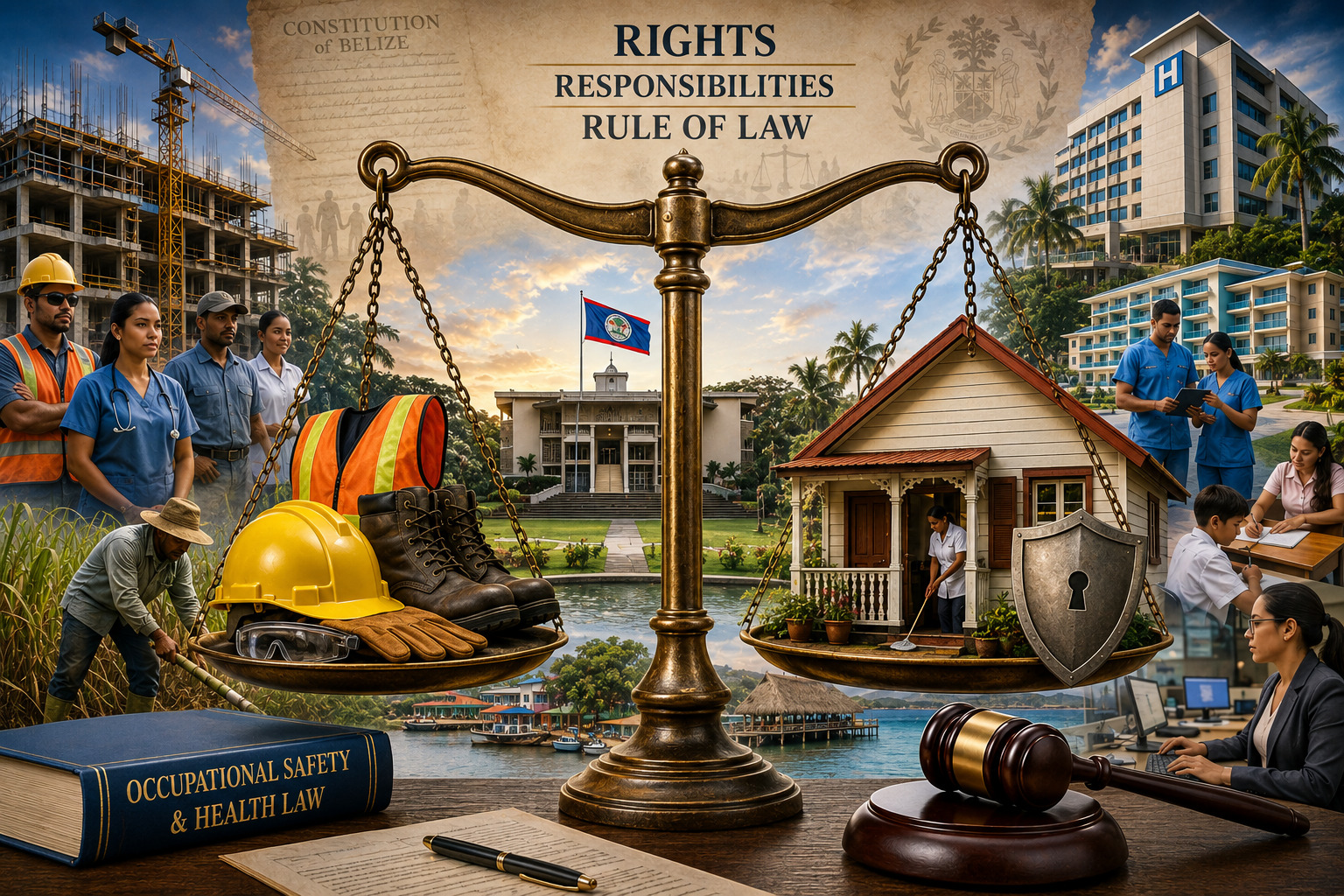
Today's workforce includes tourism employees, nurses, teachers, supermarket cashiers, construction workers, delivery personnel, office staff, agricultural workers, call-centre employees, security officers, and domestic workers. Occupational risks have evolved alongside the economy.
The OSHA Bill acknowledges that reality.
Rather than protecting only the "factory," it seeks to protect the "worker," regardless of where that work is performed.
That represents a fundamental philosophical change in labour policy.
Consultation That Changed the Law
One of the recurring themes during the Senate debate was consultation.
Government Business Senator Eamon Courtenay emphasized that more than a dozen amendments were incorporated following years of dialogue. Opposition Senator Patrick Faber, while critical of aspects of the process, also acknowledged that concerns raised by parliamentarians and stakeholders were ultimately heard and that the legislation returned substantially revised.
This is significant.
Too often, consultation becomes a procedural exercise where meetings are held but decisions remain unchanged. In this instance, the legislative record suggests that stakeholder input materially influenced the final text.
That should be welcomed regardless of political affiliation.
Democratic governance is strengthened when consultation produces substantive improvements rather than merely satisfying formal requirements.
Not Every Question Has Been Answered
Yet consultation alone does not guarantee legislative success.
The true measure of any law lies in its implementation.
- Will inspections be conducted fairly?
- Will workers experience safer workplaces?
- Will employers receive timely decisions?
- Will regulators exercise their powers transparently and consistently?
Those questions cannot be answered by debate alone. They will be answered by the institutions responsible for enforcing the law.
CHAPTER II
WHEN WORKPLACE SAFETY MEETS CONSTITUTIONAL LIBERTY
As the Bill has evolved, so too has the national conversation.
- The earlier debate centred on who should be protected.
- The current debate focuses on how those protections should be enforced.
- That evolution reflects legislative maturity.
Domestic Workers: From Exclusion to Recognition
One of the most important changes in the Bill concerns domestic workers.
Earlier versions attracted criticism because domestic workers were not adequately covered, despite performing essential labour within private households. Trade unions, labour advocates, and several parliamentarians questioned why an entire category of workers should remain outside modern occupational safety protections.
That criticism proved consequential.
Following years of consultation, the legislation was revised to extend coverage to domestic workers. This is one of the clearest examples of consultation changing the substance of the law rather than merely its presentation.
The principle is difficult to dispute.
A worker's right to health and safety should not depend on whether they are employed in a hotel, a factory, or a family home.
The Constitutional Challenge
Yet extending protection into private residences introduces an entirely different constitutional dimension.
- A private home is more than a workplace.
- It is also a constitutionally protected space where individuals enjoy expectations of privacy and family life.
- This raises legitimate legal questions.
How should workplace inspections be conducted inside private homes?
- When, if ever, may inspectors enter without consent?
- Should judicial authorization be required?
What protections exist for household members who are not employers?
- How should evidence be gathered where direct inspections are impractical?
These questions are not obstacles to protecting domestic workers.
- They are the legal architecture necessary to ensure that labour rights and constitutional rights reinforce rather than undermine one another.
The Private Sector's Practical Concerns
Private Sector Senator Kevin Herrera drew attention to another equally important issue.
- The Bill empowers inspectors to close workplaces where an imminent danger exists.
- That authority is entirely understandable.
- Where lives are at risk, immediate intervention may be essential.
But emergency powers must be accompanied by corresponding duties.
If an employer promptly remedies the identified hazard, the law should require inspectors to conduct follow-up inspections within clearly defined statutory timeframes. Without such safeguards, businesses could remain closed longer than necessary, affecting both employers and the very workers the legislation seeks to protect through lost income and economic uncertainty.
- The principle here is straightforward.
- Government should possess sufficient authority to protect life and health.
- Government should also be accountable for exercising that authority efficiently, transparently, and proportionately.
A New Social Contract
Viewed more broadly, the Occupational Safety and Health Bill is not simply about workplace inspections.
It reflects Belize's evolving understanding of the relationship between the State, employers, and workers.
- Workers have the right to return home safely at the end of every working day.
- Employers have the right to clear, predictable, and fairly administered regulations.
- The State has the duty to protect both the public interest and constitutional freedoms.
When these three responsibilities remain in balance, labour legislation becomes more than regulation—it becomes part of the nation's social contract.
National Perspective Belize Assessment
The return of the Occupational Safety and Health Bill to the Senate represents more than the revival of long-delayed legislation. It reflects the slow but important evolution of Belize's democratic law-making process.
The Bill has moved beyond the narrow confines of the colonial Factories Act and seeks to establish a modern framework capable of protecting workers across a far more diverse economy. Its lengthy consultation process demonstrates that public participation can improve legislation, particularly where concerns are genuinely considered and incorporated.
However, the success of the Bill will not ultimately depend on the number of amendments it contains. It will depend on the integrity, professionalism, and consistency with which it is implemented.
The inclusion of domestic workers marks an important affirmation that occupational safety is a universal right rather than a privilege reserved for certain sectors. At the same time, Parliament must ensure that the regulations governing inspections within private residences are sufficiently precise to protect both workplace safety and the constitutional right to privacy.
Similarly, enforcement powers must be balanced by procedural safeguards that prevent unnecessary economic harm while preserving the State's ability to intervene where genuine danger exists.
Ultimately, the OSHA Bill is not merely replacing an outdated statute. It is helping to redefine the relationship between labour, enterprise, and government in a modern Belize. If implemented with fairness, transparency, and respect for constitutional principles, it has the potential to become one of the country's most significant institutional reforms in labour protection since Independence.
By: Omar Silva - Editor/Publisher @ www.nationalperspectivebz.com
- Log in to post comments