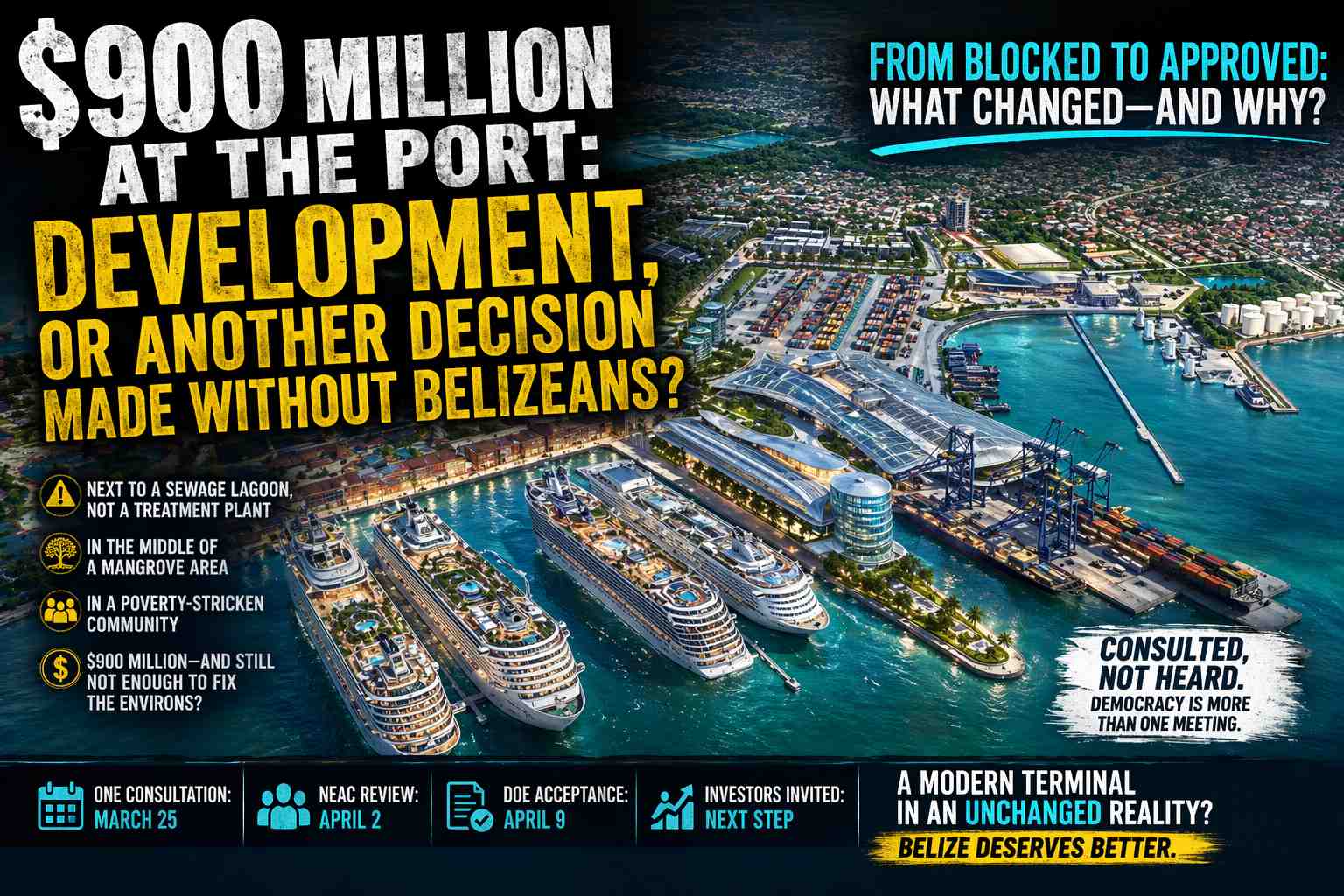
$900 Million at the Port: Development, or Another Decision Made Without Belizeans?
By: Omar Silva I Editor – Publisher
📰NATIONAL PERSPECTIVE BELIZE
Belize City: Tuesday 21st April 2026
INVESTIGATIVE FEATURE
For over two decades, the idea of expanding Belize’s primary port infrastructure has lingered in the shadows of national planning—raised, shelved, revived, and quietly deferred.
Now, suddenly, it returns—not as a concept—but as a $900 million reality-in-motion.
And just as suddenly, it receives conditional environmental clearance.
The question Belizeans must ask is not simply what is being built—
but how it is being approved, and who is being left out of the decision.
⚓ A Project Two Decades in the Making… Approved in Weeks?
The proposed expansion by Port of Belize Ltd. in the Port Loyola area represents one of the largest infrastructure undertakings in Belize’s modern history.
- Cargo expansion
- Cruise tourism development
- Dredging of channels and basins
- Construction of an artificial mangrove island
Yet despite its scale and long gestation, the public-facing process appears remarkably compressed:
- One public consultation: March 25
- NEAC review: April 2
- DOE acceptance: April 9
In less than three weeks, a project with multi-generational consequences moved from consultation to conditional clearance.
That timeline alone demands scrutiny.
🔎 From Blocked to Approved: What Changed—and Why?
Lost in the speed of the recent approval is a critical historical fact:
👉 This project was not always acceptable to Belize’s own environmental authorities.
The Department of the Environment (DOE), under prior policy direction, had previously raised fundamental objections—not minor technical concerns, but structural issues that went to the heart of whether such a development made sense at that location.
⚠️ The Location Problem No One Can Engineer Away
One of the most serious concerns identified then—and still relevant now:
👉 The proposed cruise terminal sits in close proximity to Belize City’s so-called sewer system.
But in reality:
- It is not a modern wastewater treatment facility
- It functions more like a lagoon-based discharge system
- It lies dangerously close to the coastline
This creates a stark contradiction:
👉 A modern cruise terminal—marketed internationally—
placed beside an inadequate and exposed sewage environment.
🌿 Mangroves, Poverty, and the Geography of Neglect
The site is also:
- Embedded within a mangrove ecosystem
- Located in a poverty-stricken urban zone
This is not empty land waiting for development.
It is:
👉 A fragile environmental buffer
👉 A living, struggling community
And once again, Belize must confront a recurring pattern:
👉 Why are the most ambitious projects placed in the most vulnerable spaces?
💰 $900 Million… and Still Not Enough
Even at a projected cost of $900 million, serious doubt remains that the project can:
- Correct the environmental deficiencies of the area
- Modernize the surrounding sanitation realities
- Deliver meaningful transformation to Port Loyola
Instead, the likely outcome may be:
👉 A modern terminal surrounded by unchanged structural neglect
A façade of development—without foundational change.
🔄 So What Changed?
If the environmental conditions remain:
- The lagoon system still exists
- The mangroves remain
- The community conditions persist
Then the unavoidable question is:
👉 What changed between rejection and approval?
Was it:
- New science?
- New engineering solutions?
Or simply:
👉 New urgency. New pressure. New priorities.
🌱 Environmental Concerns: Managed Risk or Managed Narrative?
The National Environmental Appraisal Committee (NEAC) acknowledged multiple risks:
- Dredging impacts
- Sediment contamination
- Air and water quality degradation
Mitigation measures were proposed:
- Containment systems
- Sediment classification
- Artificial mangrove island construction
- Long-term monitoring
But these are not guarantees.
They are:
👉 Controls on damage—not prevention of it
🏙️ Port Loyola: Development for Whom?
The project promises:
- Jobs
- Entrepreneurship
- Flood mitigation
- Traffic management
Yet history suggests:
👉 Benefits are often temporary
👉 Impacts are often permanent
The inclusion of a “grievance mechanism” signals an expectation of conflict—not harmony.
⚖️ Consultation vs. Consent
Criticism from YaYa Marin Coleman highlights a deeper issue:
👉 Consultation is not consent.
One meeting.
With developers present.
That is not community determination.
That is presentation.
🧭 The Bigger Picture
This project reflects a broader governance pattern:
- Decisions accelerated at the top
- Public engagement minimized
- Investor readiness prioritized
👉 Approval first. Participation later.
💰 The Investor Angle
With clearance secured, the Government now invites investors.
Sequence:
- Approve
- De-risk
- Market
Belize becomes:
👉 A product—prepared for investment before public understanding.
🌊 A Critical Test for Belize
This project is more than infrastructure.
It is a test of:
- Governance
- Transparency
- National priorities
- Log in to post comments