WHEN BELIZE LOOKS BETTER TO ITS CREDITORS THAN IT FEELS AT THE KITCHEN TABLE OF THE WORKING POOR
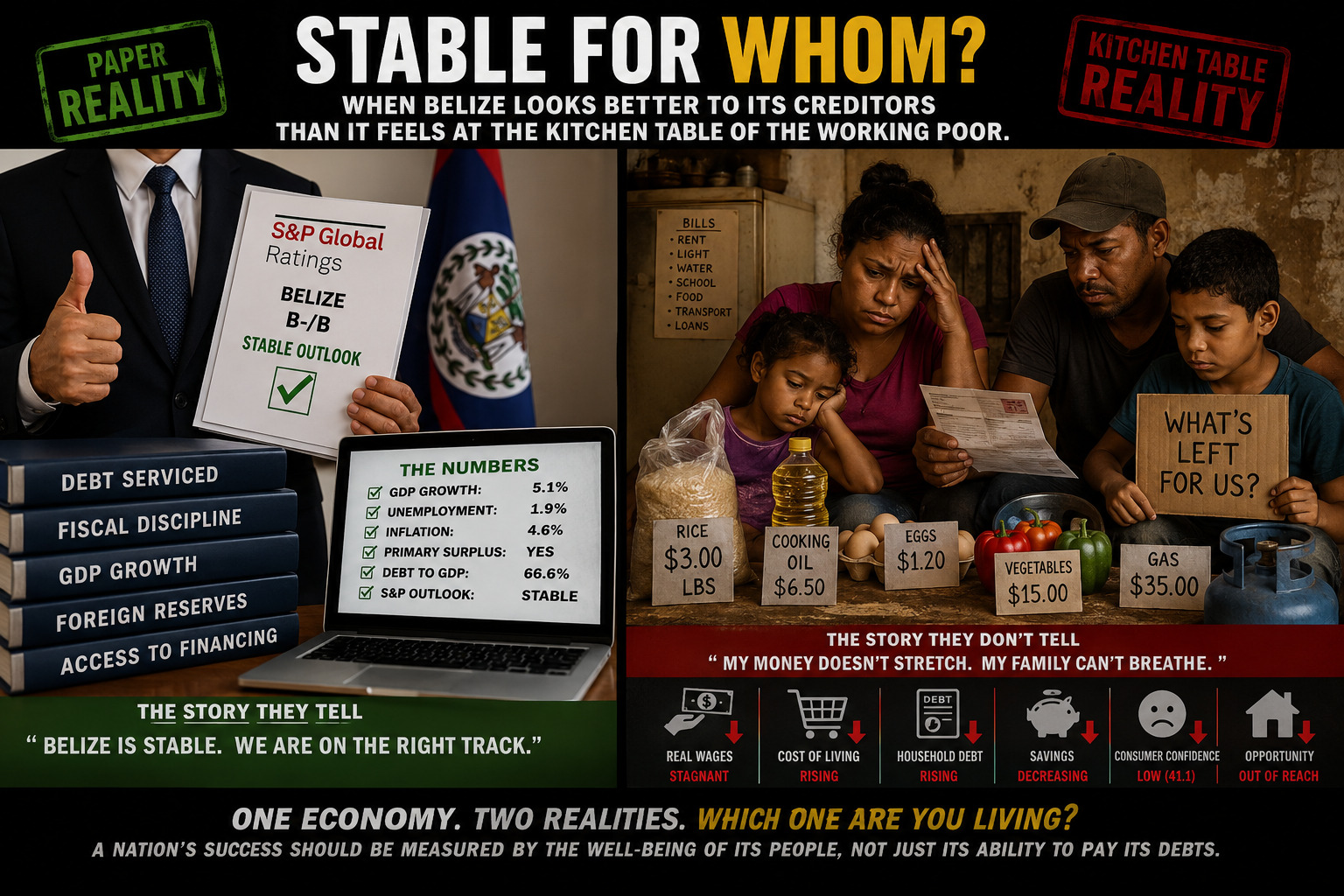
STABLE FOR WHOM?
NATIONAL PERSPECTIVE BELIZE | ECONOMIC REALITY
Belize City: Thursday 20th August 2026: There are two Belizean economies being described in August 2026.
There is the Belize seen through the windows of international credit assessment:
- Debt being serviced.
- Government revenue being collected.
- The currency peg holding.
- Official financing remaining accessible.
- Economic growth continuing.
- A sovereign credit rating carrying a “Stable” outlook.
And then there is another Belize.
- It is found at the supermarket checkout.
- At the gas pump.
- Inside the electricity bill.
- In the rent payment.
- At the construction site.
- Behind the small shop counter.
- In the cane field.
- Inside the home of the public officer, security guard, domestic worker, teacher, farmer, fisherman, mechanic, waitress and minimum-wage worker.
That Belize does not experience the economy through debt-to-GDP ratios.
- It experiences the economy through one brutally simple calculation:
After paying for everything necessary to survive, how much money is left?
- For too many working families, that is where the meaning of the word “stable” becomes questionable.
FIRST, LET US BE FAIR TO S&P
S&P Global Ratings is not conducting an election poll.
- It is not measuring whether Belizeans are happy.
- It is not measuring whether a working mother can comfortably feed three children.
- And, importantly, its latest assessment does not predict that the People's United Party will win another term in 2030.
- S&P is principally assessing something considerably narrower:
- Belize's capacity and willingness to meet its financial obligations.
Therefore, when S&P maintains Belize at B-/B with a Stable Outlook, “stable” should not be translated into:
- Belizeans are prosperous.
It does not mean:
- working-class living standards are stable.
And it certainly does not mean:
- the Government has received an international certificate of successful human development.
It means, broadly, that under S&P's assumptions Belize's sovereign creditworthiness is not presently expected to change materially in the immediate outlook period.
That distinction is fundamental.
Because a country can remain capable of paying its creditors while many of its citizens struggle to pay theirs.
THE HOUSEHOLD THAT NEVER MISSES THE BANK PAYMENT
- Imagine a Belizean family owing $40,000.
Every month that household pays the bank exactly what it owes.
- Never late.
- Never defaults.
From the bank's perspective, this is a dependable borrower.
But suppose maintaining that perfect payment record requires the family to:
- buy less food;
- postpone repairing the vehicle;
- stop saving;
- cut entertainment;
- delay replacing appliances;
- borrow elsewhere for emergencies;
- and stretch every paycheque until there is almost nothing remaining.
The bank can legitimately describe that customer as financially reliable.
- But nobody sitting around that family's kitchen table would describe the household as prosperous.
Both realities can exist simultaneously.
- That is precisely why Belizeans must understand what a sovereign credit rating measures—and what it does not.
NOW WALK FROM THE CREDIT-RATING OFFICE INTO THE SUPERMARKET
This is where economic theory encounters Belizean reality.
- Belize's inflation rate reached 4.6% year-on-year in June 2026.
But inflation is itself an average.
The working poor do not consume an “average basket” in an abstract statistical economy.
- Lower-income households spend disproportionately on necessities.
- Food.
- Transportation.
- Electricity.
- Cooking gas.
- Rent.
- School expenses.
- Medicine.
Those expenses cannot simply be eliminated when prices increase.
- A wealthy household confronted with inflation can postpone purchasing another vehicle or taking an overseas vacation.
- A struggling household cannot postpone feeding its children.
That is why identical inflation can have radically unequal consequences.
Inflation is not socially neutral.
- The poorer the household, the greater the proportion of income consumed by necessities.
- And therefore the less financial space remains when those necessities become more expensive.
“BUT UNEMPLOYMENT IS ONLY 1.9%”
This is another headline requiring examination.
According to SIB, Belize's unemployment rate fell to approximately 1.9% in April 2026.
- Extraordinary on its face.
But Belize's own Statistical Institute reported something underneath that headline that should concern every policymaker.
- The labour force itself declined substantially compared with April 2025.
Employment also declined.
SIB explained that the reduction in unemployment was substantially associated with reduced labour-force participation, particularly among women.
Therefore:
LOW UNEMPLOYMENT DOES NOT AUTOMATICALLY MEAN HIGH ECONOMIC WELL-BEING.
Neither does employment answer the question:
What kind of employment?
- A person can be employed and still poor.
- A person can work six days per week and have no meaningful savings.
- A person can receive a paycheque every Friday and still require credit before the following Friday.
Employment tells us that someone has work.
- It does not necessarily tell us whether that work provides economic security.
That distinction matters enormously in Belize.
GDP GREW. BUT WHO GOT THE GROWTH?
- Belize recorded strong economic growth during the first quarter of 2026.
That is positive.
We should never pretend otherwise simply because it complicates a political argument.
But GDP answers:
How much economic activity occurred?
- It does not fully answer:
Who received the resulting income and wealth?
- That is the missing conversation.
If hotels expand, tourism receipts increase, financial institutions perform well, construction accelerates and major investments increase economic output, GDP can grow.
But if the ordinary worker's wages rise more slowly than his cost of living, his personal economy can simultaneously deteriorate.
Therefore the worker is entitled to ask:
WHERE IS MY SHARE OF THE GROWTH?
- That is not anti-business.
- It is not anti-government.
- It is not socialism.
- It is one of the fundamental questions of development economics:
How is economic growth distributed?
Because economic growth that does not substantially improve household purchasing power eventually becomes impressive mathematics surrounded by dissatisfied people.
THE PRIMARY SURPLUS TELLS ANOTHER STORY
- Government's fiscal accounts can show considerable discipline while households experience considerable pressure.
- Government must collect revenue.
- Government must control expenditure.
- Government must service debt.
- Government must maintain access to financing.
- Government must protect international confidence.
All of these things matter.
Belize knows from painful historical experience what happens when sovereign debt becomes unsustainable.
Therefore, fiscal discipline itself is not the enemy.
But there is another question that cannot be avoided:
WHO PAYS FOR FISCAL DISCIPLINE?
- If additional revenue comes principally from economic expansion and greater productivity, excellent.
- If waste is eliminated, excellent.
- If tax leakage and evasion are reduced, excellent.
- If inefficient expenditure is removed, excellent.
- If procurement becomes more competitive and public money stretches further, excellent.
But if fiscal stability increasingly depends upon extracting more from households whose real purchasing power is already deteriorating, postponing essential public investment, or shifting rising costs onto consumers—
then the national balance sheet may improve while the household balance sheet deteriorates.
- And eventually those two balance sheets collide.
THE CREDITOR GETS PAID BEFORE THE FAMILY FEELS DEVELOPED
Here lies the uncomfortable heart of the discussion.
- International lenders understandably want evidence that Belize can repay what it borrows.
- Credit-rating agencies understandably examine debt sustainability.
- Multilateral institutions understandably demand credible fiscal management.
None of that constitutes a conspiracy against Belize.
- But their institutional priorities are not identical to the priorities of the Belizean household.
The creditor asks: Can Belize pay?
The Belizean family asks: Can WE pay?
The creditor asks: Is public debt sustainable?
The worker asks: Is my household sustainable?
The creditor examines: government revenue.
The household experiences: what Government collects from the economy.
The creditor watches: foreign reserves.
The worker watches: what remains in his wallet.
Both perspectives matter.
But only one has dominated too much of o
ur national economic conversation.
AND THIS IS WHERE POLITICS ENTERS THE PICTURE
There is nothing improper about a Government pointing to a favourable credit assessment.
- If S&P maintains Belize's rating, Government is entitled to say so.
- If debt has fallen substantially from crisis levels, Government is entitled to say so.
- If GDP grows, Government is entitled to report it.
But those numbers become politically misleading when they are presented as though they constitute the complete condition of the Belizean people.
They do not.
A Government could legitimately say:
- “S&P says Belize's outlook is stable.”
National Perspective must then ask:
- STABLE FOR WHOM?
A Government can say: “The economy grew.”
We must ask: WHO BENEFITED FROM THE GROWTH?
Government can say: “Unemployment is 1.9%.”
We must ask: HOW MANY PEOPLE LEFT THE LABOUR FORCE, AND WHAT ARE THE WAGES AND CONDITIONS OF THOSE STILL WORKING?
Government can say: “Debt has fallen.”
We must ask: WHAT HAS HAPPENED TO THE HOUSEHOLD DEBT AND PURCHASING POWER OF THE PEOPLE WHO HELPED PAY IT DOWN?
That is not opposition politics: That is economic accountability.
THE IMPORT ECONOMY REMAINS THE ELEPHANT IN THE ROOM
There is another structural reality Belize cannot continue escaping.
In June 2026, Belize imported approximately BZ$275.8 million in merchandise while domestic exports amounted to approximately BZ$26 million.
One month does not define an entire economy.
- But the imbalance illustrates the deeper structural dependency.
We import enormous quantities of what we consume.
- Fuel.
- Machinery.
- Vehicles.
- Manufactured goods.
- Medicines.
- Building materials.
- Consumer products.
- Food products.
- And electricity remains 40% dependent upon external supply.
Every imported product represents foreign exchange leaving Belize.
Every productive industry we fail to build represents employment and value-added potentially occurring somewhere else.
This is why constantly managing fiscal numbers without transforming productive capacity can never be the final solution.
BELIZE CANNOT TAX AND BORROW OUR WAY INTO DEVELOPMENT.
- Eventually Belize must produce its way into prosperity.
- AND S&P ITSELF IS WARNING US
- The most important part of the latest assessment may therefore not be the word “Stable.”
- It may be the warning underneath it.
S&P says Belize could face downward rating pressure within the coming 12 to 18 months if external or economic shocks weaken fiscal performance or constrain access to official financing.
That should tell us something.
Belize is stable—but its room for error is limited.
- A major hurricane.
- Another international energy shock.
- A serious tourism downturn.
- Agricultural losses.
- External recession.
- A disruption in concessional financing.
Any combination could rapidly test that stability.
- Therefore the objective cannot merely be to satisfy today's creditors.
- It must be to build an economy resilient enough to withstand tomorrow's shock.
THE REAL NATIONAL SCORECARD
Perhaps Belize now needs two economic reports.
The first should remain the traditional macroeconomic scorecard:
- GDP growth.
- Debt-to-GDP.
- Fiscal balance.
- Primary surplus.
- Foreign reserves.
- Credit rating.
- Inflation.
- Unemployment.
But beside it should stand a second scorecard:
THE BELIZEAN HOUSEHOLD BALANCE SHEET.
Measure:
- real wages after inflation;
- food expenditure as a percentage of household income;
- housing affordability;
- electricity and transportation burden;
- household indebtedness;
- household savings;
- working poverty;
- youth homeownership;
- income distribution;
- labour's share of national income;
- domestic ownership of productive assets;
- and disposable household income after necessities.
Then we would begin measuring not merely whether Belize is financially functioning, but whether Belizeans are economically advancing.
BECAUSE THE KITCHEN TABLE DOES NOT LIE
- Governments change.
- Credit ratings change.
- GDP numbers change.
- Political slogans change.
But every evening across Belize, another economic assessment takes place.
- Nobody from S&P attends.
- Nobody from the IMF attends.
- Nobody from the IDB attends.
- Nobody from Cabinet attends.
- A mother opens the refrigerator.
- A father calculates what remains from his wages.
- Someone decides which bill can wait.
- Someone buys fewer groceries.
- Someone postpones the dentist.
- Someone borrows twenty dollars.
- Someone tells a child:
“Maybe next week.”
That is also economic data.
It simply never appears beside the sovereign credit rating.
And until national economic policy can connect the impressive numbers appearing in financial reports with the reality occurring around those kitchen tables, Belize should be extremely careful about confusing creditworthiness with prosperity.
STABLE FOR WHOM?
- Belize should want a strong sovereign credit rating.
- Belize should want manageable debt.
- Belize should want balanced public finances.
- Belize should want strong foreign reserves.
Losing those things would ultimately punish working people more than wealthy people.
But they are foundations.
They are not the finished house.
The purpose of responsible economic management cannot simply be proving that Belize can pay yesterday's debt.
It must be creating the productive capacity that allows Belizeans to build tomorrow's wealth.
And therefore perhaps the most important economic question facing Belize in 2026 is no longer:
- CAN BELIZE PAY ITS CREDITORS?
The evidence suggests that presently it can.
The deeper question is:
- CAN THE BELIZEAN WORKER STILL AFFORD BELIZE?
Because a country has not achieved development merely because it has become better at paying its creditors.
The ultimate measure of an economy is whether the people whose labour sustains it can build a dignified life within it.
And when the international report says STABLE, while the kitchen table says STRUGGLING, responsible journalism has an obligation to report both realities.
By: Omar Silva - Editorial Director, National Perspective Belize
- Log in to post comments