“Beyond Political Soundbites: Belize’s Agricultural Crisis Demands a National Blueprint, Not Election Season Recycling”
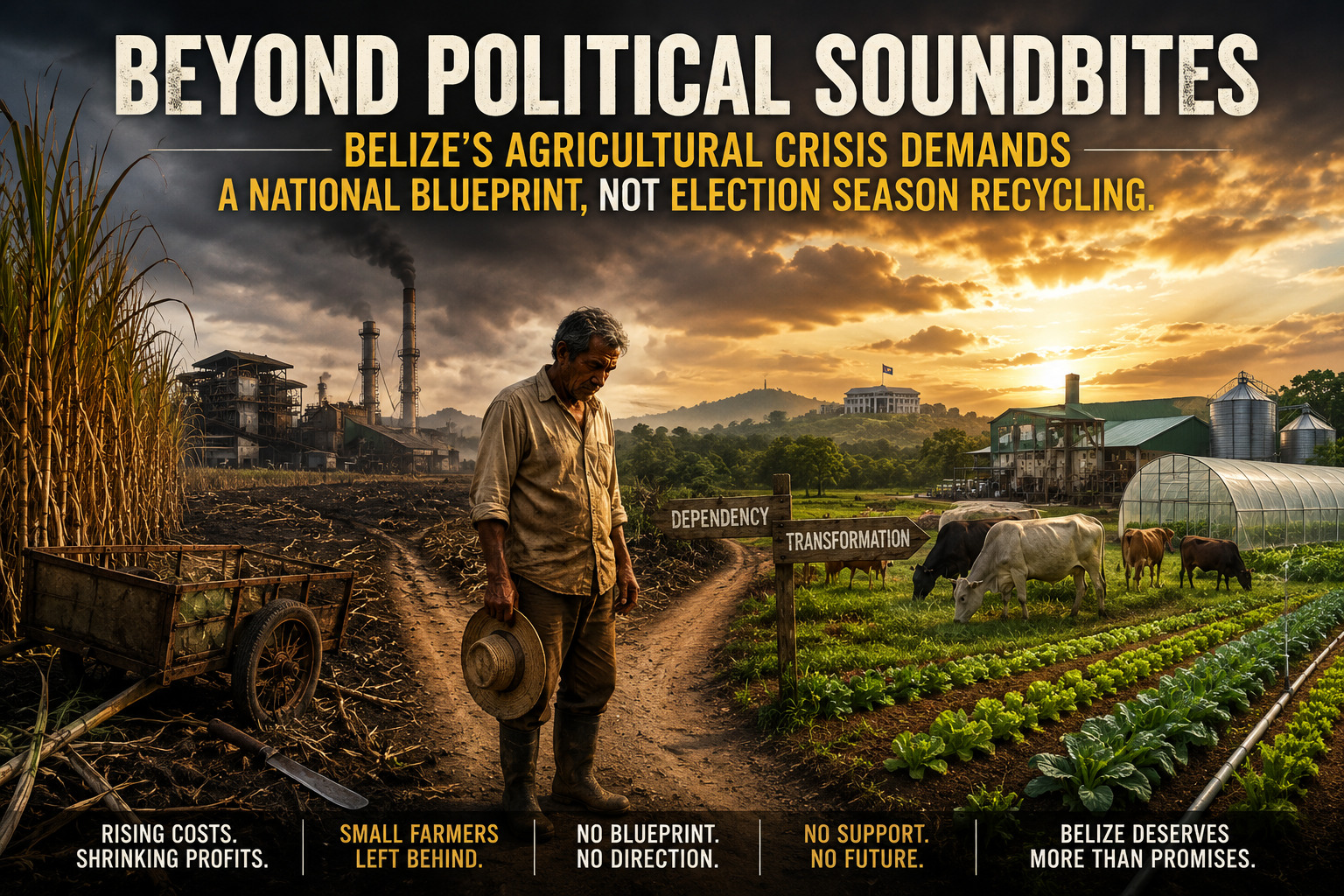
Belize City: Saturday 23rd May 2026” There is indeed a deep hidden truth buried beneath all this emotional rhetoric surrounding sugarcane and diversification in Belize. And the truth is uncomfortable for both the political establishment and the economic system that has governed Belize since independence.
Yes, former Minister of Agriculture Jose Abelardo Mai is speaking raw truths about the collapse of sustainability within the sugar industry for small farmers. On that narrow point, he is correct. Rising fertilizer costs, fuel shocks tied to Middle East instability, climate pressures, Fusarium disease, shrinking profitability, and economies of scale are realities no honest observer can deny.
But Belizeans are also intelligent enough to recognize another reality:
The same political class that now speaks passionately about diversification had decades in office to build the structural foundations for diversification and largely failed to do so.
That is where the frustration lies.
Because diversification is not merely telling struggling cane farmers:
“Fence off part of your land and put grass for cattle.”
That is not transformation.
That is survival improvisation.
And Belizeans are tired of improvisation being sold as national strategy.
The deeper issue is that Belize still does not possess a comprehensive agricultural transformation blueprint capable of turning agriculture into a modern economic engine. What exists instead are fragmented speeches, seasonal promises, donor-driven pilot projects, and election-cycle narratives recycled every five years.
The Real Question Belizeans Must Ask
If diversification is truly the future:
• Where is the National Agricultural Diversification Plan?
• Where are the identified crop zones based on soil science and climate suitability?
• Where are the low-interest agricultural development banks for small producers?
• Where are the seed subsidy programs?
• Where are the fertilizer tax reductions?
• Where are the irrigation grants?
• Where are the state-supported greenhouse projects?
• Where are the livestock breeding incentives?
• Where are the agro-processing industrial parks?
• Where are the cold storage facilities?
• Where are the guaranteed purchase agreements?
• Where are the export logistics corridors?
• Where are the technical extension officers farmers desperately need?
• Where is the crop insurance system?
• Where is the national market intelligence system telling farmers WHAT to grow and WHERE demand exists?
Without those things, “diversification” becomes little more than political vocabulary.
The Hidden Structural Crisis
The deeper hidden truth is that Belize’s agricultural economy remains largely colonial in structure.
For generations, Belize has remained trapped exporting raw commodities while importing expensive processed goods back into the country.
Sugar.
Bananas.
Citrus.
Marine products.
The pattern has barely changed.
Very little value-added production exists at scale.
That means Belize continues exporting raw labor while importing finished wealth.
And because no government has aggressively industrialized agriculture, farmers remain trapped between:
• volatile global commodity prices,
• rising imported input costs,
• climate vulnerability,
• and middlemen-controlled markets.
This is why so many young Belizeans are abandoning agriculture entirely.
Not because they hate farming.
But because the system offers no long-term economic dignity.
Mai Accidentally Revealed the Real Future
One of the most important statements made by Mai was this:
“The big ones will get bigger and the small will be out.”
That may very well become the unavoidable reality unless Belize urgently intervenes.
Because modern agriculture without state planning naturally consolidates into:
• large landholders,
• corporate-scale producers,
• mechanized operations,
• and vertically integrated agribusiness monopolies.
Small farmers simply cannot compete alone against:
• rising machinery costs,
• imported fertilizers,
• fuel spikes,
• climate disasters,
• and shrinking margins.
And that creates another dangerous national risk:
land concentration.
If small cane farmers abandon production without protection mechanisms, Belize may eventually witness large-scale land acquisitions by wealthier domestic or foreign interests.
That is not diversification.
That is displacement.
Belize Needs Agricultural Transformation — Not Campaign Theater
What Belize urgently requires is a modern agricultural revolution built around:
1. Agro-Industrialization
Belize must stop exporting raw products only.
The future is:
• cheese production,
• milk processing,
• fruit dehydration,
• meat packaging,
• cassava flour,
• cocoa processing,
• biofuel development,
• essential oils,
• herbal industries,
• animal feed production,
• and regional food exports.
2. Strategic Crop Zoning
Different regions should specialize scientifically:
• North: sugar transition + livestock + grains
• West: agro-processing + poultry + greenhouse systems
• South: cacao + spices + tropical fruits
• Coastal regions: aquaculture + fisheries support industries
3. State-Supported Agricultural Credit
No transformation can happen with commercial bank interest structures strangling producers.
Belize needs:
• long-term low-interest agricultural financing,
• grace periods,
• cooperative farming incentives,
• and youth agricultural startup funding.
4. Regional Trade Integration
Belize continues looking too far overseas while ignoring nearby opportunities.
Mexico, Guatemala, Honduras, and the wider Central American region represent enormous nearby markets.
Logistics matter.
Transportation costs matter.
Proximity matters.
Belize should already be aggressively positioning itself as a regional food supplier.
5. Agricultural Education & Technology
Where are the modern agricultural academies?
Where are the mechanization training programs?
Where are the drone mapping systems?
Where are the climate adaptation laboratories?
Without technological modernization, diversification remains a slogan.
The Media’s Role in the Political Recycling Machine
And yes, another uncomfortable truth is that portions of Belize’s mainstream media often become amplifiers for election-season political narratives rather than interrogators of policy substance.
During campaign cycles:
• politicians suddenly rediscover farmers,
• rediscover poverty,
• rediscover diversification,
• rediscover youth unemployment,
• rediscover national development.
Then after elections:
the structural problems remain untouched.
This cycle has exhausted the Belizean people psychologically.
What Farmers Actually Need
Farmers do not need sympathy speeches alone.
They need:
• predictable policy,
• affordable production costs,
• access to markets,
• infrastructure,
• technology,
• financing,
• and long-term state planning.
Without that, diversification simply becomes another word for abandonment.
And that may be the deepest hidden truth of all.
Because unless Belize moves beyond political speeches and constructs a genuine national agricultural transformation strategy, many small farmers will not be diversifying by choice.
They will be exiting agriculture out of economic desperation.
- Log in to post comments