BELIZE'S ENERGY PARADOX The More We Own, The More We Pay
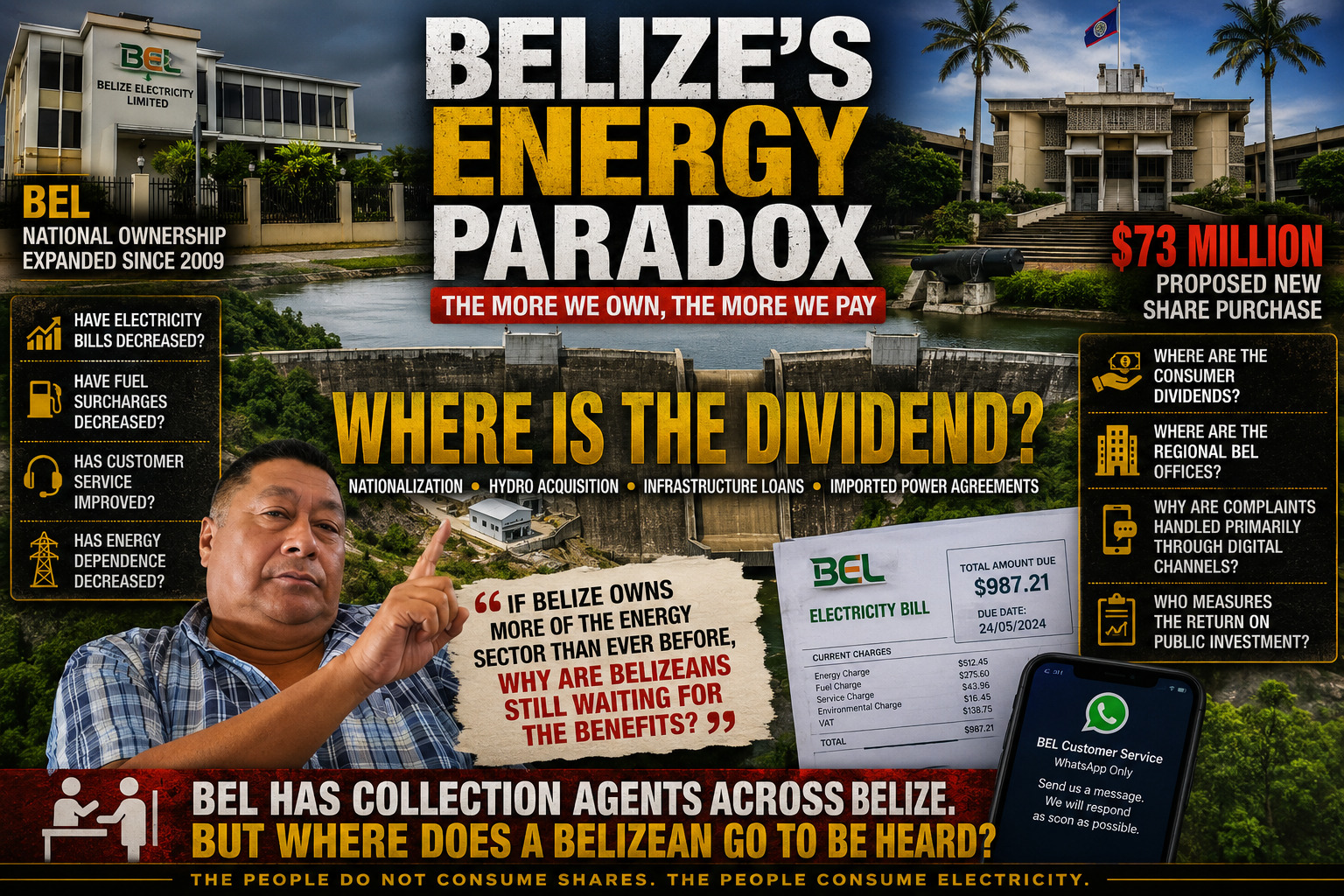
Belize City: Wednesday 17th June 2026: Fifteen Years of National Ownership, Hydro Acquisitions, Infrastructure Loans and Now Another $73 Million for BEL Shares—Yet Belizeans Are Still Waiting for Their Dividend
There is a question that every Belizean household should be asking today.
Not whether the proposed seventy-three-million-dollar purchase of Belize Electricity Limited shares is a bailout.
- Not whether the money comes from the Social Security Board.
- Not whether the proposal originated from the Government or is being opposed by the UDP.
The real question is much simpler.
After fifteen years of increasing public ownership and public investment in Belize's energy sector, what measurable benefit has the Belizean consumer actually received?
That question should not be controversial.
It should be expected.
Because the people of Belize have financed every chapter of this story.
In June of 2011, Belizeans were told that national ownership of BEL was necessary to protect the country's strategic interests.
The argument made sense.
- Electricity is not a luxury.
- Electricity is a necessity.
National control was presented as a safeguard against external interests and a pathway toward energy security.
Belizeans accepted that argument.
Years later, BEL continued borrowing for transmission upgrades, substations, infrastructure expansion, modernization projects, and system improvements.
- Again, Belizeans were told these investments were necessary.
Then came the acquisition of hydroelectric assets.
- Again, Belizeans were told that ownership of generation capacity would strengthen energy sovereignty and reduce dependence on foreign suppliers.
Then came discussions involving imported gas-generated power and expanded regional energy arrangements.
- Again, Belizeans were promised a more secure future.
Now Government seeks to purchase another seventy-three million dollars worth of BEL shares.
The justification is familiar.
- More ownership.
- More control.
- More national participation.
The question remains:
Where are the consumer benefits?
- Electricity bills have not fallen.
- Fuel charges have not disappeared.
- Businesses continue struggling with high utility costs.
- Households continue budgeting around high monthly electricity expenses.
- The public continues hearing promises of future benefits while presently paying high costs.
At some point, ownership must become more than a slogan.
Ownership must produce results.
- The people do not consume shares.
- The people consume electricity.
- The people do not pay their bills with ownership certificates.
- They pay with their wages.
- They pay with their pensions.
- They pay with their business earnings.
- They pay with money that becomes increasingly difficult to stretch.
And there is another question that receives far too little attention.
The Missing Face of BEL
For many Belizeans, BEL is represented not by customer service offices but by collection points.
Across the country, consumers can easily find somewhere to make a payment.
- Consumers can easily receive a bill.
- Consumers can easily receive a disconnection notice.
- Consumers can easily be reminded when payment is due.
But where does a Belizean go when there is a problem?
- Where does a pensioner go to challenge an unexplained increase in a bill?
- Where does a small business owner go when voltage fluctuations damage equipment?
- Where does a consumer go when repeated complaints produce no resolution?
- Where does a citizen go to sit across a desk from a responsible officer empowered to solve a problem?
Many Belizeans would argue that BEL has become increasingly accessible when it comes to collecting money and increasingly inaccessible when it comes to addressing grievances.
- A WhatsApp message is not accountability.
- An automated response is not customer service.
- A collection agent is not a consumer advocate.
If Government believes public ownership benefits the people, then the public should be able to see that benefit not only on balance sheets but also in the quality of service they receive.
The Questions Belizeans Deserve Answered
Before another seventy-three million dollars is invested, Belizeans deserve clear answers.
- How much public money has been invested directly or indirectly into the energy sector since 2011?
- How much has been borrowed?
- How much remains outstanding?
- What returns have been generated?
- What portion of those returns has directly benefited consumers?
- Will electricity rates decline because of this new share purchase?
- Will fuel surcharges decline?
- Will customer service improve?
- Will regional consumer service offices be established?
- Will Belize become less dependent on imported electricity?
- Will there be measurable targets against which success can be judged?
- Or are Belizeans once again being asked to finance another chapter of a story whose ending is always somewhere in the future?
Beyond Politics
- This is not a PUP question.
- This is not a UDP question.
- This is a Belizean question.
The energy sector exists to serve the people.
- The purpose of public ownership is not merely to increase the percentage of shares owned by Government.
- The purpose of public ownership is to create public benefit.
- If ownership grows while bills continue rising, consumers will ask questions.
- If investments grow while service remains difficult to access, consumers will ask questions.
- If public participation grows while public benefits remain unclear, consumers will ask questions.
And they should.
Because every dollar invested in the name of the Belizean people should ultimately produce something tangible for the Belizean people.
fifteen years after nationalization, following hydro acquisitions, infrastructure loans, imported power agreements and now another seventy-three million dollar share purchase, Belizeans are still waiting for a simple answer.
- When will ownership finally become benefit?
- When will investment finally become relief?
And when will the people who finance Belize's energy future finally begin receiving a reduced cost of energy?
By: Omar Silva -Editor/Publisher
National Perspective Belize – Digital
- Log in to post comments